Roadtrek

Roadtrek
Showing posts with label National Park. Show all posts

Wednesday, February 17, 2016

Yorktown Battlefield National Park, Yorktown, Virginia 2015

On our trip this past August to the Historic Triangle - Williamsburg/Jamestown/Yorktown - we also revisited Yorktown Battlefield National Park - in Yorktown, Virginia. Yorktown is the site of the last major battle of the American Revolution. It was October 1781. The result of the American Victory with the help of the French was the surrender of British General Cornwallis and the British Army under his command. This surrender was so devastating that it convinced the British Parliament and King George III to end the war with American Independence.

The Yorktown Battlefield National Park is spread over miles. The Visitors Center at the edge of the historic area of Yorktown is the place to start any visit to Yorktown. While one may drive the public roads through the battlefield without charge, there is a fee to pay at the Visitors Center to be able to see the museum that is inside, see an introductory film about the battle, take Ranger tours, see special programs, and be able to go inside two of the historic homes one of which is on the battlefield and the other which is in the historic district of Yorktown. There is parking for RVs and my Roadtrek had no problem parking in the regular spaces in the Visitors Center parking lot. The admission fee at the time of this writing is $7 and this is good for seven days. If you have been to Historic Jamestowne before visiting Yorktown and have a current ticket your Jamestown NPS ticket gets you into Yorktown at no additional charge. If you visit Yorktown before visiting Jamestown, within the valid period your Yorktown ticket is good for half the price of the $14 Jamestown NPS admission (see our last article about Jamestown). The best thing is that if you have a National Park Service Senior Pass you get into Yorktown Battlefield NP for FREE! I have to admit that I had paid the Senior Pass discounted rate at Jamestown a few days before and because I wanted to get into something free with my Senior Pass I just went up to the cashier, showed my Senior Pass and Meryl and I both got our free tickets! We could have just shown our receipt from Jamestown but hey, I wanted to see my tax dollars directly giving me something back.

We started with the museum. In the museum you will go through the interior of a reproduction of a British Man of War battleship with cannon below deck, crew's quarters - hammocks hanging from the ceiling, and get a feel for what life was like in the cramped quarters of the ship. Exiting the ship, you will come to one of George Washington's marquee's and field tents.


The museum also has artifacts of the battle, weapons, and display boards that explain the two sides who fought here, the circumstances of the battle, and the importance of the result of this battle.

Do not leave the Visitors Center without seeing the introductory film. This is a complicated battle spread over miles. The French Army was an integral part of this battle and the outcome depended upon the French Fleet blocking the York River preventing the British Fleet from coming to the aid of their Army. If you do not know what happened in most of the areas in this battlefield, then when you take the self-guided driving tour (which is very easy to get lost in) all you will come away with is seeing vast fields of grass, mounds of earth, and trees. The film will give a fast review of the battle and the locations that you will see as you drive the battlefield. The National Park Service website for Yorktown Battlefield also gives a good review of what took place at the battle.

Before we went back to the Roadtrek to begin the tour we walked into the historic district of Yorktown which is adjacent to the Visitors Center by a short walk.  You will first come to the Yorktown Monument.


Follow along from their down the street and you come into the historic district of homes and buildings that have been restored and were standing where you see them at the time of the battle in 1781. Only one of these is open to the public with your Yorktown Battlefield ticket.


The house that is open is the home of Thomas Nelson, Jr., a signer of the Declaration of Independence, the Governor of Virginia at the time of the battle, and the commander of the Yorktown Militia in the Battle of Yorktown. The house was taken by the British and served through the battle as the headquarters of General Cornwallis, commander of the British Army. During the battle the large house was visible from many points and it is said that Nelson directed the American and French artillery to use his house as its aiming point. The result is still visible on the exterior walls of the house. The house is furnished inside as it was during the battle. As the battle went on the house was also used as a field hospital by the British.


There are special programs scheduled at different times - some several times a day. When we were there we lucked out and had an opportunity to see something that we had never seen or heard before - the firing of an 18th Century (reproduction as one would have to be crazy to fire an antique) 18 pounder siege gun (cannon). As an 18th century living historian in a reenacting unit with a cannon, I have fired a three pounder field cannon hundreds of times. A three pounder cannon fires a ball that weighs three pounds about the size of a tennis ball - and that is considered loud and can do a lot of damage. An 18 pounder siege cannon fires a ball that weighs 18 pounds about the size of a bowling ball. The ground shakes. Below is a photo - at the end of this article we will put that photo into motion...


After the cannon firing (twice) we headed back to the Roadtrek to head out into the battlefield. This was our last day in Virginia and we were heading north at the end of the day. We decided that we would drive to the key points of the battle which does take you through the entire battlefield.

With all of the fighting that took place at the Battle of Yorktown, the battle comes down to two places that have come down through history as key to the victory. These two locations are named Redoubt Number 9 and Redoubt Number 10. A redoubt is a mound of earth dug out in the middle to become a fortress. The exterior of the mound is lines with a series of well sharpened logs or pikes that stick out preventing anyone from getting into the fort. A siege is made on each of these redoubts on the night of October 14, 1781 at the same time. Redoubt No. 9 attacked by the French and Redoubt No. 10 attacked by the Americans. Here is Redoubt Number 9 -

The French are OUTSIDE


The inside of Redoubt Number 9 -

(The British are INSIDE.)


The French made it inside victorious.

Here is Redoubt Number 10. While you can get very close to Redoubt Number 9 and even walk a path over the top and into the middle, Redoubt Number 10 is now fenced off (to preserve it from further erosion) and you find yourself standing in front of a massive hill.

The Americans are OUTSIDE. The British are INSIDE.


The day after the two sieges British General Cornwallis wrote to British General Clinton: "My situation now become very critical;..."

From the two redoubts we went to the house in which the terms of surrender were discussed. The Moore House is along one of the roads through the battlefield. These are all public roads with public traffic and with many points were there is no clear marking as to where to turn. The Battlefield Visitor's Map included with your admission is vital to getting through the battlefield and not driving in circles.  We were fine in the Roadtrek along the route. Very large Class A RVs or very long travel trailers may have a problem getting around on some of the smaller roads. There are small parking areas at each of the various sites - more significant sites have more parking. Before Cornwallis surrenders he hides in one of several caves in the hillside below Yorktown on the beach of the York River. You can visit this cave.


The Moore House was a family's home and the interior has been restored and furnished as it was during the battle and then for the surrender meeting. Each army involved met here to come to the terms of the surrender of the British fighting here against the Americans and the French. The surrender table is seen below -


Of course, in this age of gentlemen led armies, when there is a surrender it is a formal affair with the defeated marching through the victorious and then surrendering their weapons and themselves. This was held on a large open field - known today as The Surrender Field.


The field is too large to photograph as a whole - even from the brick pavilion seen in the photo on the top just off center to the left. The British marched between the two rows of fence - the American and French lining each side. Inside the pavilion you will hear an audio presentation of the surrender. It has been believed - though there is now some doubt - that the tune the British fifes and drums played as they marched here is a nursery rhyme tune called "The World Turned Upside Down". You hear this tune being played inside the pavilion as you look out onto the surrender field. You can walk from the pavilion along one side of the surrender field. Around the pavilion are cannons and mortars surrendered by the British in the surrender. (The blue green is the oxidation of the metal over time.)


We spent most of one day in Yorktown. Had we wanted to go through more of the battlefield we could have spent more time, but a lot of the battlefield stops on the visitor's map are the places that various regiments encamped and where troops were moved. So while we went to the highlights and did not drive all of the roads through the battlefield - and we did get lost at the end and were way out of our way in small neighborhood streets with no easy place to turn the Roadtrek around in to get back out to a main road - we really saw what we came to see at Yorktown. Check their website for special programs and scheduled Ranger tours. There is a new museum being built at a commercial attraction, The Yorktown Victory Center, and when this is completed - hopefully by summer 2016 but that is uncertain - that will be something to add to a visit to Yorktown - or warrant a second day's visit coming over from Williamsburg where the campground is that we stay in when we come to this area. From what I have read, this new museum will be something to see!

As promised above - we saw and heard an 18 pounder siege gun fired and you can see it too right here.  Turning up your volume all the way will still not be the same as hearing and feeling this fired live...

Wednesday, October 1, 2014

Gettysburg National Military Park, Gettysburg, Pennsylvania PART I

We were in Lancaster, PA on another of those days that seemed to be all too frequent during our travels this summer that was predicted to rain. We decided that this would be a good day to do something that we have never done with the Roadtrek but had done many times before we started traveling in the Roadtrek and that was to go to Gettysburg. This was a day trip. A day is really not enough to go to Gettysburg if you have never been there before. A visit can easily take two days - perhaps three. Our intention on this possibly rainy day was go to the NPS Visitors Center with its film, Cyclorama, and museum.We have been through the battlefield many times and knew that there would not be enough time to do that again on this trip and that was OK.

Gettysburg is about 75 miles from Lancaster to the west. There is a very direct route from Lancaster to Gettysburg going west on Route 30 and remaining on that same route right into the town of Gettysburg. I have always hated that route when we drove by car and I knew that it would be even worse in a larger vehicle like a Roadtrek - or any RV or Travel Trailer for that matter. Route 30 is fine until you get not too far from Gettysburg when it becomes a one lane each way road through small towns with slow speed limits and traffic circles. I will never forget the night years ago when we drove this back to Lancaster from Gettysburg in a severe storm with trees falling around us and barely able to see what was ahead. In good weather it is not much better. There is another route to Gettysburg that is far from direct but only adds five minutes to the trip and is completely on multi-lane highways that is just five miles longer but so much more comfortable to drive. This route takes you off Route 30 West right at Lancaster onto Route 283 up and across and around to Route 15 South and down right into the town of Gettysburg at Route 30. This is the preferred way to go and the drive from Lancaster is one hour and twenty minutes as opposed to one hour and fifteen minutes on the so called direct route. (I discussed this on an RV forum and had a number of locals and others who have driven both routes agree.)  We set out from Lancaster, stopped for lunch at a Wendy's as soon as we got off Route 15 in Gettysburg, and after a fast lunch we headed for the National Park Visitors Center.

There is a relatively "new" NPS Visitors Center in Gettysburg. We were there several years back when it first opened. The old Visitors Center's building is still in the center of town and was actually much better located in relation to the battlefield and the town itself - which is also a place to tour as much of it is as it was during the battle. The "new" Visitors Center is off on a much bigger plot of land. Building this meant moving the small museum that they once had and expanding with many more artifacts into a large facility, moving the Cyclorama - which I will explain as we go along, and creating a theater in which to show a film made for the site that briefly explains the battle of Gettysburg. Before we left we learned from their website that due to construction one of the parking lots for the Visitors Center was closed. We had some concern that this might be a problem but we ventured out to see what we would find.

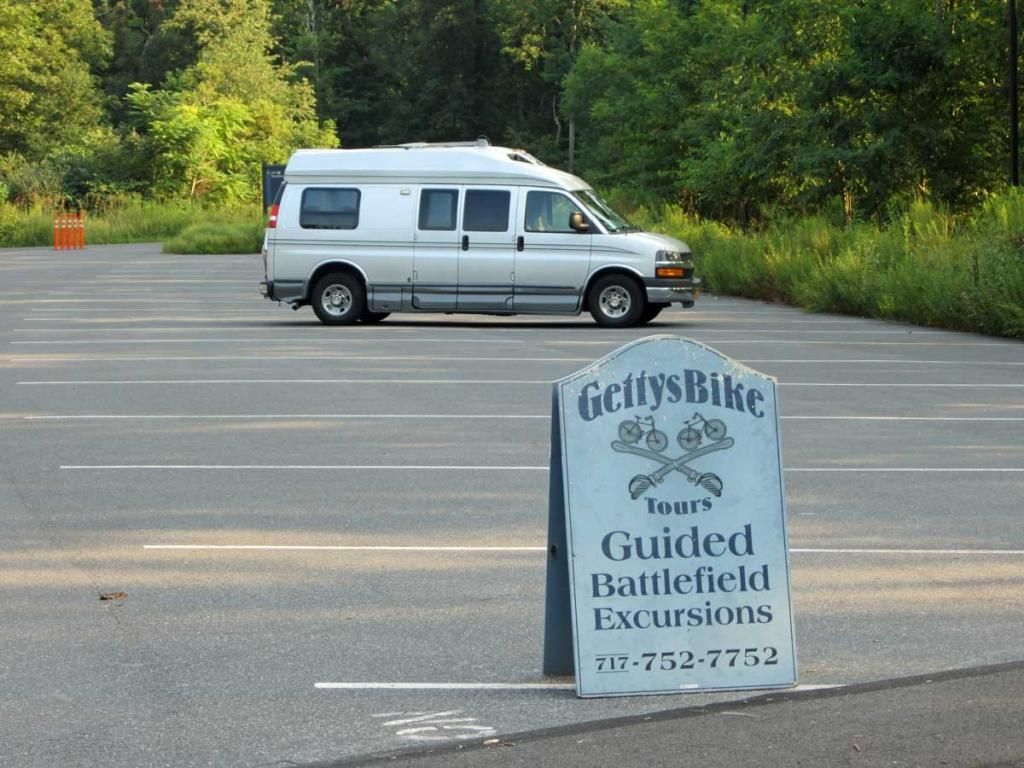
There is an RV parking lot at the Visitors Center. This is a good thing, particularly while one of the parking lots is closed, as the parking lot for cars was a problem for the Roadtrek. Lanes were narrow and spaces were tight. We drove through this parking lot and could not have fit into any of the few spaces that were open. Even had it been less crowded the Roadtrek would really not have fit. We drove back out and back down to the RV and Bus parking lot which was a distance away from the Visitors Center building. One can walk or wait for a not frequent shuttle bus. We walked.


As you can see from the photo above the RV spaces are large. The spaces behind where we parked had a number of large RVs in them, what looked like another Class B, and buses. From this parking lot you can arrange a tour of the battlefield with a guide, by bus, or go on bicycles. There are all types of tours one can take of the Gettysburg Battlefield including one on horseback.

A paved cement path that was for the most part uphill went from this parking lot to the Visitors Center building - and the car parking lot. As I said there was a sign for a shuttle bus, but no sign of any shuttle, and we would have walked even if it was sitting there waiting. (And I made this walk twice, as once at the Visitors Center building, I realized that I left something in the Roadtrek and went right back down the path to get it. Meryl stayed inside.)

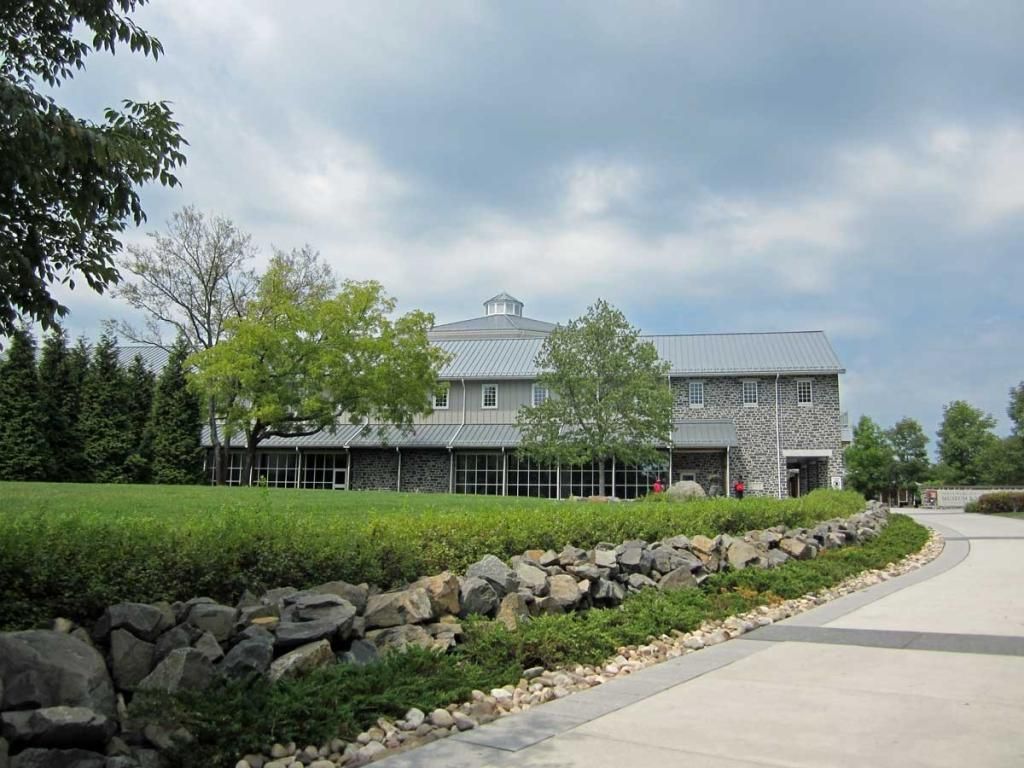
You come up to see this building - the "new" Visitors Center.


There is a cafeteria in the building with very high prices. There is also a very nice and large gift shop including an excellent book selection of books on the Civil War and the Battle of Gettysburg. They also sell driving tour CDs in the gift shop to play while you take the tour of the battlefield which needs to be driven (with whatever form of transportation) and cannot be walked due to distance and safety. And as I said above in this building is the musuem, the film, and the Cyclorama.

Let me explain a little about how to understand the Battle of Gettysburg that is vital to know for anyone going to visit Gettysburg. This is a very difficult battle to follow. The battle took three days. Each day was very different from the day before and over each day and over the three days the battle took place in a variety of locations - some of what could be considered battles all on their own taking place at the same time as each other. I visited Gettysburg as a boy and as a young man and never really grasped what had gone on there other than it was another Civil War battlefield. Without this understanding all you are seeing are big fields, rocky hills, and you drive on a winding road throughout it all. When I was younger I never really liked visiting Gettysburg. It took until my interest in history grew - and then one big thing that helped me  - and others I have discussed this with - to immensely finally understand and appreciate the battle in its entirety.  That was seeing the major motion picture, Gettysburg, which stared Jeff Daniels and many others. Like the long battle this film portrays, it is a long movie. It was filmed in Gettysburg - some on location and some on nearby farms that were part of the battle. (National Park Service is very strict about reenactments in any of their parks including prohibiting the firing of any arms towards anyone - including reenactors firing blanks toward an opposing force of reenactors. When you attend a reenactment of the Battle of Gettysburg it is held at a farm just off the NPS park.) This movie shows each day of the battle and significant events that took place on each day of the battle. It does not include all parts of the battle but watching this movie before going to Gettysburg will bring these fields and rocky hills to life for you. You will stand in places you see in the film and know exactly what happened on that spot. You will know why those involved in the battle did what they did. You will appreciate your visit so much more if you and your family watch this movie before you go. And as it happens this movie is now available as a bargain DVD for $5 in many places that sell bargain DVDs. This is not a documentary film - it is a Hollywood movie made for entertainment that was made well. The film is taken from a book named. The Killer Angels by Michael Shaara. So, I get nothing from the producers of the movie for telling you any of this - it is just a very easy way to have this whole complicated battle make sense and you will appreciate your visit to what is known as hallowed ground so much more.

OK - so we get into the Visitors Center and go up to the ticket desk. I recently got a National Park Service Senior Pass that entitles those who have it to go into National Parks for free along with up to four guest - who also get in free. I was thrilled to finally be able to get this. I was all ready to use this to go to the three attractions in the Gettysburg Visitors Center building which, frankly, is not something I had paid to do in the past. Touring the actual battlefield is free to all. At the ticket desk there was a sign that said that no passes are accepted. Really!?! My first big chance to use my pass and it was not accepted. OK - we bought the tickets - and could not even buy them for the senior price as that was 65 and over! So we plunked down $12.50 each and got our tickets.

With your tickets you move on toward an outer gallery with exhibits behind glass along the walls - various weapons, uniforms, insignias, etc. The entrance to the film is there and this is the first part of your visit with tickets. The film is titled A New Birth of Freedom and is narrated by Martin Freeman with voices by many well known actors. You are presented a brief introduction to the start of the Civil War as it moves quickly on to the Battle of Gettysburg and its aftermath. This battle took its tolls not only on both armies but also heavily on the people of the town. This battle moved from the battlefield into the streets of the town and into people's homes. You get a brief understanding of what took place here - though far from what is done with the movie I have explained above. The film is presented in a comfortable auditorium designed for the showing of this film. When the film is over you are escorted from the theater and to the entrance way to the Cyclorama, which is the next thing your ticket entitles you to see.

As I am writing here, I am realizing that this article will be almost as long as the battle itself so I better split it at this point and leave you here with the end of Part I and start on a Part II in which you will hear about the Cyclorama, the museum, and a very abbreviated drive through the battlefield.

END OF PART I
PART II IN THE NEXT ARTICLE