Roadtrek

Roadtrek
Showing posts with label tourist attraction. Show all posts

Wednesday, October 12, 2016

WINTERTHUR

Winterthur in Delaware is the mansion and property owned by the du Pont Family and is now an extensive museum of the collections that Henry Francis du Pont acquired through his lifetime. They decorated his home and were put on display in a museum when he opened his childhood home to the public over 60 years ago. He was also a horticulturist and property has extensive gardens. A visit to Winterthur can be quite extensive with walking tours through the trails in his gardens or a guided tram tour through them, a visit to the du Pont home, and a visit through the extensive museum with changing and static exhibitions.

Our plan to visit Winterthur started over a year ago when Meryl learned of a special exhibition of antique samplers and embroidery. Things just did not work out for us to visit that exhibition, but this past summer another exhibition of samplers opened and we had planned several times to go to Delaware and see this exhibit. It looked again like things were not working out but during our vacation trip we decided that we would spend a day in Winterthur and not only see this exhibition but also tour the house and see the musuem.

Many of the places that we travel to involve being outdoors. One of the problems of planning trips when the weather seems never to be cooperating is finding indoor museums and attractions that we can easily get the Roadtrek to. Cities pose a problem, as I have said before. Many cities have gone to all indoor garage parking and with the height of the Roadtrek this is just not possible. The trip we planned this past summer was one in which we had a few places to stop where the weather would not matter - and we saved the good days for the outdoor places we were going to and the raining days for indoors - and this is when we went to Winterthur.

Winterthur is not far into Delaware across the Pennsylvania border and the drive there was a pleasant mix of country roads, Route 1 and more country roads. We arrived after an early fast food lunch and parked in a large parking lot that would not be a problem for even the largest RV or Travel Trailer. We walked down a short trail to the Visitors Center and purchased tickets. Tickets are $20 adults or $18 senior (love those senior discounts) plus they were having a limited time adult discount of $3.00. Tickets entitle you to the whole thing - house tour, museum, special exhibitions, and all that is in the gardens. Our main interest was the special exhibition on Samplers and this was where we were heading first. You reach the house and museum by shuttle bus. The museum is also the entrance to the house tour and your ticket puts you to be on a specified time tour of the du Pont family home - home should read  Mansion. The Sampler exhibition was on the second floor of the musuem and we had some time to go their first before our tour would start.

Meryl is a student of 18th and 19th Century embroidery as well as being an accomplished hand embroider, herself. We have been to many exhibitions on 18th and 19th Century embroidery and Samplers and Meryl is becoming quite in the "know" between what she has seen on exhibit and what she has read, along with stitching reproductions. This was one of the smaller exhibitions that we have been to and we decided that we would go through it quickly before our tour of the house would start and then come back to it later after the tour to spend time with each piece of embroidery in the exhibit. To give you and idea, the following photo is just one element in an embroidered picture created by an 18 year old girl in Boston in the year, 1748. What has fascinated me about all of the Samplers that we have seen here and in other museums is that these are all art created by children. Age 18 is old for some of the exceptional work we have seen. We have seen exceptional pieces worked by girls of 8 to 12 years old. Anyway -


The tour through the home starts with gathering the tour group in a meeting room and showing a brief video about Henry Francis du Pont and the family. You are then escorted through doors and past - and not stopping at - a display room of 17th (1600s) furniture - which we would have loved to spend some time looking at but the guide was determined to stick to her schedule - which in the end she did not do as she got carried away with anecdotes about the family. We were then all loaded into an elevator adn taken up to the first floor of the home which was the second floor of the building. From the elevator we were taken out to an outdoor balcony with a view of the house and the Library that is housed in one of the building of the estate. First photo - side view of the house from the porch. Second photo - view of the library building from the balcony. (The library is open to the public for research.)


   I will not go into details of the tour. Here are some photos that I took as we went along. The rooms are decorated in antiques - many from the Federal period - late 18th Century into the early 19th Century. As the family came originally from France there are a number of antiques of French heritage.


The upper floors of the house are the family and guest bedrooms. The du Pont's liked to entertain and would have guests stay with them. Their guests included dignitaries and U.S. Presidents.


The house was not our favorite part of the visit and we both felt that were we to return to Winterthur we would skip the house tour and spend a lot more time in the museum. The museum is extensive. We returned to the special exhibition of Samplers that we had specifically come to and spent a great deal of time there looking closing at details. I photographed everything for Meryl and she also took notes. She was able to find a catalog of the exhibition in the gift shop/bookstore and that was a must have.

The museum had another special exhibition of South American embroideries and we spent a lot of time there as well. There were also the regular exhibit galleries which also had textiles, needlework, and Samplers, along with furniture, every day items, and home decor. There was also a room with an entire building displayed that was a 1700's Clock Makers Shop with all of the equipment and tools set out in the two rooms as they were when the shop was in business.

18th Century Woman's Gown (Sack Back Gown)


 We really did not have enough time to do that museum justice and we stayed until the announcement that the musuem was closing and the guards came through to make sure everyone was moving to the exit back on the first floor. When we got out side we had missed the last shuttle bus back to the Visitors Center so we walked back.  The gift shop/bookstore is open past the museum and we spent some time in this shop at the Visitors Center. There is a larger gift shop with reproduction pieces in a building near the museum.

We never made it to any of the gardens - though we were not much interested in touring those. I am certain that anyone who loves gardens will find these exceptional and there is a children's fantasy garden in the gardens as well.

We had a very nice time. If you like the material and cultural side of history you will enjoy Winterthur. Since we are writing about this in relation to a visit in the Roadtrek - or any RV, it is easiest to stay in a campground in Pennsylvania. The one thing you don't want to have to do is cross the Delaware River as the tolls on the various bridges are expensive. There is a new toll being charged as you cross the Delaware River Bridge from the New Jersey Turnpike into the Pennsylvania Turnpike that used to be included in the turnpike toll but is not a separate toll of $5.00. Of course, the turnpike tolls have remained the same. If you are in Pennsylvania you can go into Delaware without crossing the river again. There is a campground, a KOA (we have not stayed there) in West Chester, PA. Winterthur is about an hour's drive from several of the Lancaster, PA campgrounds.

Winterthur is located at 5105 Kennett Pike, Wilmington, DE 19807. This address in your GPS will get you right there. Their actual address is 5105 Kennett Pike (Route 52)
Winterthur, DE 19735. Winterthur is CLOSED on Mondays so plan accordingly. They are open until 5:00 pm. The last house tour tickets are sold at 3:15 pm. They have a website - http://www.winterthur.org/ .


Wednesday, February 17, 2016

Yorktown Battlefield National Park, Yorktown, Virginia 2015

On our trip this past August to the Historic Triangle - Williamsburg/Jamestown/Yorktown - we also revisited Yorktown Battlefield National Park - in Yorktown, Virginia. Yorktown is the site of the last major battle of the American Revolution. It was October 1781. The result of the American Victory with the help of the French was the surrender of British General Cornwallis and the British Army under his command. This surrender was so devastating that it convinced the British Parliament and King George III to end the war with American Independence.
The Yorktown Battlefield National Park is spread over miles. The Visitors Center at the edge of the historic area of Yorktown is the place to start any visit to Yorktown. While one may drive the public roads through the battlefield without charge, there is a fee to pay at the Visitors Center to be able to see the museum that is inside, see an introductory film about the battle, take Ranger tours, see special programs, and be able to go inside two of the historic homes one of which is on the battlefield and the other which is in the historic district of Yorktown. There is parking for RVs and my Roadtrek had no problem parking in the regular spaces in the Visitors Center parking lot. The admission fee at the time of this writing is $7 and this is good for seven days. If you have been to Historic Jamestowne before visiting Yorktown and have a current ticket your Jamestown NPS ticket gets you into Yorktown at no additional charge. If you visit Yorktown before visiting Jamestown, within the valid period your Yorktown ticket is good for half the price of the $14 Jamestown NPS admission (see our last article about Jamestown). The best thing is that if you have a National Park Service Senior Pass you get into Yorktown Battlefield NP for FREE! I have to admit that I had paid the Senior Pass discounted rate at Jamestown a few days before and because I wanted to get into something free with my Senior Pass I just went up to the cashier, showed my Senior Pass and Meryl and I both got our free tickets! We could have just shown our receipt from Jamestown but hey, I wanted to see my tax dollars directly giving me something back.

We started with the museum. In the museum you will go through the interior of a reproduction of a British Man of War battleship with cannon below deck, crew's quarters - hammocks hanging from the ceiling, and get a feel for what life was like in the cramped quarters of the ship. Exiting the ship, you will come to one of George Washington's marquee's and field tents.


The museum also has artifacts of the battle, weapons, and display boards that explain the two sides who fought here, the circumstances of the battle, and the importance of the result of this battle.

Do not leave the Visitors Center without seeing the introductory film. This is a complicated battle spread over miles. The French Army was an integral part of this battle and the outcome depended upon the French Fleet blocking the York River preventing the British Fleet from coming to the aid of their Army. If you do not know what happened in most of the areas in this battlefield, then when you take the self-guided driving tour (which is very easy to get lost in) all you will come away with is seeing vast fields of grass, mounds of earth, and trees. The film will give a fast review of the battle and the locations that you will see as you drive the battlefield. The National Park Service website for Yorktown Battlefield also gives a good review of what took place at the battle.

Before we went back to the Roadtrek to begin the tour we walked into the historic district of Yorktown which is adjacent to the Visitors Center by a short walk.  You will first come to the Yorktown Monument.


Follow along from their down the street and you come into the historic district of homes and buildings that have been restored and were standing where you see them at the time of the battle in 1781. Only one of these is open to the public with your Yorktown Battlefield ticket.


The house that is open is the home of Thomas Nelson, Jr., a signer of the Declaration of Independence, the Governor of Virginia at the time of the battle, and the commander of the Yorktown Militia in the Battle of Yorktown. The house was taken by the British and served through the battle as the headquarters of General Cornwallis, commander of the British Army. During the battle the large house was visible from many points and it is said that Nelson directed the American and French artillery to use his house as its aiming point. The result is still visible on the exterior walls of the house. The house is furnished inside as it was during the battle. As the battle went on the house was also used as a field hospital by the British.


There are special programs scheduled at different times - some several times a day. When we were there we lucked out and had an opportunity to see something that we had never seen or heard before - the firing of an 18th Century (reproduction as one would have to be crazy to fire an antique) 18 pounder siege gun (cannon). As an 18th century living historian in a reenacting unit with a cannon, I have fired a three pounder field cannon hundreds of times. A three pounder cannon fires a ball that weighs three pounds about the size of a tennis ball - and that is considered loud and can do a lot of damage. An 18 pounder siege cannon fires a ball that weighs 18 pounds about the size of a bowling ball. The ground shakes. Below is a photo - at the end of this article we will put that photo into motion...


After the cannon firing (twice) we headed back to the Roadtrek to head out into the battlefield. This was our last day in Virginia and we were heading north at the end of the day. We decided that we would drive to the key points of the battle which does take you through the entire battlefield.

With all of the fighting that took place at the Battle of Yorktown, the battle comes down to two places that have come down through history as key to the victory. These two locations are named Redoubt Number 9 and Redoubt Number 10. A redoubt is a mound of earth dug out in the middle to become a fortress. The exterior of the mound is lines with a series of well sharpened logs or pikes that stick out preventing anyone from getting into the fort. A siege is made on each of these redoubts on the night of October 14, 1781 at the same time. Redoubt No. 9 attacked by the French and Redoubt No. 10 attacked by the Americans. Here is Redoubt Number 9 -

The French are OUTSIDE


The inside of Redoubt Number 9 -

(The British are INSIDE.)


The French made it inside victorious.

Here is Redoubt Number 10. While you can get very close to Redoubt Number 9 and even walk a path over the top and into the middle, Redoubt Number 10 is now fenced off (to preserve it from further erosion) and you find yourself standing in front of a massive hill.

The Americans are OUTSIDE. The British are INSIDE.


The day after the two sieges British General Cornwallis wrote to British General Clinton: "My situation now become very critical;..."

From the two redoubts we went to the house in which the terms of surrender were discussed. The Moore House is along one of the roads through the battlefield. These are all public roads with public traffic and with many points were there is no clear marking as to where to turn. The Battlefield Visitor's Map included with your admission is vital to getting through the battlefield and not driving in circles.  We were fine in the Roadtrek along the route. Very large Class A RVs or very long travel trailers may have a problem getting around on some of the smaller roads. There are small parking areas at each of the various sites - more significant sites have more parking. Before Cornwallis surrenders he hides in one of several caves in the hillside below Yorktown on the beach of the York River. You can visit this cave.


The Moore House was a family's home and the interior has been restored and furnished as it was during the battle and then for the surrender meeting. Each army involved met here to come to the terms of the surrender of the British fighting here against the Americans and the French. The surrender table is seen below -


Of course, in this age of gentlemen led armies, when there is a surrender it is a formal affair with the defeated marching through the victorious and then surrendering their weapons and themselves. This was held on a large open field - known today as The Surrender Field.


The field is too large to photograph as a whole - even from the brick pavilion seen in the photo on the top just off center to the left. The British marched between the two rows of fence - the American and French lining each side. Inside the pavilion you will hear an audio presentation of the surrender. It has been believed - though there is now some doubt - that the tune the British fifes and drums played as they marched here is a nursery rhyme tune called "The World Turned Upside Down". You hear this tune being played inside the pavilion as you look out onto the surrender field. You can walk from the pavilion along one side of the surrender field. Around the pavilion are cannons and mortars surrendered by the British in the surrender. (The blue green is the oxidation of the metal over time.)


We spent most of one day in Yorktown. Had we wanted to go through more of the battlefield we could have spent more time, but a lot of the battlefield stops on the visitor's map are the places that various regiments encamped and where troops were moved. So while we went to the highlights and did not drive all of the roads through the battlefield - and we did get lost at the end and were way out of our way in small neighborhood streets with no easy place to turn the Roadtrek around in to get back out to a main road - we really saw what we came to see at Yorktown. Check their website for special programs and scheduled Ranger tours. There is a new museum being built at a commercial attraction, The Yorktown Victory Center, and when this is completed - hopefully by summer 2016 but that is uncertain - that will be something to add to a visit to Yorktown - or warrant a second day's visit coming over from Williamsburg where the campground is that we stay in when we come to this area. From what I have read, this new museum will be something to see!

As promised above - we saw and heard an 18 pounder siege gun fired and you can see it too right here.  Turning up your volume all the way will still not be the same as hearing and feeling this fired live...


Wednesday, February 3, 2016

Historic Jamestowne - Jamestown, VA 2015

Let's leave the cold winter of 2016 and go back several months to a much warmer time and some nice memories of our Summer 2015 trip. One of the places that we went back to on this trip was Historic Jamestowne - the National Park Service and Preservation Virginia site of the original Jamestown site - the first English settlement in America in 1607.

This is a historic site and "attraction" that is always in transition. You can visit this week and next week there may be a discovery that will change history and it will be presented to those visiting as it is happening. Before this trip, I knew that there had been a new discovery that was doing just that. Historic Jamestowne is also known as Jamestown Rediscovery. Rediscovery because until 1994 no one really knew for sure what lay beneath the ground on this historic site and landmark. It was known that this was the site of the original settlement and the start of the colony. It was known that there was a fort built here, but it was believed that the ground that the fort stood on had been overtaken by the James River and sat somewhere close by off shore under the water. This is what you would be told when taking a tour - this is what I was told when I was a boy visiting with my parent's in the 1960's. They would point out into the James River and say that was where the fort was. They would walk you past monuments and a series of rolling hills that were the "Confederate Earthworks" - an earthen fort the Confederate soldiers built during the early part of the  Civil War to defend this area from Northern attack from the James River. I was always interested in history and always curious. I also have always had a sense of what is logical and I remember that my thought then was clearly this - if the original Jamestown Fort is supposed to be in the river but no one is really sure, then why has no one dug here - in the Confederate Earthworks that bordered the river - just to make sure that Jamestown was not underneath. I remember asking the guide/Park Ranger this and was told that the earthworks were just as much a part of history as Jamestown and no one would ever desecrate that historic landmark. Well, it seems that I was not the only one who had this thought, and before I got there, Dr. William Kelso came to the site in 1963 as a grad student and had the same idea. It took him until 1994 for the permissions to be had, the grants to be obtained and the digging to start - only to discover that I  - and Dr. Kelso - were correct. The whole thing is under where so many had walked since 1607 and little by little - with some leaps and bounds - it is all being revealed.

If you have any interest in history at all this is really exciting. You can go to a museum or a historic site and look at things in a glass case and see an old structure and someone will tell you this or that happened here and this is what we found and this is exciting, but you are looking at the same things that so many others have looked at coming there. You will do that here too - BUT you may just be here on a day when an archaeologist is digging in just the right spot and will pull out of the dirt something that no one has seen for over 400 years until that moment when the person digging and you watching will see it for the first time since. Here is a video that will show you what I am talking about -


 This is why we keep going back. The last time that we were at Historic Jamestowne we also got to experience another first - a significant earthquake. There were no earthquakes this time but I did have a new experience that I will tell you about later on. I also got to use my National Park Service Senior Pass for the first time - and I knew ahead of time that I would not get to go in free since the NPS is joint here with Preservation Virginia and they do not accept the pass for any discount - but we did only pay $5 each rather than the usual admission price of $14.00 each which was OK by me!

There is RV parking here at Historic Jamestowne that will accommodate large RVs. Because the Roadtrek can often fit in a regular single car parking space and the spaces here are all up against a low curb with grass behind, we just parked the Roadtrek in a regular parking space. If you come in a larger RV or trailer just follow the signs to the RV parking lot and you will have no problem parking.

There is a museum in the Visitor's Center building that has been in existence since before Jamestown Rediscovery and that has some interesting artifacts - though none to the original settlement. There is also an introductory film presentation that is very well done and should be seen before heading outside. There are also tours and programs that are scheduled throughout the day. These include tours guided by Park Rangers and also first person living history programs where you will encounter specific people of the past who were there.

The new discovery that I wanted to see was outside but we watched the film, saw a living history presentation (that related to this new discovery),  and joined a tour before we headed along on our own.  A recent focus has been on the original church (Church of England or Anglican Church) of 1608. The church that most are familiar with at Jamestown is a later church building which a good section of which had remained standing through the years (the large brick building seen in one of the photos below). The Church of 1608 is long gone but with the discovery of the fort and locating where things were, the location of the church has been known. In 2015, four graves were found on the location of the church - four of Jamestown's founders - and with one of them was found a little silver box.


As you can see in the photo above - taken of a sign at the site, the skeletons of the four men were uncovered (they remain there still) and on the left of the photo you can see a picture of the silver box.


What is the big deal about a small silver box when there have been so many things dug up here at Historic Jamestowne? The box is identified as a "Reliquary" - a container of Holy Relics. It cannot be opened without damaging it but it has been examined with high technology to see what is inside. There are seven pieces of bone, two fragments of lead ampulla which is a small flat flask to hold holy water or sacred blood. So what? This is something only a Catholic would have. So what? Catholics are not accepted in England at this period of time - since Henry the Eighth broke England away from the Catholic Church and the Pope declared the King and Great Britain his enemy and Britain returned the sentiment. Catholics were called Papists (the followers of the Pope) and they were not tolerated in England. So what is a Catholic Reliquary doing in the grave of a founder of Jamestown? It has been felt over time that there may have been one or more Spanish spies in Jamestown. The Spanish were the enemy - not just because they were Catholics but for many reasons of the time. Could this noted figure of the colony be one of them? No one knows for sure. Perhaps someday more evidence will surface about why this was in this grave, but this was a major discovery - and is noted for 2015 as one of the Top Ten archaeology discoveries in the world for 2015. This is not the first time that a discovery at Historic Jamestowne has achieved this honor.  To historians this really is a big deal.


There have been other discoveries as well in this past year - not quite so monumental as the silver box but of interest. A cellar kitchen has been unearthed which was part of the bread bakery for the settlement. There were two bake ovens found in the walls of what was the cellar to an above ground building. Below you can see one of them.


The beginning of the colony was very difficult and there came a period that is called "The Starving Time". In this cellar were found bones that had been butchered for food - and proving what has been long suspected, the some of the colonists resorted to cannibalism to survive as there were human bones among these including several parts of the young woman pictured at the left of the photo above - named now as "Jane". You can see Jane in the exceptional museum of many of the artifacts that have been brought up at Historic Jamestowne - thanks to Preservation Virginia and Jamestown Rediscovery.


My other first on this visit was to experience 3D goggles as part of a hands on exhibit area in a shed located between the fort site and the Preservation Virginia museum. This is only open select hours and it has a number of things that you can see up close and touch. The 3D goggles contained the bake oven cellar site and by putting them on you could move around the archaeological dig - walk through it, turn and see around it - reach out and feel that you could perhaps touch it (which, of course you can't and won't until someone finally invents the holodeck). This blew me away. With all of the history around me, I was so impresses with this 21st Century high tech device. We would have easily passed up this little education shed - we usually do figuring that they are intended for children, but I am so happy that I decide to go and take a look inside this one!

Meryl got to see something that she was looking forward to seeing also. I have mentioned before that Meryl researches and is becoming quite an authority on historic embroidery - focusing on the 17th through 19th Centuries. There was a reenactment this past year of Pocahontas's wedding to John Rolfe. A number of embroiders volunteered to recreate the wedding clothing worn by Pocahontas and this was on exhibit in (of all places) the gift shop at the Preservation Virginia museum. Meryl got to see it up close - she did not participate in its creation but she had followed it along as it was discussed in progress.


The embroidery is on her shift and cap. This was worn by the woman portraying Pocahontas at the reenactment of the wedding four hundred years after the actual event.

We always have a good time here. I highly recommend this as a must see. America started here - not in Plymouth, Massachusetts in 1620 but in Virginia at Jamestown in 1607.  Historic Jamestowne is not to be missed.

Wednesday, September 16, 2015

Hollywood Casino and Penn National Race Course, Grantville, PA

 UPDATE:  The museum is gone from this casino and so is the buffet. It is just a racetrack and a casino now.  Sad - as the museum was really something to see! 

A year ago we tried to go to the Hollywood Casino with the Roadtrek. The casino is part of the Penn National Race Course near Hershey, PA - the city the chocolate comes from. Before going on that trip I contacted the casino and asked where RVs may park as I knew that they had a parking garage that we would not fit in. I was told that there was a special lot for RVs and trucks and that we should not enter at the main entrance but follow the signs past that and continue on to this special lot. When we got to the parking lot it was nothing more than a gravel road that went in a circle with a line of 18 wheelers parked in it every which way. There was no place to put even an RV as small as a Roadtrek. We drove around that lot a couple of times and gave up. In the distance we could see a regular parking lot for cars. When I had contacted the casino before we went, I was told very emphatically DO NOT PARK in the car parking lots. OK. We left.

This year we would be in Hershey again for the same event as last year and I decided in advance that we were going back to the Hollywood Casino. I brought their location up on Google Maps in satellite mode and carefully examined where the main entrance leads. There was a very large parking lot right before the entrance to the indoor parking garage just to the right. There was plentyl of parking there and I could easily see that the Roadtrek would have no problem finding a place to park there. After mentioning last year in a article here about our experience in the so-called RV lot there, I received a few responses that there is no problem parking if you just go into the car lot.  The heck with what management told us in the email... And that is exactly what we did.

This was at night and the lot we went to was not crowded at all. Most of the cars were turning toward the parking garage. We would have a short walk mostly uphill, but that was fine. There were two other RVs in the lot - one a Class C and another Class B off in the distance which could have been just a standard conversion van. We parked and went into the casino.

We are not gamblers but I love the atmosphere of casinos. This one, I learned from their website  has a museum. A museum of gambling? Nope. This casino's name and theme is Hollywood and this casino has a collection of Hollywood memorabilia - props and costumes from some pretty significant stars and movies. I am a long time film buff and have been going to the movies since I was an infant in my mother's arms. My parents were not going to stay home and not go to the movies and brought me along. I don't remember, of course, what I saw as an infant but I remember some pretty big films that we saw in the mid-50's and beyond. I love the movies! Anyway - I wanted to see the collection at this casino.

The museum is free and not very large but we saw some pretty neat things that impressed me. There are two costumes worn by Marilyn Monroe, props from Elizabeth Taylor's Cleopatra though the dress on display was a reproduction - everything else in the museum was original, and more.  Here is the motorcycle driven in Indian Jones and the Last Crusade - Harrison Ford and Sean Connery!


Another motorcyle - the Triumph ridden by Marlon Brando in The Wild One (and owned by him when he made the movie).


And another motorcycle - but the BEST of all - Steve McQueen in The Great Escape! This one got a big "Oh MY!"


There were costumes and props from Batman Returns - both Batman's outfit worn by Michael Keaton shown below and Catwoman's stitched together jump suit (no photo - it was dark in the museum and this all was behind glass which made photograph quality marginal).


From the movie Aliens - the Alien - (up on the ceiling hanging over you as you walked past)


From one of the Star Trek movies (Kirk era - Star Trek IV) - a phaser and autographed poster -


And from Back to the Future II - a hoverboard!


There was more in the musuem. And my photos here do not really do these objects justice.

The decor of the museum is also Hollywood and there are Roman Arches, backdrop sets, a full size park statue of a Rev War soldier on horseback, the front of a cruise ship (that I looked to see if it said Titanic but it didn't - but that was what it was supposed to be, and more. It is important to know that no one under the age of 21 can go through any entrance door to the casino. No children at all may enter. Some casino complexes - Atlantic City and the casinos in Connecticut have areas that children can go into and walk through to game rooms, shops, restaurants, etc. NOT HERE. They can't see the musuem. They cannot get to any of the restaurants that are part of the casino.

We walked around the casino and no, we did not make a bet. We had dinner and then after dinner we got to see something that neither of us had never seen before.

Penn National Race Course was running races and neither Meryl or I have ever been to a racetrack where the jockeys sit on the horses. Years ago we both were at a local racetrack - since closed - at which Trotters raced. These are horses pulling sulkies (carriages) driven by a jockey. We are not far from the famous Belmont Race Track but neither of us have ever gone. After dinner we went out of the casino and walked right into the racetrack. The racetrack is also free. (Another surprise as it used to cost an admission fee to go to the trotters track we had been to. While there are no children allowed in the casino - there were plenty of children with their parents at the track! This was all a new experience for us and I am sure if this is all common to you, you are wondering what the big deal is but it was a big deal for us. We walked up to the rail and were just a very few feet away from where the horse run. We heard the trumpet and the race was about to start. Each horse came out with its jockey and another horse ridden by what I assume is a trainer and they all walked around the track. Again - all new to us. We watched three races - had we known that the races were going on we would have come out earlier. Between each race you can walk up to where the horses are prepared for the next race - and when the race ended we followed the crowd to see what was going on and found this. There was a food stand outside so if you bring children to the track you can eat outside without going into the casino - though the Skybox Restaurant is within the casino where no children are allowed. Again, we did not make any bets. We did get to see a horse and jockey injured during the last race resulting in both a "people" ambulance and a horse ambulance going out to get them.

Now, while the kids can't go into the casino, there were lots of kids waving race bet tickets around and not one's that they found discarded on the ground. The kids were all making bets along with their parents! And lining up at the payout window with mom or dad to get their winnings. After the races the kids and their parents took off and we went back into the casino to see a free show in the lounge on the casino floor. Not a name but a decent band with a good singer.

Lots of excitement for one night out! For non-gamblers we had a really good time.  We had two events to attend this weekend - one during that day and one the next day and this was the highlight of the trip for us. The events were good too.

The casino is open 24 hours a day, seven days a week. I am not sure if you could stay overnight without drawing some reaction from the security cars that drive around the parking lots here. If you are inside the casino, no one will stop you from parking. If it is obvious late at night that you are sleeping there, I don't know if they will react. The Connecticut casinos anticipate that an RV will stay overnight - but this is in a specially set aside lot. Here that lot is full of 18th wheelers - which we could see in the distance. We were staying in a campground a bit of a distance away but we choose that not for our Hershey event but for our event near Kutztown, PA the next day.

Here is a link to the museum with hours - http://www.hollywoodpnrc.com/Casino/Museum

The Hollywood Casino at Penn National Race Course is located at 777 Hollywood Blvd
Grantville, PA 17028. Their phone number is 717-469-2211. Their website is http://www.hollywoodpnrc.com/

Hooray for Hollywood!


Wednesday, October 15, 2014

Gettysburg National Military Park, Gettysburg, Pennsylvania PART II

PART II
PART I WAS THE LAST ARTICLE

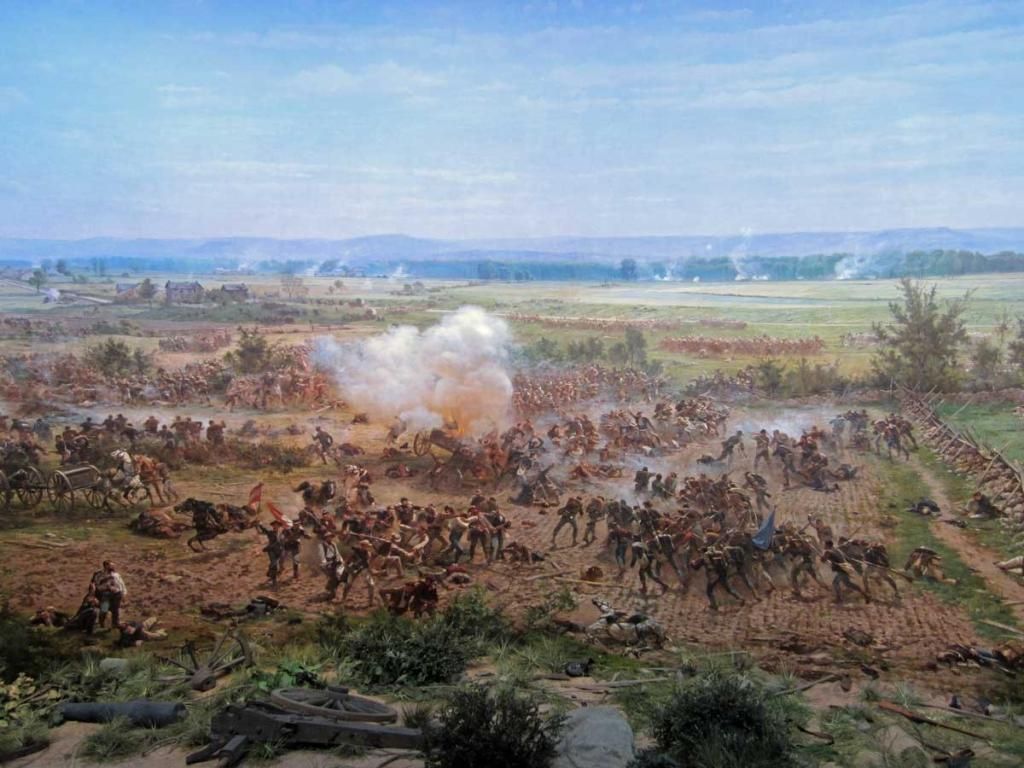
We left Part I with our just leaving the film in the Gettysburg National Military Park Visitors Center and being escorted with everyone else who had just watched the film up to the Cyclorama. The Cyclorama is located in the dome in the center of the building. So what is a Cyclorama?

In the 1880s, French artist Paul Philippoteaux painted the Battle of Gettysburg in the round. He and his assistants took more than a year to do the actual painting after months of research on the battlefield with veterans, guides, and a photographer. The painting is 377 feet in circumference and 42 feet high. What you are seeing is a depiction of Pickett's Charge on the third day of the battle. Four versions of the painting existed in the United States. It is the Boston version that is on display here and this first was displayed in Boston in 1884.

You come up into the center of the dome and there is a metal walkway all around the dome facing the painting. You can walk anywhere around the painting to see it. The painting is displayed as the artist originally intended with a three dimensional diorama in front of the bottom of the painting - making what you are seeing very realistic. Each place you stop around the painting and each place you look you are seeing another part of this battle.


There is a very short recorded narration that is played while you are up looking at the painting. What they do not do is tell you to look at any one particular part of the painting as the narration starts and you may be looking at a part of the painting that has nothing to do with what the narrator is saying. Your time with the Cyclorama is short - perhaps ten minutes and everyone is then asked to follow back down and out of the Cyclorama. You are then brought into a room with an explanation of the Cyclorama and its own historic artifacts. Frankly, this should have been at the start of the Cyclorama experience and not at the conclusion of it.

The Cyclorama is the end of your escorted part of the building and now you are on your own to go into the museum. Your tickets are only good for the day of purchase, so unless it is very early in the day it would be unwise at this point to leave intending to come back later. Your ticket does let you into the museum throughout that day. The film and the Cyclorama may be seen only once with a ticket. We went right into the musuem.

The museum consists of 12 galleries. The exhibits are displays of artifacts - some put together to create a room or a scene. There are also video presentations in some of the galleries. The first gallery is the Impact of War. The second gallery is the Causes of War from 1776 to 1861. Gallery three is the Approach to War. Gallery four gets into the Civil War 1861 to1863. Now in the galleries are approaching July 1863 with gallery five's Campaign to Pennsylvania. Included in Gallery five is the Campaign to Pennsylvania Voices Theater, a film program where you will hear from people who were there.

General Robert E. Lee's campaign furniture as it would have been set up in his tent.


Now the museum turns to telling you the story of the Battle of Gettysburg that took place from July 1, 1863 through July 3, 1863. (Think of the irony of the timing of this battle in relation to the Fourth of July.) Gallery six is divided into six sections - essentially six galleries - Into Battle, Day 1, Day 2, Day 3, and Out of Battle.

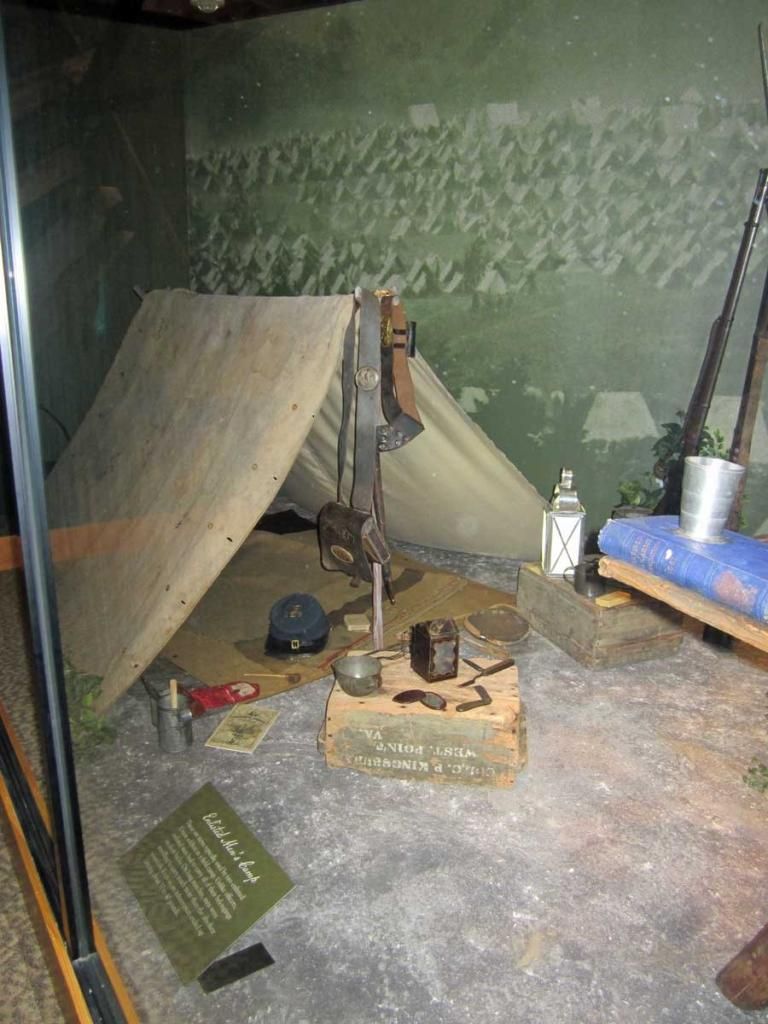
Soldiers' tent - two men share this tent - each carries half the tent with him.
General George Meade's bedroom furniture from his Gettysburg Headquarters


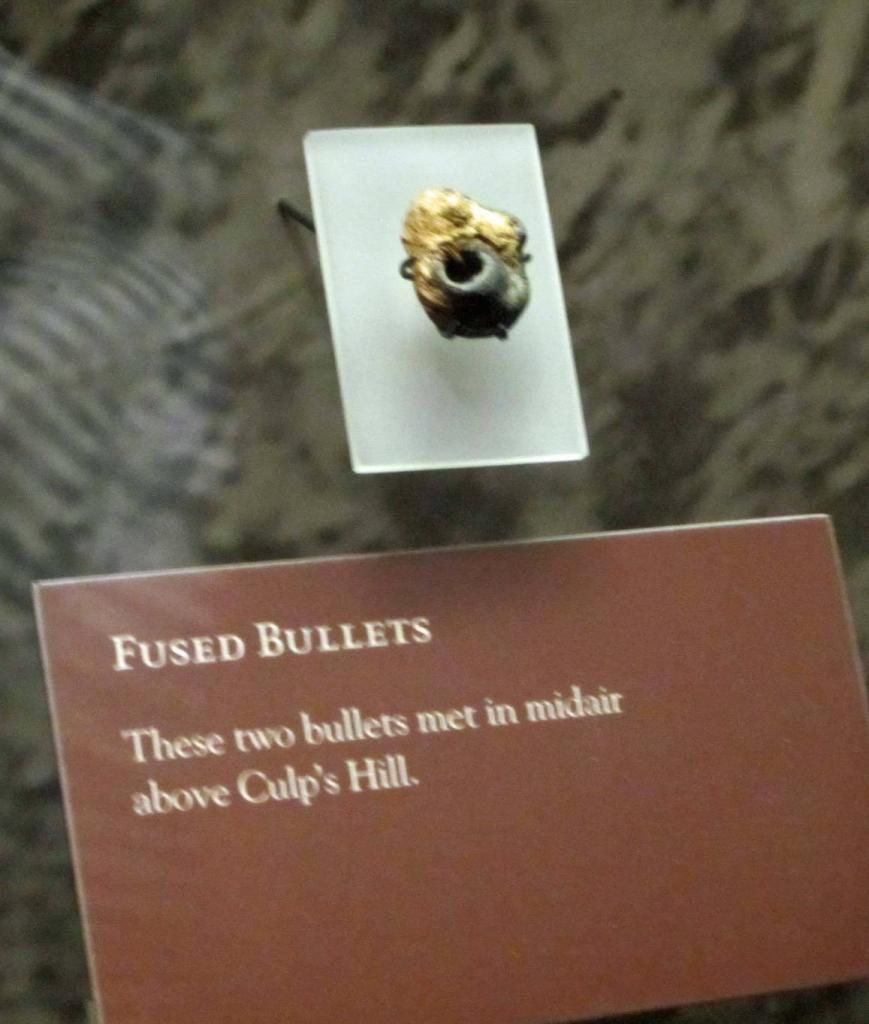
Two bullets that met in mid-air!

 Gallery seven is Aftermath of Battle: the Brave Men, Living and Dead. The gallery includes the Voices of the Aftermath Theater, again with a video program with people who were there. Gettysburg is one of the bloodiest battles in American History. Over the three days of fighting 50,000 men died or were wounded. During the battle the people of the town saw their homes and buildings used by both sides as places to fight, hospitals, and places to die. You will see furniture from some of those homes full of bullet holes. These three days were devastating to both sides and everyone who lived in Gettysburg. Some historians feel that this battle was a draw. Some see it as a turning point for the North toward victory. (I personally do not agree with that as much more will take place in the two years that the war continues.) Both sides reported the battle as a victory but it was the Confederate forces who had to quietly move themselves and those who they could carry on July 4th out of the threat of total destruction and further danger.

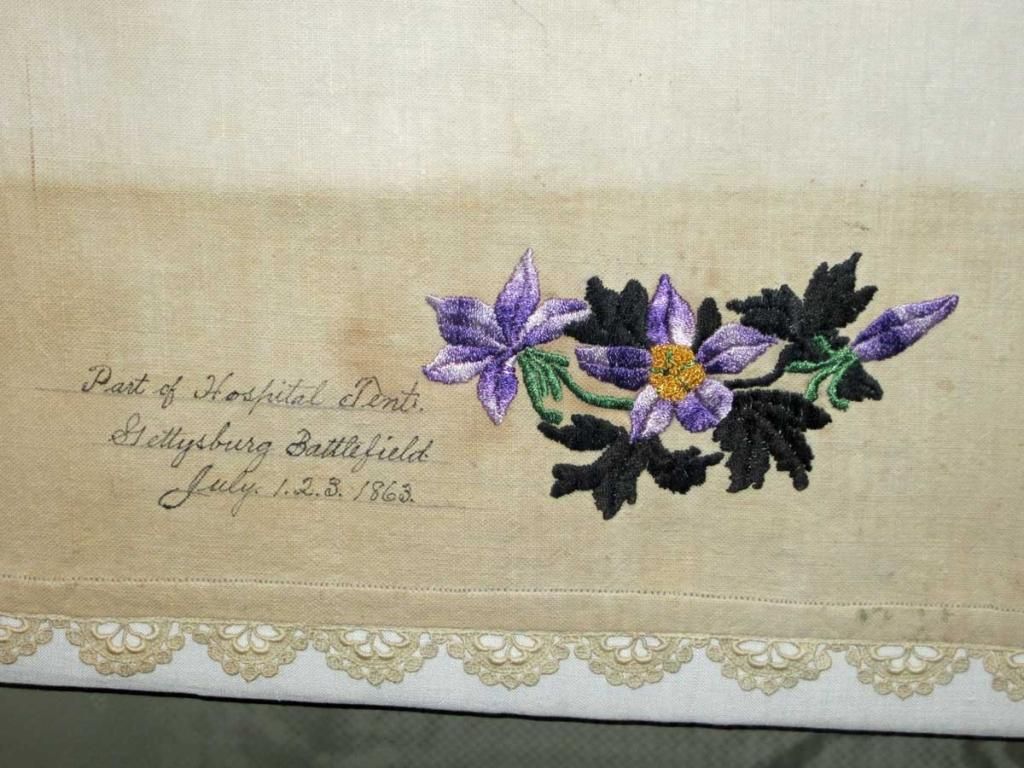
This photo of a piece of a hospital tent from the battle kept and embroidered as a remembrance. This photo and a series of photos of this piece were taken for Meryl who is an embroidery historian.
 When most people hear Gettysburg they think of the Gettysburg Address, a short speech made by Abraham Lincoln - added to the ceremony is a secondary speaker. Gallery eight is about the Gettysburg Address. The ceremony honored all that fell in the battle and dedicate the cemetery - part of the battlefield - where so many who died in the battle were buried. That is Northern soldiers - Confederate soldiers were buried in mass graves and then later moved to a well known cemetery in Richmond, Virginia. In this gallery you will learn about the ceremony, the speech, and see documents written by Abraham Lincoln.

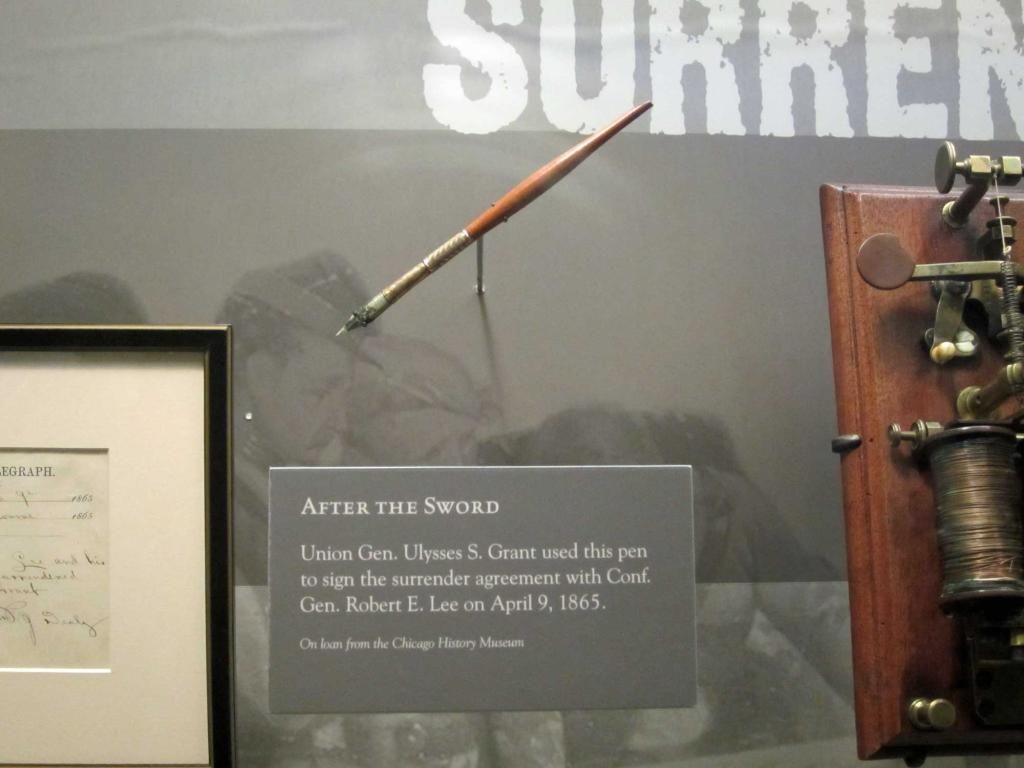
Gallery nine is the Civil War, 1863 to 1865 - the remainder of the war all the way through to General Lee's surrender of his army to General Grant at Appomattox which led to the end of the Civil War. There are some very significant artifacts to see in this gallery.

The Surrender Pen
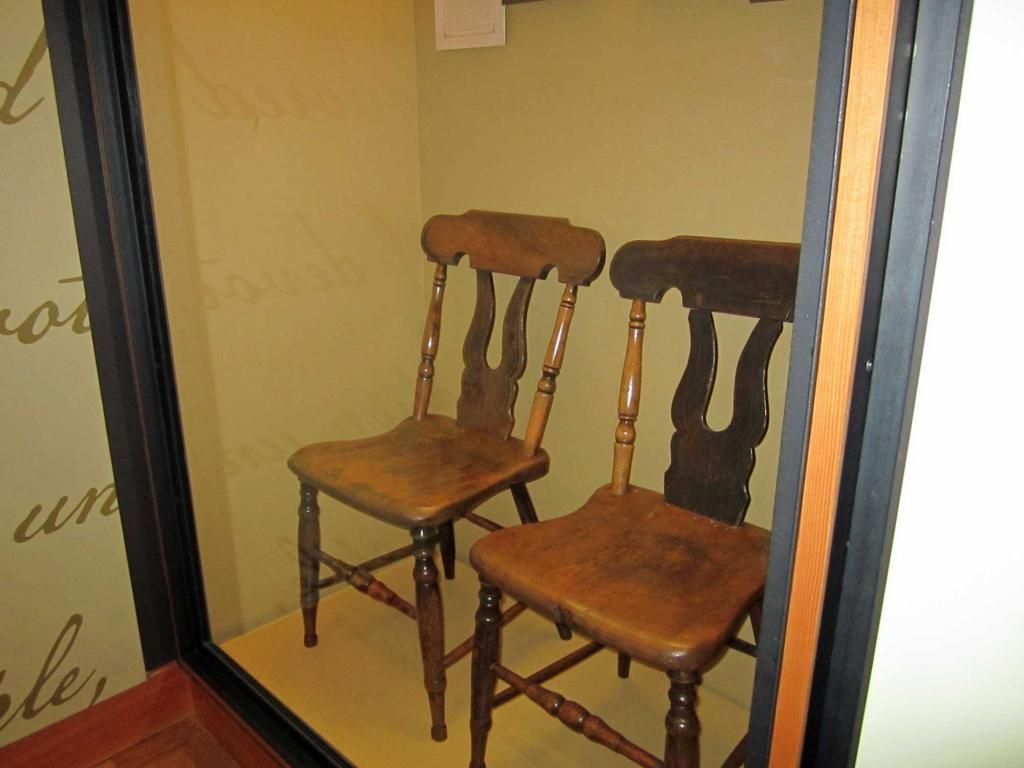
Chairs used by Grant and Lee while signing the surrender


Gallery 10 is Results of the War: That These Dead Have Not Died in Vain. Gallery Gallery 11 is Preservation of the Battlefield in which you learn about the immediate collecting of artifacts of the battle, the reunions of both sides held at the battleground, and the work done to preserve the battlefield as a National Military Park. That work still continues. The NPS is currently removing trees that did not exist on parts of the battlefield in 1863. They are trying very hard to put the battlefield back to what it looked like at the time of the battle. (For every tree removed, another tree is planted at another local site.)

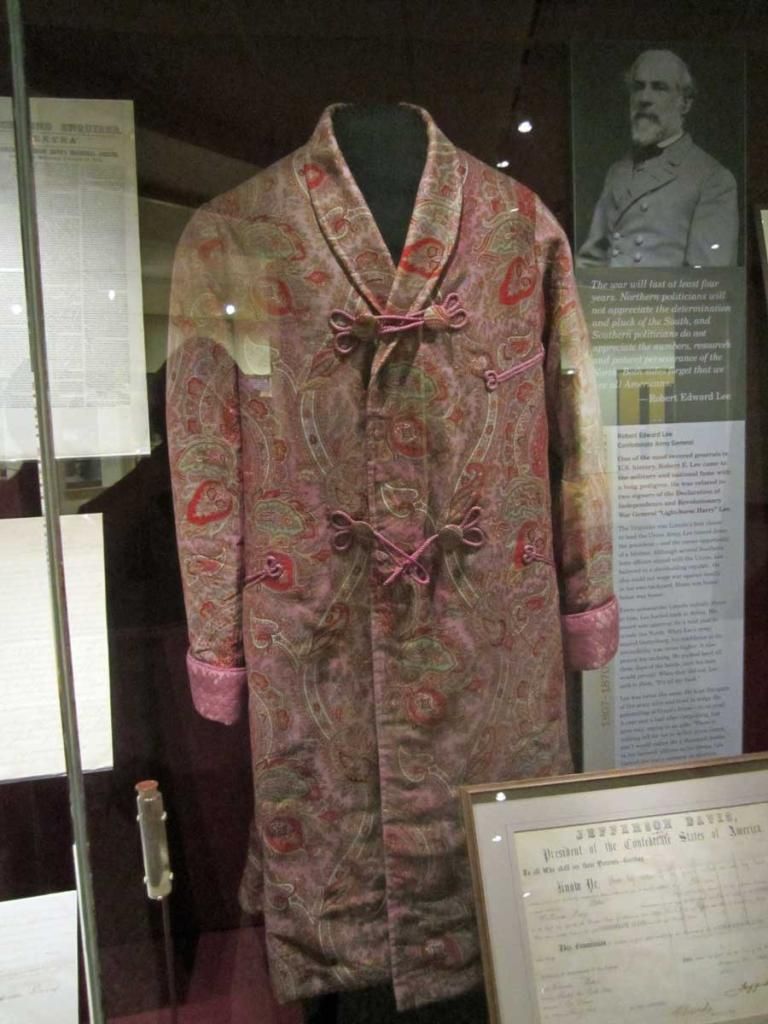
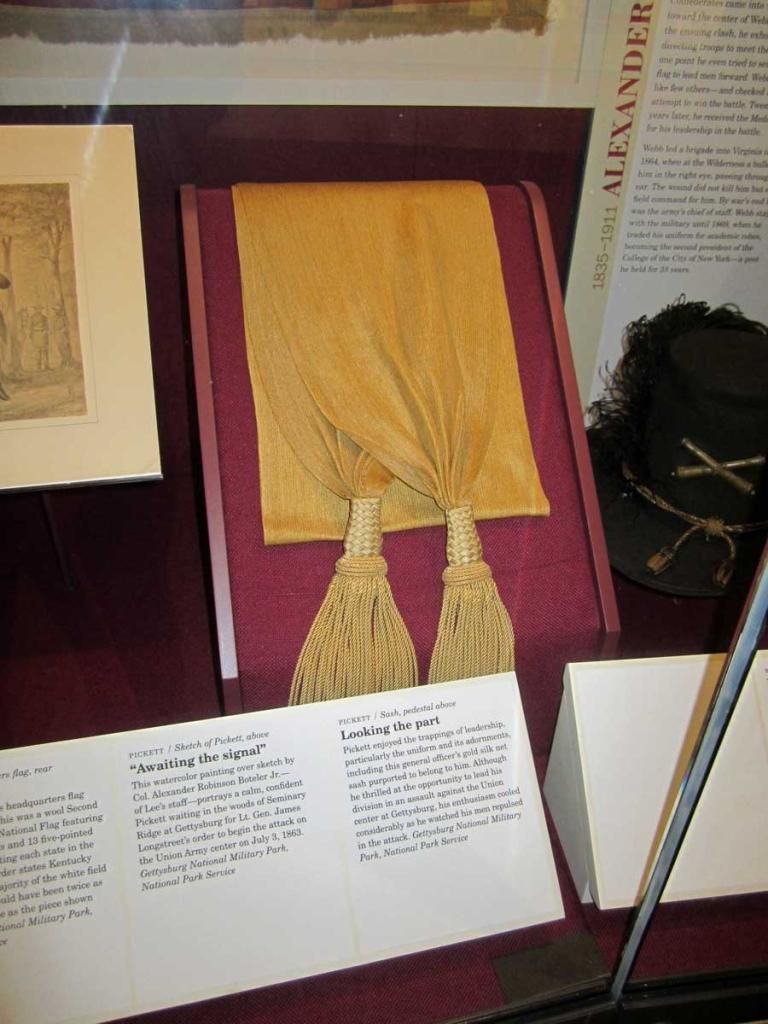
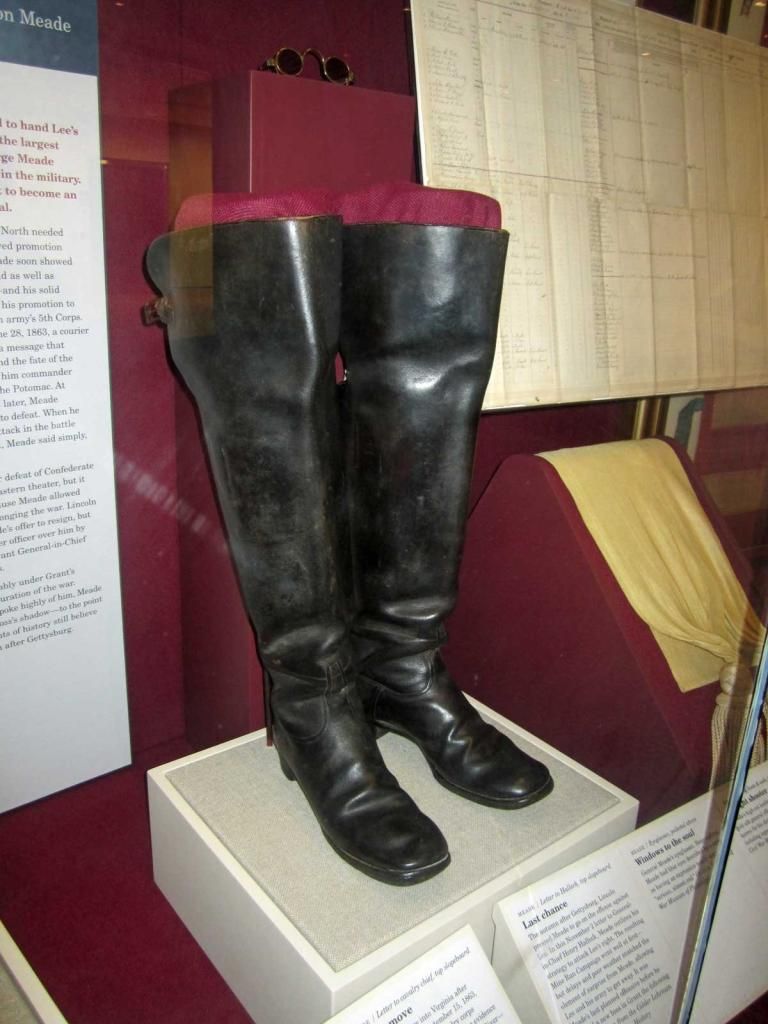
The last gallery is a special exhibits gallery and the exhibits here change here on a schedule. At the time of our visit this exhibit was (and may still be) Treasures of the Civil War: Legendary Leaders Who Shaped a War and a Nation. This includes artifacts from collections from all over the country. The following three photographs are of artifacts in that exhibit.

Robert E. Lee's Dressing Gown

Pickett's Sash
George Meade's Boots

 After the gallery we went into the gift shop - which was soon to close at 6 pm. We knew at the beginning of the day that we would not have very much time to see any of the actual battlefield itself - and as I said at the beginning of Part I of this article, we have been through the battlefield many times before - but never in a Roadtrek. We headed back to the parking lot and decided that before dinner we would try to see a little of the battlefield and headed toward the route of the tour. The tour road goes in one direction only. You start the tour on the Confederate side of the battlefield at the bottom and drive along in a long oval past the field where Pickett's Charge started - and the statue of Robert E. Lee.


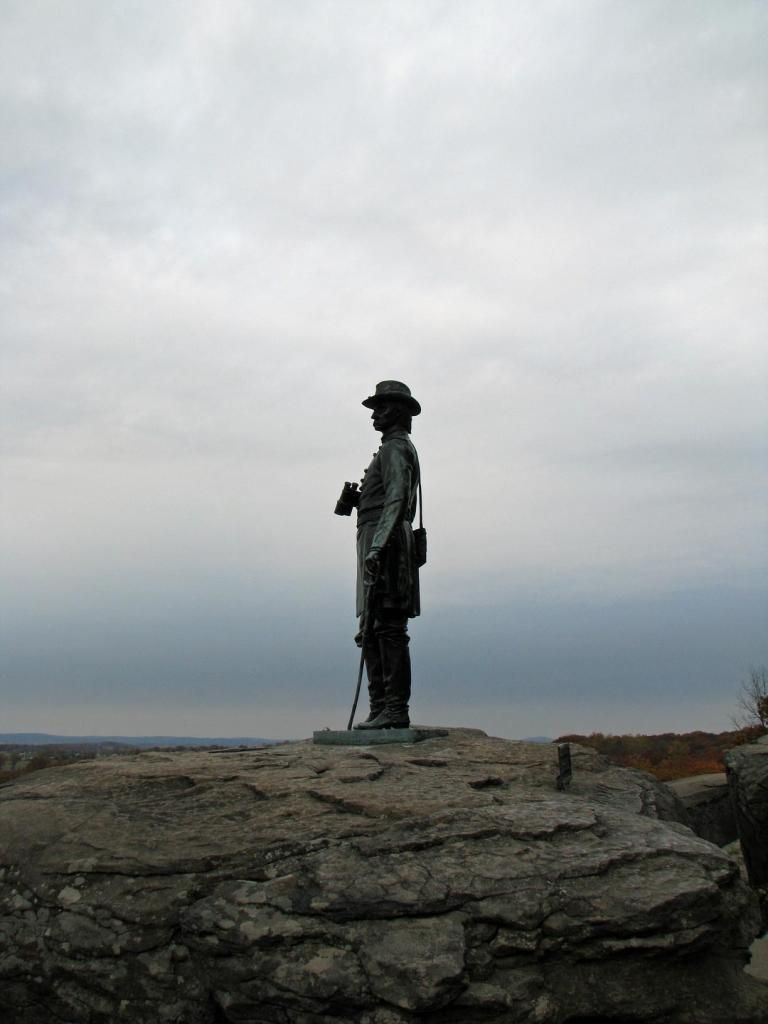
The route takes you along to Big Round Top and then Little Round Top. There was fierce fighting on Little Round Top. You may park and climb to the top of both looking out over the entire battlefield.

Atop Little Roundtop


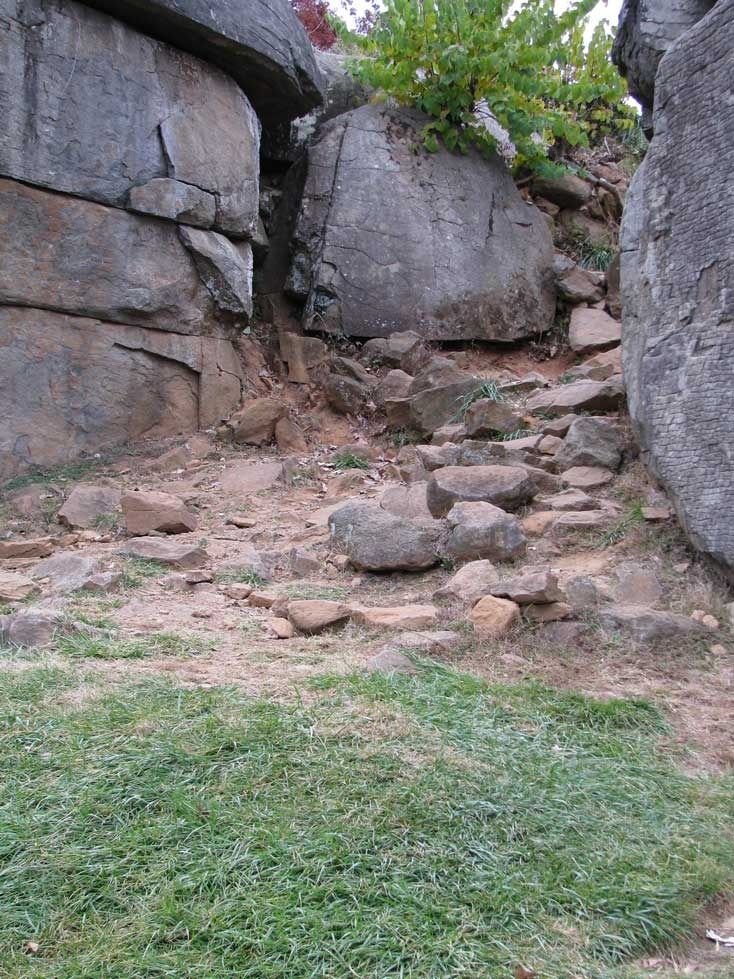
After Little Round Top in the Roadtrek it is important to make the correct turns and I am not certain that it is a good idea to go down along the route to Devil's Den where the route climbs a rather steep hill and then drives through some very tight roads with rocks on each side. Now, tour buses do this route, but these are drivers experienced in maneuvering a large vehicle on a road they know well. I have driven on these roads with a car and with a small van - as it was beginning to get dark, I decided not to attempt it with the Roadtrek and we took the alternate route that continued the oval.

Devil's Den - a famous photograph taken right after the war was taken at this same spot by Alexander Gardener showing dead soldiers between the rocks right here.
 The oval route then takes you past the ending point of Pickett's Charge and the High Water Mark monument. This then leads you out of the park. There are other routes through other parts of the battlefield. As I have been saying this battle took place all around the town.

It was getting dark and we went to a place that many reenactors know to go to for dinner when in Gettysburg - General Pickett's Buffet - a Southern buffet menu restaurant almost outside of town. Going into the main parking lot entrance of the restaurant the Roadtrek banged as it hit bottom in the back going up the driveway cut from the street. I hoped that no damage was done - and so far it seems we were OK. Leaving the restaurant later that night we went out the rear of the parking lot where the exit cut was less of an incline - and no bang.

We returned to the campground in Lancaster that night the same way that we came. What happened to the rain? It did not rain in Gettysburg while we were there. The roads to Lancaster where wet and it had rained there. We saw some interesting lighting shapes in the distant sky as we drove back - one of which was red and in the shape of a U - high in the sky.

I recommend going to Gettysburg. Go for more than one day. There are several campgrounds in Gettysburg. Some are better in the reviews than others so be sure to check RVparkreviews.com before you go and pay close attention to the reviews. There is a Walmart in Gettysburg but overnight parking is not allowed in their parking lot. This is a local ordnance and applies to all parking lots in Gettysburg. When in Gettysburg be sure to see walk around the town. There is a great history bookstore in town called The History Store. There are also a number of ghost tours of the town at night - these cost money and may or may not be showing you anything but legends, but we aware that Gettysburg is said to be one of the most haunted places in the country - and considering what happened here, I would not doubt that at all.

(The three photographs taken of the battlefield above were not taken on this trip. It was too dark and we had no time to stop for photos when we drove the battle route with the Roadtrek. These photos were taken by me on a trip to Gettysburg in the Fall of 2008 and this explains the color of the leaves on the trees in General Lee's statue photo.)