Roadtrek

Roadtrek
Showing posts with label Williamsburg. Show all posts

Wednesday, February 17, 2016

Yorktown Battlefield National Park, Yorktown, Virginia 2015

On our trip this past August to the Historic Triangle - Williamsburg/Jamestown/Yorktown - we also revisited Yorktown Battlefield National Park - in Yorktown, Virginia. Yorktown is the site of the last major battle of the American Revolution. It was October 1781. The result of the American Victory with the help of the French was the surrender of British General Cornwallis and the British Army under his command. This surrender was so devastating that it convinced the British Parliament and King George III to end the war with American Independence.

The Yorktown Battlefield National Park is spread over miles. The Visitors Center at the edge of the historic area of Yorktown is the place to start any visit to Yorktown. While one may drive the public roads through the battlefield without charge, there is a fee to pay at the Visitors Center to be able to see the museum that is inside, see an introductory film about the battle, take Ranger tours, see special programs, and be able to go inside two of the historic homes one of which is on the battlefield and the other which is in the historic district of Yorktown. There is parking for RVs and my Roadtrek had no problem parking in the regular spaces in the Visitors Center parking lot. The admission fee at the time of this writing is $7 and this is good for seven days. If you have been to Historic Jamestowne before visiting Yorktown and have a current ticket your Jamestown NPS ticket gets you into Yorktown at no additional charge. If you visit Yorktown before visiting Jamestown, within the valid period your Yorktown ticket is good for half the price of the $14 Jamestown NPS admission (see our last article about Jamestown). The best thing is that if you have a National Park Service Senior Pass you get into Yorktown Battlefield NP for FREE! I have to admit that I had paid the Senior Pass discounted rate at Jamestown a few days before and because I wanted to get into something free with my Senior Pass I just went up to the cashier, showed my Senior Pass and Meryl and I both got our free tickets! We could have just shown our receipt from Jamestown but hey, I wanted to see my tax dollars directly giving me something back.

We started with the museum. In the museum you will go through the interior of a reproduction of a British Man of War battleship with cannon below deck, crew's quarters - hammocks hanging from the ceiling, and get a feel for what life was like in the cramped quarters of the ship. Exiting the ship, you will come to one of George Washington's marquee's and field tents.


The museum also has artifacts of the battle, weapons, and display boards that explain the two sides who fought here, the circumstances of the battle, and the importance of the result of this battle.

Do not leave the Visitors Center without seeing the introductory film. This is a complicated battle spread over miles. The French Army was an integral part of this battle and the outcome depended upon the French Fleet blocking the York River preventing the British Fleet from coming to the aid of their Army. If you do not know what happened in most of the areas in this battlefield, then when you take the self-guided driving tour (which is very easy to get lost in) all you will come away with is seeing vast fields of grass, mounds of earth, and trees. The film will give a fast review of the battle and the locations that you will see as you drive the battlefield. The National Park Service website for Yorktown Battlefield also gives a good review of what took place at the battle.

Before we went back to the Roadtrek to begin the tour we walked into the historic district of Yorktown which is adjacent to the Visitors Center by a short walk.  You will first come to the Yorktown Monument.


Follow along from their down the street and you come into the historic district of homes and buildings that have been restored and were standing where you see them at the time of the battle in 1781. Only one of these is open to the public with your Yorktown Battlefield ticket.


The house that is open is the home of Thomas Nelson, Jr., a signer of the Declaration of Independence, the Governor of Virginia at the time of the battle, and the commander of the Yorktown Militia in the Battle of Yorktown. The house was taken by the British and served through the battle as the headquarters of General Cornwallis, commander of the British Army. During the battle the large house was visible from many points and it is said that Nelson directed the American and French artillery to use his house as its aiming point. The result is still visible on the exterior walls of the house. The house is furnished inside as it was during the battle. As the battle went on the house was also used as a field hospital by the British.


There are special programs scheduled at different times - some several times a day. When we were there we lucked out and had an opportunity to see something that we had never seen or heard before - the firing of an 18th Century (reproduction as one would have to be crazy to fire an antique) 18 pounder siege gun (cannon). As an 18th century living historian in a reenacting unit with a cannon, I have fired a three pounder field cannon hundreds of times. A three pounder cannon fires a ball that weighs three pounds about the size of a tennis ball - and that is considered loud and can do a lot of damage. An 18 pounder siege cannon fires a ball that weighs 18 pounds about the size of a bowling ball. The ground shakes. Below is a photo - at the end of this article we will put that photo into motion...


After the cannon firing (twice) we headed back to the Roadtrek to head out into the battlefield. This was our last day in Virginia and we were heading north at the end of the day. We decided that we would drive to the key points of the battle which does take you through the entire battlefield.

With all of the fighting that took place at the Battle of Yorktown, the battle comes down to two places that have come down through history as key to the victory. These two locations are named Redoubt Number 9 and Redoubt Number 10. A redoubt is a mound of earth dug out in the middle to become a fortress. The exterior of the mound is lines with a series of well sharpened logs or pikes that stick out preventing anyone from getting into the fort. A siege is made on each of these redoubts on the night of October 14, 1781 at the same time. Redoubt No. 9 attacked by the French and Redoubt No. 10 attacked by the Americans. Here is Redoubt Number 9 -

The French are OUTSIDE


The inside of Redoubt Number 9 -

(The British are INSIDE.)


The French made it inside victorious.

Here is Redoubt Number 10. While you can get very close to Redoubt Number 9 and even walk a path over the top and into the middle, Redoubt Number 10 is now fenced off (to preserve it from further erosion) and you find yourself standing in front of a massive hill.

The Americans are OUTSIDE. The British are INSIDE.


The day after the two sieges British General Cornwallis wrote to British General Clinton: "My situation now become very critical;..."

From the two redoubts we went to the house in which the terms of surrender were discussed. The Moore House is along one of the roads through the battlefield. These are all public roads with public traffic and with many points were there is no clear marking as to where to turn. The Battlefield Visitor's Map included with your admission is vital to getting through the battlefield and not driving in circles.  We were fine in the Roadtrek along the route. Very large Class A RVs or very long travel trailers may have a problem getting around on some of the smaller roads. There are small parking areas at each of the various sites - more significant sites have more parking. Before Cornwallis surrenders he hides in one of several caves in the hillside below Yorktown on the beach of the York River. You can visit this cave.


The Moore House was a family's home and the interior has been restored and furnished as it was during the battle and then for the surrender meeting. Each army involved met here to come to the terms of the surrender of the British fighting here against the Americans and the French. The surrender table is seen below -


Of course, in this age of gentlemen led armies, when there is a surrender it is a formal affair with the defeated marching through the victorious and then surrendering their weapons and themselves. This was held on a large open field - known today as The Surrender Field.


The field is too large to photograph as a whole - even from the brick pavilion seen in the photo on the top just off center to the left. The British marched between the two rows of fence - the American and French lining each side. Inside the pavilion you will hear an audio presentation of the surrender. It has been believed - though there is now some doubt - that the tune the British fifes and drums played as they marched here is a nursery rhyme tune called "The World Turned Upside Down". You hear this tune being played inside the pavilion as you look out onto the surrender field. You can walk from the pavilion along one side of the surrender field. Around the pavilion are cannons and mortars surrendered by the British in the surrender. (The blue green is the oxidation of the metal over time.)


We spent most of one day in Yorktown. Had we wanted to go through more of the battlefield we could have spent more time, but a lot of the battlefield stops on the visitor's map are the places that various regiments encamped and where troops were moved. So while we went to the highlights and did not drive all of the roads through the battlefield - and we did get lost at the end and were way out of our way in small neighborhood streets with no easy place to turn the Roadtrek around in to get back out to a main road - we really saw what we came to see at Yorktown. Check their website for special programs and scheduled Ranger tours. There is a new museum being built at a commercial attraction, The Yorktown Victory Center, and when this is completed - hopefully by summer 2016 but that is uncertain - that will be something to add to a visit to Yorktown - or warrant a second day's visit coming over from Williamsburg where the campground is that we stay in when we come to this area. From what I have read, this new museum will be something to see!

As promised above - we saw and heard an 18 pounder siege gun fired and you can see it too right here.  Turning up your volume all the way will still not be the same as hearing and feeling this fired live...


Wednesday, February 3, 2016

Historic Jamestowne - Jamestown, VA 2015

Let's leave the cold winter of 2016 and go back several months to a much warmer time and some nice memories of our Summer 2015 trip. One of the places that we went back to on this trip was Historic Jamestowne - the National Park Service and Preservation Virginia site of the original Jamestown site - the first English settlement in America in 1607.

This is a historic site and "attraction" that is always in transition. You can visit this week and next week there may be a discovery that will change history and it will be presented to those visiting as it is happening. Before this trip, I knew that there had been a new discovery that was doing just that. Historic Jamestowne is also known as Jamestown Rediscovery. Rediscovery because until 1994 no one really knew for sure what lay beneath the ground on this historic site and landmark. It was known that this was the site of the original settlement and the start of the colony. It was known that there was a fort built here, but it was believed that the ground that the fort stood on had been overtaken by the James River and sat somewhere close by off shore under the water. This is what you would be told when taking a tour - this is what I was told when I was a boy visiting with my parent's in the 1960's. They would point out into the James River and say that was where the fort was. They would walk you past monuments and a series of rolling hills that were the "Confederate Earthworks" - an earthen fort the Confederate soldiers built during the early part of the  Civil War to defend this area from Northern attack from the James River. I was always interested in history and always curious. I also have always had a sense of what is logical and I remember that my thought then was clearly this - if the original Jamestown Fort is supposed to be in the river but no one is really sure, then why has no one dug here - in the Confederate Earthworks that bordered the river - just to make sure that Jamestown was not underneath. I remember asking the guide/Park Ranger this and was told that the earthworks were just as much a part of history as Jamestown and no one would ever desecrate that historic landmark. Well, it seems that I was not the only one who had this thought, and before I got there, Dr. William Kelso came to the site in 1963 as a grad student and had the same idea. It took him until 1994 for the permissions to be had, the grants to be obtained and the digging to start - only to discover that I  - and Dr. Kelso - were correct. The whole thing is under where so many had walked since 1607 and little by little - with some leaps and bounds - it is all being revealed.

If you have any interest in history at all this is really exciting. You can go to a museum or a historic site and look at things in a glass case and see an old structure and someone will tell you this or that happened here and this is what we found and this is exciting, but you are looking at the same things that so many others have looked at coming there. You will do that here too - BUT you may just be here on a day when an archaeologist is digging in just the right spot and will pull out of the dirt something that no one has seen for over 400 years until that moment when the person digging and you watching will see it for the first time since. Here is a video that will show you what I am talking about -


 This is why we keep going back. The last time that we were at Historic Jamestowne we also got to experience another first - a significant earthquake. There were no earthquakes this time but I did have a new experience that I will tell you about later on. I also got to use my National Park Service Senior Pass for the first time - and I knew ahead of time that I would not get to go in free since the NPS is joint here with Preservation Virginia and they do not accept the pass for any discount - but we did only pay $5 each rather than the usual admission price of $14.00 each which was OK by me!

There is RV parking here at Historic Jamestowne that will accommodate large RVs. Because the Roadtrek can often fit in a regular single car parking space and the spaces here are all up against a low curb with grass behind, we just parked the Roadtrek in a regular parking space. If you come in a larger RV or trailer just follow the signs to the RV parking lot and you will have no problem parking.

There is a museum in the Visitor's Center building that has been in existence since before Jamestown Rediscovery and that has some interesting artifacts - though none to the original settlement. There is also an introductory film presentation that is very well done and should be seen before heading outside. There are also tours and programs that are scheduled throughout the day. These include tours guided by Park Rangers and also first person living history programs where you will encounter specific people of the past who were there.

The new discovery that I wanted to see was outside but we watched the film, saw a living history presentation (that related to this new discovery),  and joined a tour before we headed along on our own.  A recent focus has been on the original church (Church of England or Anglican Church) of 1608. The church that most are familiar with at Jamestown is a later church building which a good section of which had remained standing through the years (the large brick building seen in one of the photos below). The Church of 1608 is long gone but with the discovery of the fort and locating where things were, the location of the church has been known. In 2015, four graves were found on the location of the church - four of Jamestown's founders - and with one of them was found a little silver box.


As you can see in the photo above - taken of a sign at the site, the skeletons of the four men were uncovered (they remain there still) and on the left of the photo you can see a picture of the silver box.


What is the big deal about a small silver box when there have been so many things dug up here at Historic Jamestowne? The box is identified as a "Reliquary" - a container of Holy Relics. It cannot be opened without damaging it but it has been examined with high technology to see what is inside. There are seven pieces of bone, two fragments of lead ampulla which is a small flat flask to hold holy water or sacred blood. So what? This is something only a Catholic would have. So what? Catholics are not accepted in England at this period of time - since Henry the Eighth broke England away from the Catholic Church and the Pope declared the King and Great Britain his enemy and Britain returned the sentiment. Catholics were called Papists (the followers of the Pope) and they were not tolerated in England. So what is a Catholic Reliquary doing in the grave of a founder of Jamestown? It has been felt over time that there may have been one or more Spanish spies in Jamestown. The Spanish were the enemy - not just because they were Catholics but for many reasons of the time. Could this noted figure of the colony be one of them? No one knows for sure. Perhaps someday more evidence will surface about why this was in this grave, but this was a major discovery - and is noted for 2015 as one of the Top Ten archaeology discoveries in the world for 2015. This is not the first time that a discovery at Historic Jamestowne has achieved this honor.  To historians this really is a big deal.


There have been other discoveries as well in this past year - not quite so monumental as the silver box but of interest. A cellar kitchen has been unearthed which was part of the bread bakery for the settlement. There were two bake ovens found in the walls of what was the cellar to an above ground building. Below you can see one of them.


The beginning of the colony was very difficult and there came a period that is called "The Starving Time". In this cellar were found bones that had been butchered for food - and proving what has been long suspected, the some of the colonists resorted to cannibalism to survive as there were human bones among these including several parts of the young woman pictured at the left of the photo above - named now as "Jane". You can see Jane in the exceptional museum of many of the artifacts that have been brought up at Historic Jamestowne - thanks to Preservation Virginia and Jamestown Rediscovery.


My other first on this visit was to experience 3D goggles as part of a hands on exhibit area in a shed located between the fort site and the Preservation Virginia museum. This is only open select hours and it has a number of things that you can see up close and touch. The 3D goggles contained the bake oven cellar site and by putting them on you could move around the archaeological dig - walk through it, turn and see around it - reach out and feel that you could perhaps touch it (which, of course you can't and won't until someone finally invents the holodeck). This blew me away. With all of the history around me, I was so impresses with this 21st Century high tech device. We would have easily passed up this little education shed - we usually do figuring that they are intended for children, but I am so happy that I decide to go and take a look inside this one!

Meryl got to see something that she was looking forward to seeing also. I have mentioned before that Meryl researches and is becoming quite an authority on historic embroidery - focusing on the 17th through 19th Centuries. There was a reenactment this past year of Pocahontas's wedding to John Rolfe. A number of embroiders volunteered to recreate the wedding clothing worn by Pocahontas and this was on exhibit in (of all places) the gift shop at the Preservation Virginia museum. Meryl got to see it up close - she did not participate in its creation but she had followed it along as it was discussed in progress.


The embroidery is on her shift and cap. This was worn by the woman portraying Pocahontas at the reenactment of the wedding four hundred years after the actual event.

We always have a good time here. I highly recommend this as a must see. America started here - not in Plymouth, Massachusetts in 1620 but in Virginia at Jamestown in 1607.  Historic Jamestowne is not to be missed.

Wednesday, October 14, 2015

Colonial Williamsburg Revisited

I have been going to Colonial Williamsburg for over 50 years and have seen many changes over those years. Meryl and I started going to CW - as called by those who work there and those who have a special relationship to Colonial Williamsburg - when we were first married and have gotten there almost every year since. We had not been able to get there last year and I have not written about it here since the first year that we had the Roadtrek. Things have changed since then and it is time for another article.

From where we live - by routings - the trip should take eight hours including stops for lunch and dinner. With construction and traffic the trip can take almost 12 hours and while we have done this straight through it is not the best idea to do. A stop in PA and move on the next day for the rest of the trip. I take what many would consider the wrong way to go. We go on 95, around Baltimore to avoid propane restricted tunnels - which some claim you can go through and some claim you cannot - so we just go around and take the bridge - if we are not stopping in PA first. Then it is 95 to the Capital Beltway and around DC back to 95 and straight down until the Richmond bypass and then onto Rt. 60 which takes you right to CW and the campground that we prefer. We have rarely gotten stuck around Baltimore and we have never had a problem around DC. The problem comes in before Fredericksburg and approaching the bypass around Richmond. Many have shared what they feel are better routes - all of which take one way around and way out of the way - and when looking at travel times for these routes come out to be the same time as dealing with the traffic - but you are moving along through the many more miles. Anyway - the unpopular 95 has worked for us before and since the Roadtrek. It also brings us to a gas station that has always had the lowest price gas of any in that area or any other that we go through - both traveling and at home. I don't know why this is with this station but it has been this way for years. We paid $1.94 here in August when gas at home was still near $2.60 and was not much better anywhere else that we traveled through. Hmm... wondering what it is right now - quick check with Gas Buddy and its $1.88 (Oh my!). (This is at the time of this writing 9/30/15.) Here it is still well over $2.00. (I get real excited when I see low gas prices!) So moving on - cheap gas that actually lasts and is not gone after 100 miles - to getting to the campground.

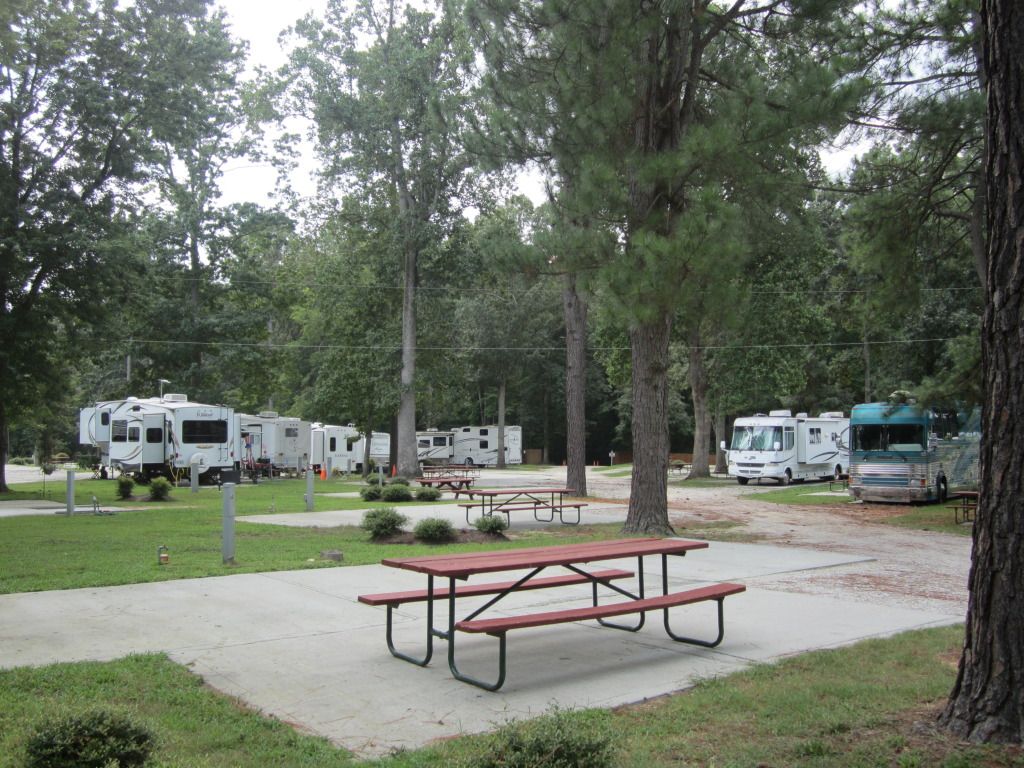
We stay at American Heritage campground in Williamsburg, VA. It is reasonable and is the nicest campground of any that we have ever been to. Every site is a paved, level site. The cable television selection is better than most and the wifi is very good. We don't use it but there is a swimming pool and also sports fields and a hiking trail into the woods. It is situated off the road and you do not hear the road noise.

So, on to Colonial Williamsburg. If you have never been there or don't know at all what it is, CW was built in the 1930s with Rockefeller money. Rockefeller was enticed to spend his wealth by the pastor of the local and historic Anglican church who had a vision of restoring a sleepy college city back to what it looked like in the 18th Century. Many of the buildings remained. Well, Rockefeller with the help of Rev. Goodwin's influence bought the whole town - well just about the whole town as there were a few holdouts and they were just built around. They created Williamsburg as it was with archaeologists and researchers and specialist architects and did so with 18 Century building techniques. What you see today is coming on 100 years old on its own in a not a very long time. What you see, go into and are surrounded by are restored or reconstructed homes, public buildings, and trades shops populated with people of the past - living history interpreters that bring the city of the 18th Century back to life. It is all around you and if you let yourself be drawn in, you are part of it. It is time travel - and for the serious visitor - meaning not the family or couple who come in for the afternoon on their way to the amusement park, walk the streets and don't buy a ticket to experience what goes on inside and areas outside not on the street and look and leave - it can be an experience like none other.

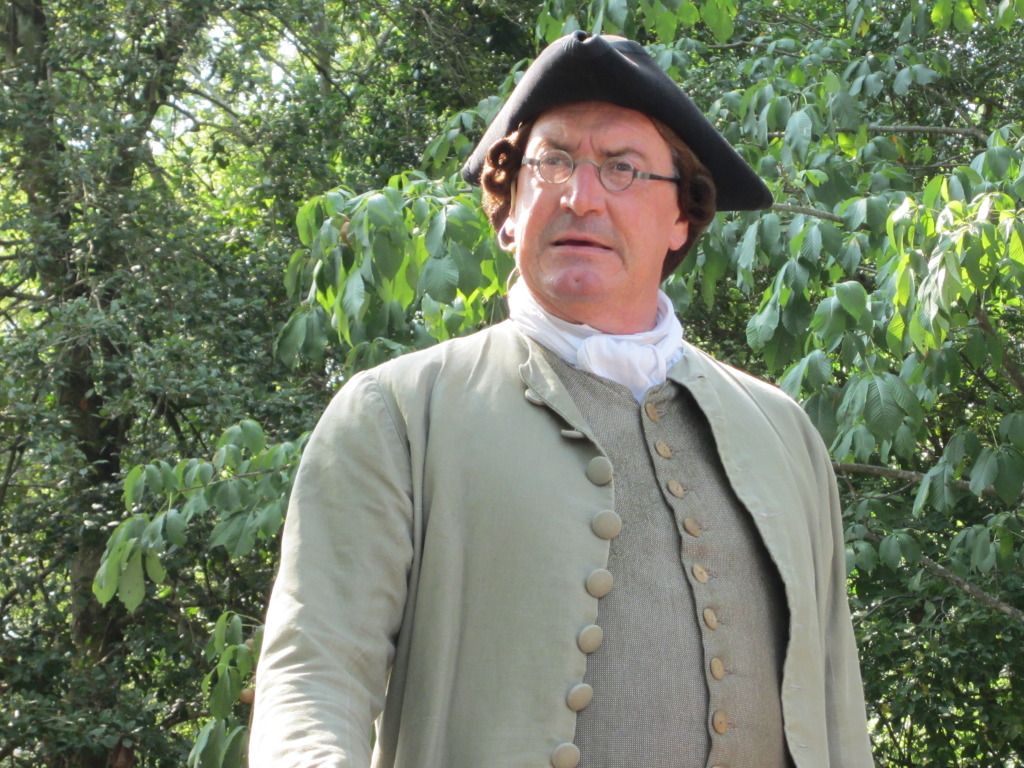
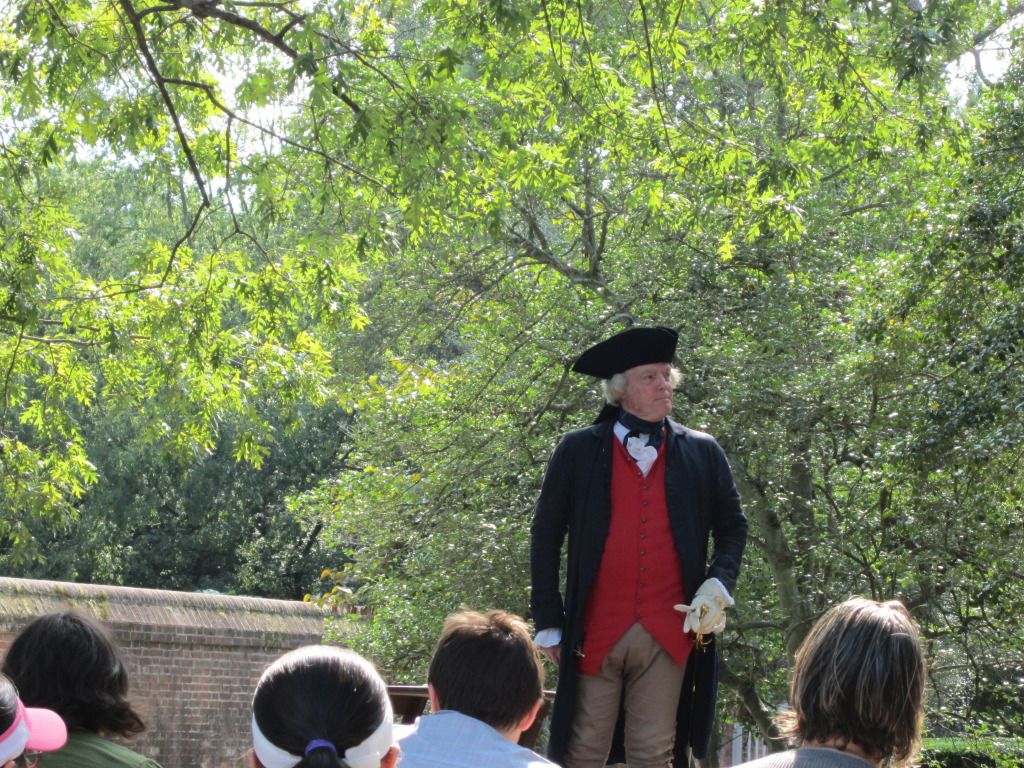
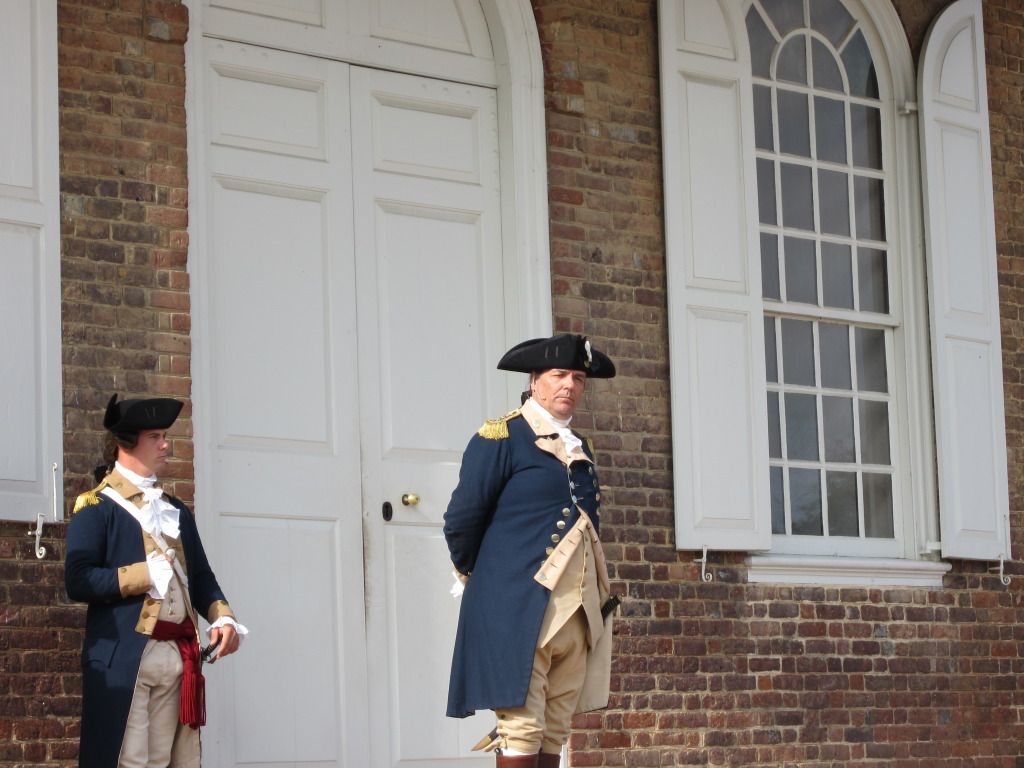
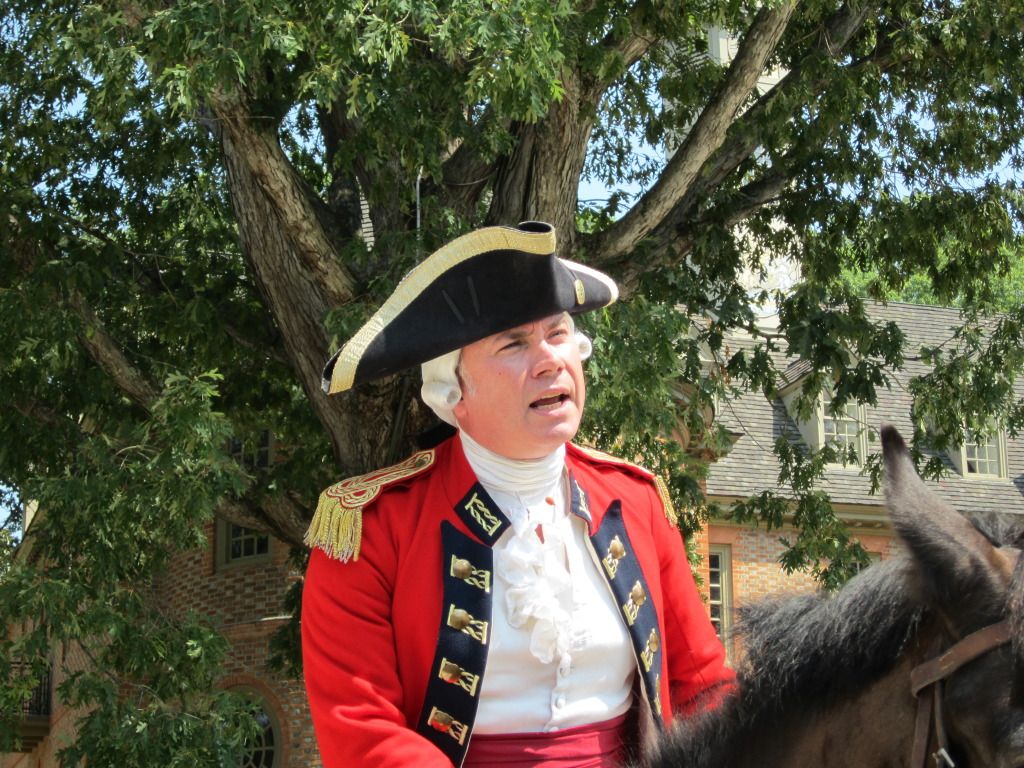
In CW you will encounter every day people of the past, trades and workmen - men and women, and some people who you may recall from history lessons long ago - Patrick Henry, Thomas Jefferson, George Washington - to name a few. These are not people in costumes walking around as in Disney parks - these are historians who have taken their interpretations to the highest levels of research and will convincingly portray these people of the past so that you will come away believing that you have met the real thing.

Since my last article some things have changed. I spoke then of the Revolutionary City program which at that time was spread over three days. Since that program has gone from three days to two days to now a part of one day. These are scenes of events that took place in the city of Williamsburg in various years during and before the American Revolution. The focus this year has been 1781 - the year leading up to Washington's victory over the British at Yorktown, Virgina just several miles from Williamsburg. The year will change next year, and the next year, etc. Added in the day in the afternoon were outdoor,  staged programs about other events that took place in the city - most on a more personal basis between people who lived in the city in the 18th Century.

There has been some construction going on as research showed that a "Market House" existed on a stretch of property that has been left open. The CW team of archaeologists did a dig and found traces of the posts that supported this open air structure along with a small building that was also found in the research. It has taken three years to complete the research, build the buildings using historic tools and methods and it is about to open to the public this Fall.


This is where people would go to do their food shopping - no, not everyone grew their own. There was a market place that would open early in the morning and some would have stands inside the Market House structure and others would sell from blankets around the outside. You would go to buy vegetables, fruits, fish, and meats. One needed to get there early to get the best cuts and the best choices. When opened it will be interpreted both as an historic site and also be used as a sales site.

This is the newest - some of the photos below are the oldest. The Capitol Building - the building that housed the legislative body of the House of Burgesses where Washington, Jefferson, Henry all served as Burgesses. The Capitol is a reconstructed building built on the original foundation.


Duke of Gloucester Street - the main street of the colonial city - full of trades shops, taverns, and residences.


A tavern in the 18th Century is not only a place to go to enjoy a rum or punch but also is a place to dine and/or sleep.


You will also find the homes of some patriots who were very famous in their time but little taught in history books today - unless you live in Virginia. This is the home of Peyton Randolph - the President of the First Continental Congress and the President of the Second Continental Congress until his death while in Philadelphia at the beginning of the proceedings. He was highly respected  throughout the Colonies and would have been, it is felt, the first President of the United States had he lived.


In the trades shops and yards you get to see and interact with those everyday people who helped make things happen. This is the yard of the Wheelwright's shop.


One of the staged programs - this looks at a serious situation of a woman about to be married who realizes as we watch the short encounter with the aunt of her fiance that she will not be able to bring both her personal servant (slave) and that servant's child with her to her marriage. There are many programs presented that make very real to us the realities of life in this time.


For us this is always a great trip. We had the pleasure to be able to talk with old friends who work at CW who we have met over the years and we also met, by surprise, friends from home that were there visiting as we were who are fellow members in our reenacting unit.

If you have an interest in history this is a must visit. When you arrive buy a multi-day ticket. It is now good for any number of days from the date of purchase to the end of the calendar year. It takes a minimum of three days to see enough of Colonial Williamsburg to come away with an appreciation for it. Less and you barely scrape the surface. There are also many other historic places to visit in this area and I will write articles about our visits to those soon as well. We spent 9 nights and ten days here this year. We have stayed longer. It is open all year. From January through February there are fewer programs but all buildings remain open. There is RV parking at the Visitors Center and shuttle buses or a walking trail to the historic area . I have a secret parking place to park the Roadtrek that I am thinking now I better keep to myself...

Colonial Williamsburg


Wednesday, November 14, 2012

The Williamsburg Pottery. Williamsburg, Virginia

For many, many years The Williamsburg Pottery, known by many as just "The Pottery" was one of the must stops when visiting Williamsburg, Virginia. It was a conglomeration of warehouse buildings and outlet stores. It was started by a man who put some old dishes on their lawn to sell to tourists driving by. The business grew to include a pottery - yes, where pottery is made - and this salt-glazed pottery made in colonial style became a popular souvenir of the area, not just sold at "The Pottery" but all in all of the local gift shops. Soon odd lot items were brought in along with baskets, flower arrangements, woodwork, housewares, garden decorations, and the list just goes on and on. The great thing about The Pottery always was that you would find the most unusual things there and the prices were exceptionally inexpensive. It was incredible. And there was an RV park on the rear of the property.

A few years back the Williamsburg Pottery closed for renovations. The gentleman who started the business passed away and now it was in the hands of the family who decided that it needed updating. There was a lot of apprehension of people who loved the place when the drawings of the new Pottery were revealed. When it opened this past April, I read a lot of disappointing reports from people who went looking for The Pottery and found something very different. On this last trip to Williamsburg we decided to see for ourselves.

The Williamsburg Pottery is located on Route 60 and the address is 6692 Richmond Road in Williamsburg. It is actually very close to the campground that we stay at - American Heritage Campground. This is what you will see from the road. There is a very large parking lot and the building in this photo extends to several buildings all in the same design. What there is now is a "cute" Williamsburg Pottery. If what was inside matched what had in the past been inside the warehouse buildings, it would have been great. But while some was the same on a much smaller scale, a lot was now "upscale" and the prices were increased to match the look. Gone are the bargains. Gone are the oddities. Gone is the room full of baskets, each only a couple of dollars. Gone is most of the fun. Even the food court is gone. Replaced with an upscale cafe and a Bon Pain restaurant. They used to have these great pulled pork sandwiches and a refillable souvenir of The Pottery plastic cup of soda. Those, too, are gone.


You can still see one of the buildings, shown in the photo above of the original Pottery. Seeing standing next to one of the new buildings made me miss the old Pottery even more. The railroad tracks go through the Pottery property and you can see them in the foreground of the above photo. Freight trains still come through on a regular basis. In the photo to the right you can see the old railroad crossing that in the past you had to cross to get to the Pottery buildings. It is all in rubble now.


We went through all of the sections of the "new" Williamsburg Pottery hoping to find a bargain. No bargains were to be found. We looked at the salt-glazed pottery that was on display and did find the section of "seconds" which the Pottery was always known for. Pots with slight mistakes that really did not make a difference and always in the past sold for much, much less than the same piece of pottery that was "perfect". The seconds were there but the prices were more than the price of the same perfect piece that we saw at a tourist gift shop.

It was sadly disappointing. Meryl said to me - as she often does - "change is not always for the better".  It was a way to spend a rainy afternoon, but it turned out to be a sad afternoon recalling what used to be.


They have not forgotten the founder. They put up a monument to him. I wonder when he looks down on what his family has done with his pride and joy what he must be thinking.

Wednesday, October 31, 2012

An Enlightinging Idea about the Continental Spare Tire Kit

When we are in Williamsburg, Virginia, we like to walk around the historic area after dark. It is quiet, peaceful, and history seems to come to life in the shadows. We park in a lot on the edge of the historic area that is very dark. The spaces, while fine for cars, are just a little short for the Roadtrek even if I pull the tires all the way up to the wooden log that serves as a curb for each space. When I looked the back of the Roadtrek was sticking out into the exit lane by the length of the Continental Spare Tire kit on the back. The spare on the back adds about a foot in length to the standard Roadtrek length.

During the day, the Roadtrek is clearly visible to anyone driving past in such a situation, but I noticed while parked here at night that from the side, if driving down the entrance/exit lane, the Roadtrek was almost completely in the dark - and there was the spare tire sticking out into the lane. That night walking around in Williamsburg I kept thinking that this was really not good. There is no reflector on the side of the Roadtrek at all and the only reflectors on the rear are up in the air on the lights that are on the top halves of the cargo doors. I wondered why Roadtrek had not added reflectors to the Continental Spare Tire Kit - and it was certainly shaped to accommodate their placement. I decided that a trip to Walmart was in order. And, of course, we when got back to the Roadtrek that night I headed over to the 24 hour Walmart in Williamsburg.

I was not certain if I wanted to use plastic reflectors or reflector tape. I looked through what they had in the auto department and decided that the plastic reflectors with an adhesive backing would never stay on during all types of weather and temperature. I found the reflective tape and it just did not look reflective to me. You should have seen us walking around the store to where there were lights focusing down to a spot where I could hold the tape package and see how well the tape reflected the light. Pretty much it looked no more reflective than the red duct tape that they had. Then I saw a package of reflective strips intended to be placed on a truck bumper. This was very reflective and combined both red and white foil reflectors in each strip. Cut down this would work perfectly. It installed with an strong adhesive backing and should hold much better than the stick on foam that was on the plastic reflectors. (I did not want to drill holes to screw anything on.)

When I get an idea, no matter what time it is, I have to see it through. We purchased the reflective strips and went out to the Roadtrek in the parking lot where there was plenty of light. I knew that the campground was too dark - and besides, do it now when there is nothing else to do than wait until the morning and take the time for things we had planned. And it was not raining...


We cleaned the Continental Spare Tire cover with household cleaner that we have in the Roadtrek and paper towels. I washed it well and dried it completely. I cut the long strips into pieces and placed the side strips on - which were for the time being the most important. I decided that I would wait until I got home to do any more - but at night with just the side strips we would be fine in the dark parking lot. The large white strip at the top and the large red strip at the bottom are what we put on that night.The dots you see were added after we got home and I punched those from this same material with a 3/4" leather punch. It punched very cleanly.


At home I was pulling into my driveway behind the Roadtrek and realized that I could not see the back of the Continental Spare  Tire Kit at all in the dark. I had the reflector strips so I added the two red strips that you see here on the bumps that are molded into the tire cover.  The s original strip was cut lengthwise in half to fit here perfectly. Of course, everything was cut to matching size using a ruler and when stuck on I made sure with the ruler that each strip was as close as possible in a matching position. The bottom white strip was the last added, because I saw that my small car's headlights were not lighting up the upper reflectors.

I look at this now, and wonder, "too much?" I really don't think so. We are out of the campground a lot at night and the Roadtrek is very dark in a lot of parking lots. This added just enough to make the part of the Roadtrek that sticks out the most visible. Even if they are able to see the side of the Roadtrek - you could not see the spare tire sticking out the back - and if you cut it close, you clipped the spare tire. This is an easy mod and it cost about $8 for the reflective strips (package of four) to enlighten your Roadtrek's Continental Spare Tire Kit.


Wednesday, October 24, 2012

How I Spent My Summer Roadtrek Vacation, Part III

We left Monticello and started directly for out next stop - Williamsburg, Virginia. Monticello to Williamsburg is a direct route east on Route 64 with a bypass around the city of Richmond on Route 295 and then back on to Route 64. The trip is all of two hours and there is not much of a concern about traffic.

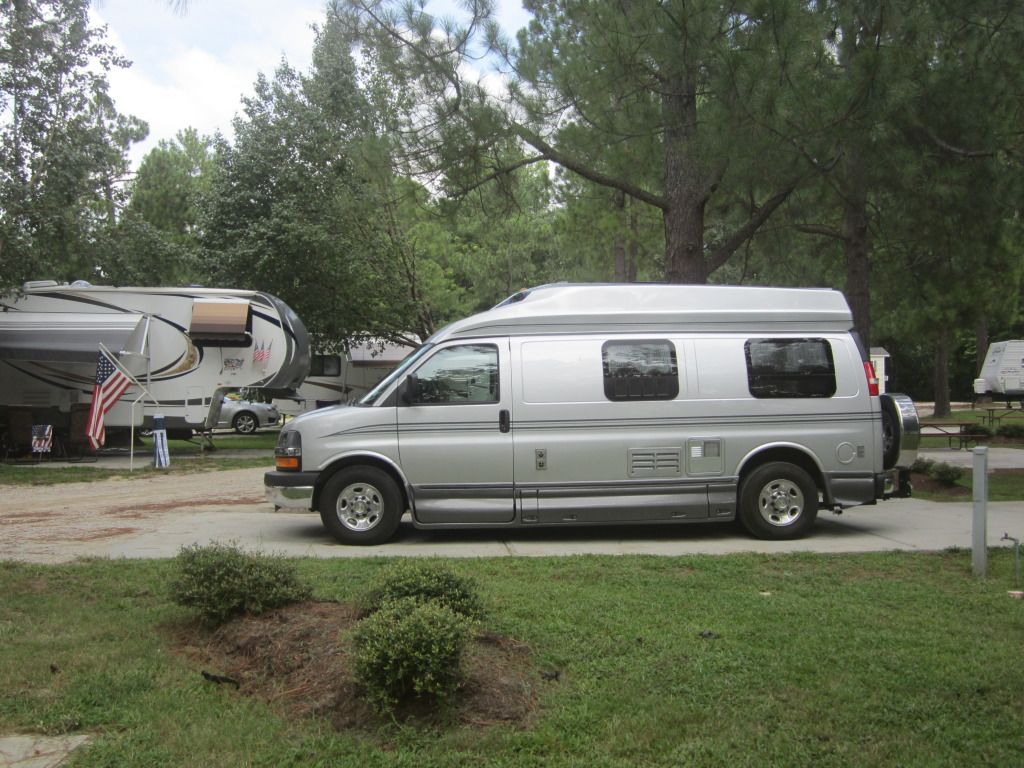
Directly off Route 64 in Williamsburg is American Heritage Campground which is our campground of choice in Williamsburg. I have written about this campground before and there is not really anything to add - though the space that we were assigned was not as level as the other spaces that we have had here in the past. When I backed into the space I found a place on the cement pad that was close, but just off to the passenger side. Other spots on the pad that I tried were way off. Looking later at the cement, it could be seen that it had sunk down toward the left side looking head in. I had an idea to somehow mark the spot that I found that was level - and this should not be hard on the cement.  We put down three twigs as a temporary marking. One at the side of the front driver's side wheel, one at the side of the rear driver's side wheel, and one at the back of that same wheel.That night, I bought a box of sidewalk chalk - which washes away completely with water - or the rain (which we later in our stay saw for ourselves). That night I came as close to the twigs as possible. With the chalk we marked the same locations we had placed the twigs. The markings remained for the stay - until it rained heavily one night toward the end.  The chalk idea works - if you are on a cement or asphalt pad site. It does not work on gravel. (I will share my new and improved marking system in a later article.)

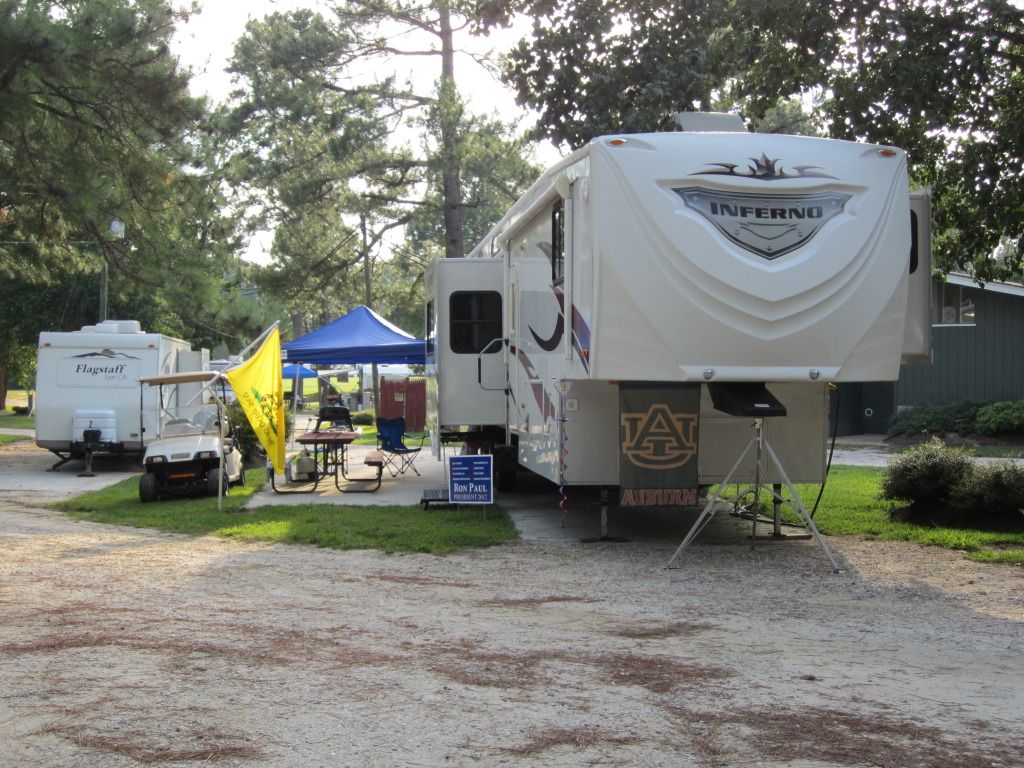
One of the many nice things about American Heritage Campground in Williamsburg is the nice landscaping around the spaces. Spaces also have shade trees - though at this campground you do not get the atmosphere of camping in the middle of the woods. That is fine with us. But many here - more here than the other campgrounds we have been too - do their own decoration of their sites. Some really to extremes. This was the site directly across from us. And you can see in the photo all that he has put out - including a political sign (in August well before the elections). If one is traveling to an area where there is little to do in the way of local attractions, I could understand making a comfortable place to be during the day at the campground, but here in Williamsburg there is nothing but attractions to fill all of your time. At this campground and a couple of others we see people spending the day sitting outside of their RVs or trailers and spending the day there. If they were walking a nature trail or this was off in the forest surrounded by nature, or there were tennis courts or a golf course, I might even understand that - but they seem to spend the day looking at the view - which is the trailer or RV next to or across from them. And the golf carts! In the photo you see off the the left a golf cart. No he did not bring that with him. You can rent these at many campgrounds. This campground is not so large that there is nothing that the campground has to offer that is not within very fast and easy walking distance.  The building behind his fifth-wheel trailer is the bathroom/shower building. So certainly, there was no need for a golf cart to get there. No, you can't take the golf cart off the campground property so there is on traveling out that is possible with it.  I really don't understand the golf carts.

American Heritage Campground Sites
We spent our time here for the most part at Colonial Williamsburg (CW for those who work there and come there often). Because we were were here for ten nights, I had also planned to go to a few other area attractions. As you will recall from Part I - the weather forecast every day though this trip was "Scattered Showers and Isolated Thunderstorms". Each morning it became a routine - get up, look out the window (the Roadtrek skylights in the front make this easy) and check the weather for the day. Each day was overcast. The question was - would it rain. And if it might rain, would we want to go somewhere and pay an admission to an outdoor attraction in the rain. It was one of those trips where you just wanted to yell at the sky and say "I am on my vacation, make the sun come out!" - it  didn't work. We spent each day at Colonial Williamsburg with one day at Jamestowne Settlement. On two of those days at CW, it was actually pouring.

I know of a little known parking area for Colonial Williamsburg that is usually empty and easy for RVs  to park in - even those larger than our Roadtreks. I have thought about whether I am just going to share the location of this parking lot - and I have decided not to. Contact me only by email if you would like to know where it is. On one of the raining mornings we parked at this lot and started out with our fold up rain jackets on. Just because it is raining, does not mean that the temperature is cool and the rain just increased the humidity on this already hot day. As we walked around Colonial Williamsburg, it was just too hot to wear the jacket and just as we were peeling them off - the rain stopped and the sun actually peeked through the clouds. The next time it actually did rain, it was pouring and this time it did not stop. We spent the day inside CW's museum building - after waiting a considerable time for the rain to at least let up enough to go outside the Roadtrek and disconnect the electric  cable from the campground outlet without getting electrocuted. Raining or not - always click the campground outlet's circuit breaker OFF before removing your plug. The circuit breaker is generally right above your outlet and it is marked "30 AMP". Do this also when plugging in - turn it ON only after you have plugged in. There are free lockers in the museum and we stashed our rain jackets there and spent a nice dry afternoon inside. The rain was so severe that day that there was heavy flooding within twenty miles of where we were.

I am not going to go into detail about Colonial Williamsburg but I will say that last year, I was not happy to see the overemphasis on "production-like" programs without any real interaction with the public. This year that has changed - at least a little. And we spent time talking one on one with several "people of the past" during programs. We, actually spent a lot of time attending programs - something that has not been offered as much in several years. Despite the uncertainty of the weather, we had a very good time in Colonial Williamsburg. Here are some photos -

People you might see -

Patrick Henry


Thomas Jefferson

General Geoge Washingon and Staff

British General Benedict Arnold who led the British troops to capture Williamsburg in 1781

Building a mold to cast a brass cannon

I usually don't talk about where we eat when we are traveling but we had dinner in a restaurant in Williamsburg that I just have to share. The name of the restaurant is Pierces Pit Bar-Be-Cue and it is located at  447 East Rochambeau in Williamsburg, Virginia. The food is - barbecue - and I had some of the most wonderful ribs and pulled pork that I have ever had. It is said that really good ribs are fall off the bone ribs - and the bone came out clean from these ribs. The sauce was not to overwhelming or excessively sweet. This is not a waitress restaurant. You order at a counter and wait for your number to be called to pick up your food. There are tables both inside and outside to sit at. There is extra sauce at a counter and soda machines to fill and refill your soda cup.  I have been to regular restaurants for ribs, but these have been for the most part, chain barbecue restaurants. Pierces is not a chain - and everyone local knows about it. Expect to wait on line before you get up to the counter.  It is worth the wait.
 
We left American Heritage on our last day and headed north toward Mount Vernon which was our next attraction stop. We would be not be staying over night there, but would be moving on from there to Pennsylvania for a few days before we headed home. 

As I said, we did go to Jamestown Settlement and I will write about that in two weeks. I will write about Mount Vernon - and our exciting ride in the Roadtrek in a bad storm to get there, after that. Next week we will take a little detour to a mod I made while in Virginia.


Wednesday, January 4, 2012

Grand Illumination at Colonial Williamsburg

The main attraction for our trip in our Roadtrek to Colonial Williamsburg in December 2011 was to return to Colonial Williamsburg's annual event - Grand Illumination. It was a British custom to celebrate significant events with an Illumination - the lighting and display of candles in the windows of homes and public buildings. Very special events would be accompanied by fireworks. Among the events that would receive such honor was the celebration of the King's birthday. And since the early days of the Colonial Williamsburg restoration, the historic area of the city has celebrated the birthday of the "King of Kings" with an Illumination - accompanied by the decoration of the homes and buildings in Colonial Williamsburg with elaborate wreathes and greens.

Grand Illumination takes place on the Sunday of the first full weekend in December. The historic area is decked out in natural decorations - you won't see a plastic Santa Claus anywhere. The decorations must be made and represent only things that would have existed in the 18th Century. Now, it is important to understand that the decorations that you see are not historically correct to the 18th Century - when, if any decorations at all were put up, they would have been simple greens hung inside on a window or wall. What you are seeing are decorations that are a traditional Southern style. These are wreathes of greens and fruits and other natural things. But it is lavish and very much what one would like for a traditional Christmas celebration. It attracts tens of thousands every year and the high point is the actual Grand Illumination with fireworks at three locations in the historic area that are set off simultaneously. It is possible to stand in one place and see the same fireworks in the sky in three directions! To say the least, it is very impressive.

We have been going to Grand Illumination since 1996, but this was interrupted for two years when our traveling stopped. With the Roadtrek, we knew we were going back again! Read the last two articles for the details of the trip itself.

The colonial city begins to be decorated just before Thanksgiving and the decorations stay up until after Christmas and New Years Day. The day of the Grand Illumination is always a Sunday and as I said, is the first full weekend in the month of December. That day at about 3 pm things start happening on the street. Colonial performers move up and down Duke of Gloucester Street playing music. You encounter colonial citizens of the city as they walk about. You may see acrobats. Everything is a delight and great fun! Since the morning the number of tourists increase exponentially. Thousands come in for this event. Since everything takes place outside no ticket is required to come, watch, and enjoy. Parking gets to be difficult as the day progresses so this is a day to come early and plan to stay late. There are stages set up at four locations around the city - one on two sides of the Capitol, one at the Palace Green directly in front of the Governor's Palace, and one on Market Square at the Magazine. At around 5:30 pm entertainment is presented on each stage. The acts this year moved from stage to stage so you saw the same entertainment no matter where you were. Years past the acts varied from stage to stage. The fireworks go off when it is dark - and they are spectacular! After the fireworks, things get a bit crazy as you are in a crowd of over 30,000. It is a time to hold onto your family and make your way to the center of Duke of Gloucester Street where two marching fife and drum corps will come from two directions and meet in the middle - all lit by carried torches. This signifies the end of the ceremonies for the day.

Now, I want to share with y0u some of the things that we saw and I will do that through the photos that I took on this trip. What you are seeing are the decorations, the main street in Colonial Williamsburg - Duke of Gloucester Street, and some of the people who work at Colonial Williamsburg who come out in 18th Century persona to bring history to life as it was just before the American Revolution during the Christmas season.