I have been going to Colonial Williamsburg for over 50 years and have seen many changes over those years. Meryl and I started going to CW - as called by those who work there and those who have a special relationship to Colonial Williamsburg - when we were first married and have gotten there almost every year since. We had not been able to get there last year and I have not written about it here since the first year that we had the Roadtrek. Things have changed since then and it is time for another article.
From where we live - by routings - the trip should take eight hours including stops for lunch and dinner. With construction and traffic the trip can take almost 12 hours and while we have done this straight through it is not the best idea to do. A stop in PA and move on the next day for the rest of the trip. I take what many would consider the wrong way to go. We go on 95, around Baltimore to avoid propane restricted tunnels - which some claim you can go through and some claim you cannot - so we just go around and take the bridge - if we are not stopping in PA first. Then it is 95 to the Capital Beltway and around DC back to 95 and straight down until the Richmond bypass and then onto Rt. 60 which takes you right to CW and the campground that we prefer. We have rarely gotten stuck around Baltimore and we have never had a problem around DC. The problem comes in before Fredericksburg and approaching the bypass around Richmond. Many have shared what they feel are better routes - all of which take one way around and way out of the way - and when looking at travel times for these routes come out to be the same time as dealing with the traffic - but you are moving along through the many more miles. Anyway - the unpopular 95 has worked for us before and since the Roadtrek. It also brings us to a gas station that has always had the lowest price gas of any in that area or any other that we go through - both traveling and at home. I don't know why this is with this station but it has been this way for years. We paid $1.94 here in August when gas at home was still near $2.60 and was not much better anywhere else that we traveled through. Hmm... wondering what it is right now - quick check with Gas Buddy and its $1.88 (Oh my!). (This is at the time of this writing 9/30/15.) Here it is still well over $2.00. (I get real excited when I see low gas prices!) So moving on - cheap gas that actually lasts and is not gone after 100 miles - to getting to the campground.
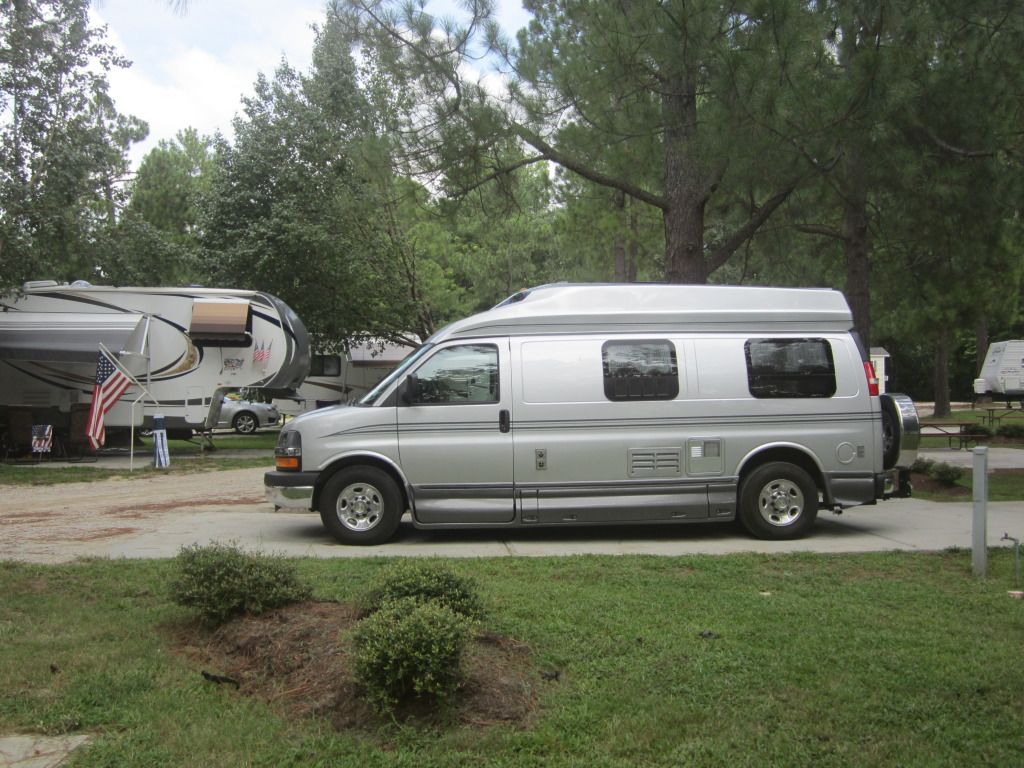
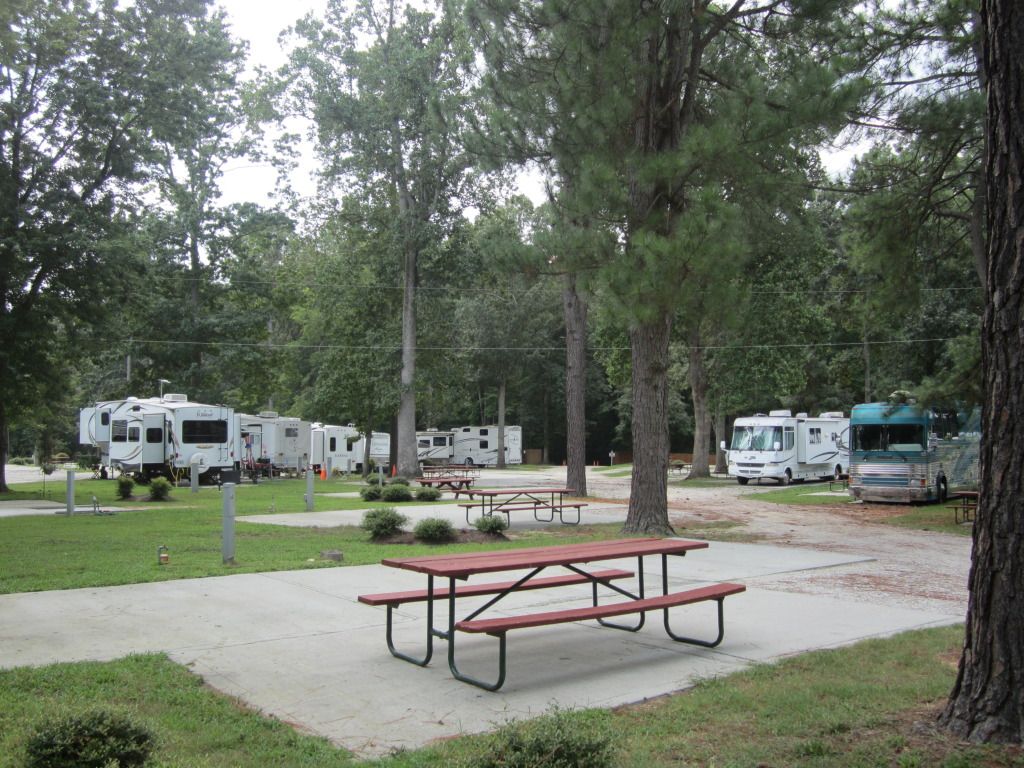
We stay at American Heritage campground in Williamsburg, VA. It is reasonable and is the nicest campground of any that we have ever been to. Every site is a paved, level site. The cable television selection is better than most and the wifi is very good. We don't use it but there is a swimming pool and also sports fields and a hiking trail into the woods. It is situated off the road and you do not hear the road noise.
So, on to Colonial Williamsburg. If you have never been there or don't know at all what it is, CW was built in the 1930s with Rockefeller money. Rockefeller was enticed to spend his wealth by the pastor of the local and historic Anglican church who had a vision of restoring a sleepy college city back to what it looked like in the 18th Century. Many of the buildings remained. Well, Rockefeller with the help of Rev. Goodwin's influence bought the whole town - well just about the whole town as there were a few holdouts and they were just built around. They created Williamsburg as it was with archaeologists and researchers and specialist architects and did so with 18 Century building techniques. What you see today is coming on 100 years old on its own in a not a very long time. What you see, go into and are surrounded by are restored or reconstructed homes, public buildings, and trades shops populated with people of the past - living history interpreters that bring the city of the 18th Century back to life. It is all around you and if you let yourself be drawn in, you are part of it. It is time travel - and for the serious visitor - meaning not the family or couple who come in for the afternoon on their way to the amusement park, walk the streets and don't buy a ticket to experience what goes on inside and areas outside not on the street and look and leave - it can be an experience like none other.
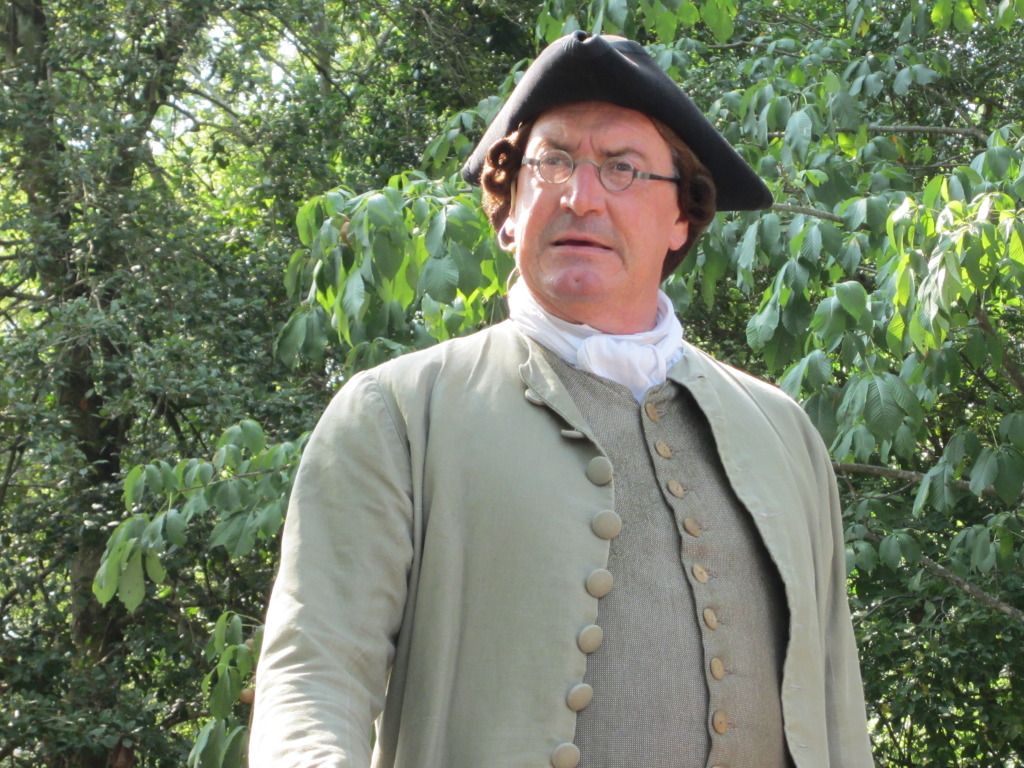
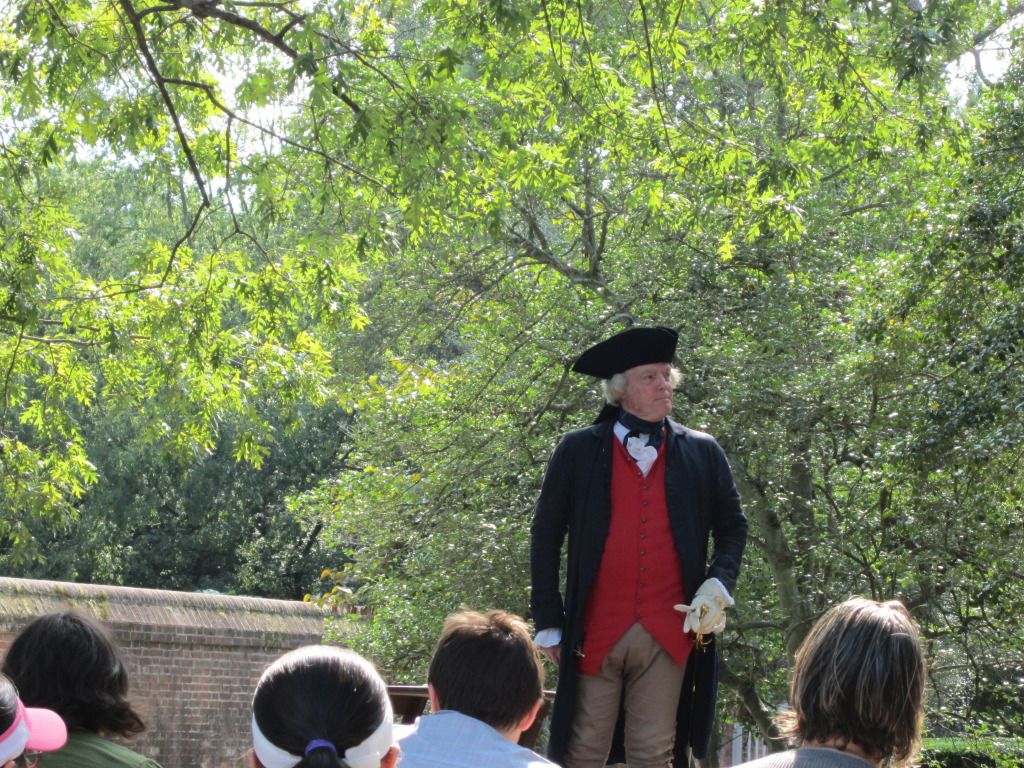
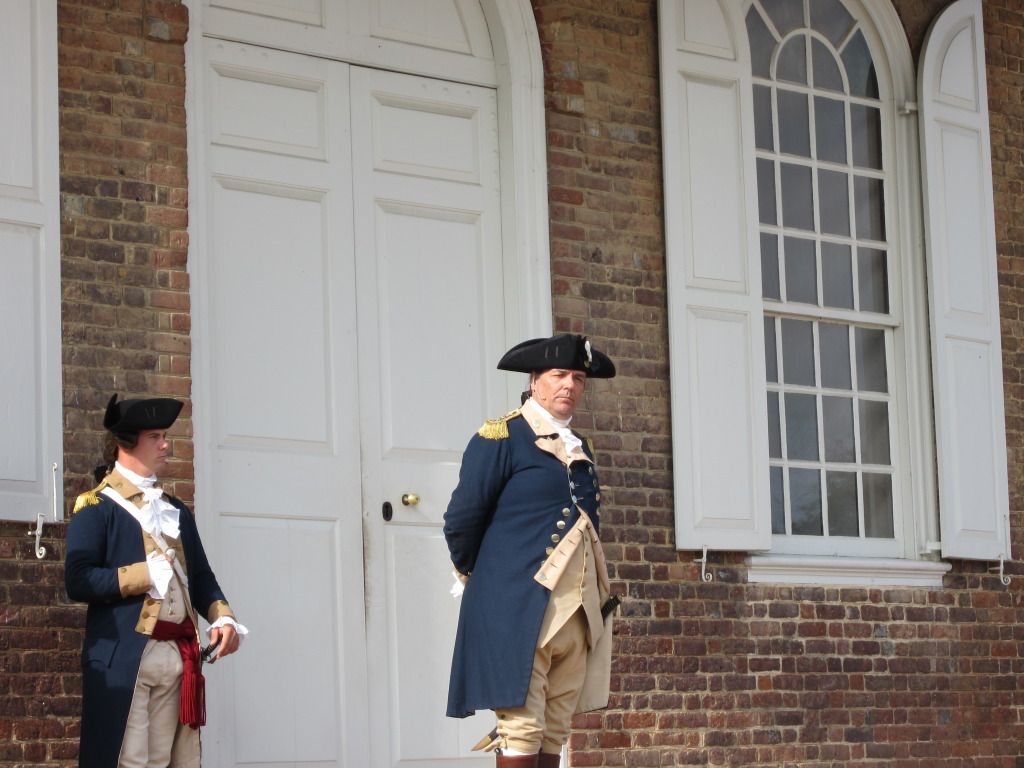
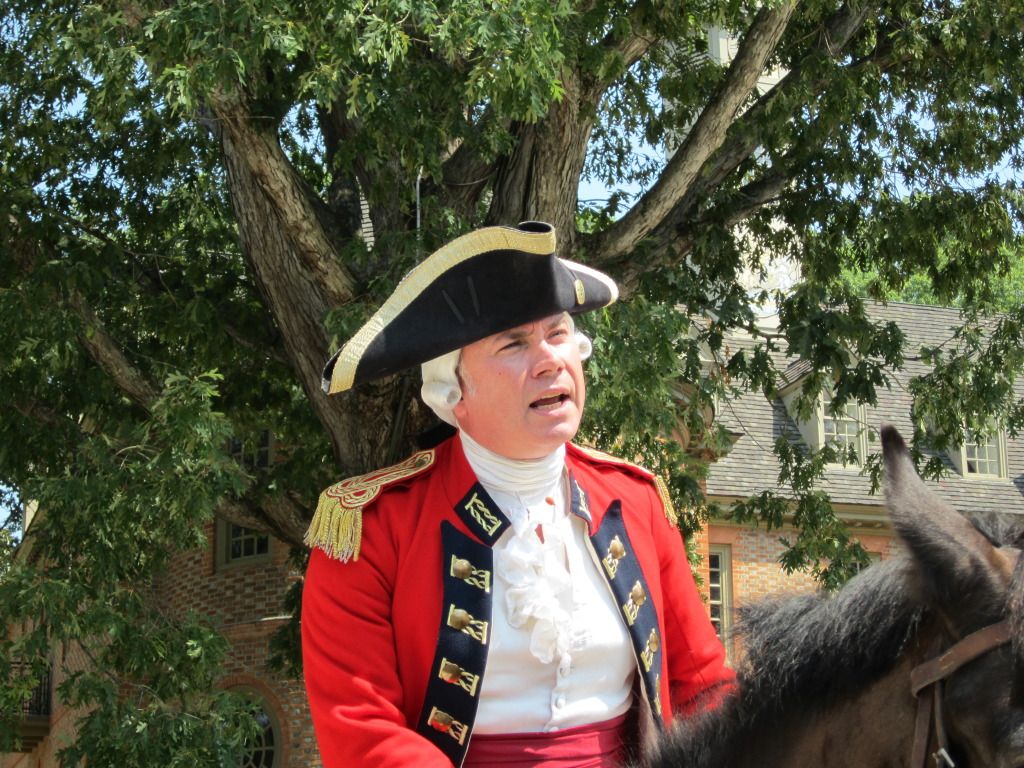
In CW you will encounter every day people of the past, trades and workmen - men and women, and some people who you may recall from history lessons long ago - Patrick Henry, Thomas Jefferson, George Washington - to name a few. These are not people in costumes walking around as in Disney parks - these are historians who have taken their interpretations to the highest levels of research and will convincingly portray these people of the past so that you will come away believing that you have met the real thing.
Since my last article some things have changed. I spoke then of the Revolutionary City program which at that time was spread over three days. Since that program has gone from three days to two days to now a part of one day. These are scenes of events that took place in the city of Williamsburg in various years during and before the American Revolution. The focus this year has been 1781 - the year leading up to Washington's victory over the British at Yorktown, Virgina just several miles from Williamsburg. The year will change next year, and the next year, etc. Added in the day in the afternoon were outdoor, staged programs about other events that took place in the city - most on a more personal basis between people who lived in the city in the 18th Century.
There has been some construction going on as research showed that a "Market House" existed on a stretch of property that has been left open. The CW team of archaeologists did a dig and found traces of the posts that supported this open air structure along with a small building that was also found in the research. It has taken three years to complete the research, build the buildings using historic tools and methods and it is about to open to the public this Fall.
This is where people would go to do their food shopping - no, not everyone grew their own. There was a market place that would open early in the morning and some would have stands inside the Market House structure and others would sell from blankets around the outside. You would go to buy vegetables, fruits, fish, and meats. One needed to get there early to get the best cuts and the best choices. When opened it will be interpreted both as an historic site and also be used as a sales site.
This is the newest - some of the photos below are the oldest. The Capitol Building - the building that housed the legislative body of the House of Burgesses where Washington, Jefferson, Henry all served as Burgesses. The Capitol is a reconstructed building built on the original foundation.
Duke of Gloucester Street - the main street of the colonial city - full of trades shops, taverns, and residences.
A tavern in the 18th Century is not only a place to go to enjoy a rum or punch but also is a place to dine and/or sleep.
You will also find the homes of some patriots who were very famous in their time but little taught in history books today - unless you live in Virginia. This is the home of Peyton Randolph - the President of the First Continental Congress and the President of the Second Continental Congress until his death while in Philadelphia at the beginning of the proceedings. He was highly respected throughout the Colonies and would have been, it is felt, the first President of the United States had he lived.
In the trades shops and yards you get to see and interact with those everyday people who helped make things happen. This is the yard of the Wheelwright's shop.
One of the staged programs - this looks at a serious situation of a woman about to be married who realizes as we watch the short encounter with the aunt of her fiance that she will not be able to bring both her personal servant (slave) and that servant's child with her to her marriage. There are many programs presented that make very real to us the realities of life in this time.
For us this is always a great trip. We had the pleasure to be able to talk with old friends who work at CW who we have met over the years and we also met, by surprise, friends from home that were there visiting as we were who are fellow members in our reenacting unit.
If you have an interest in history this is a must visit. When you arrive buy a multi-day ticket. It is now good for any number of days from the date of purchase to the end of the calendar year. It takes a minimum of three days to see enough of Colonial Williamsburg to come away with an appreciation for it. Less and you barely scrape the surface. There are also many other historic places to visit in this area and I will write articles about our visits to those soon as well. We spent 9 nights and ten days here this year. We have stayed longer. It is open all year. From January through February there are fewer programs but all buildings remain open. There is RV parking at the Visitors Center and shuttle buses or a walking trail to the historic area . I have a secret parking place to park the Roadtrek that I am thinking now I better keep to myself...
Colonial Williamsburg
Our travels in and life with a 2011 Roadtrek 190 Popular. An adventure in RVing by two people who have never been inside an RV or travel trailer before but find out of necessity that this is now their method of travel... In addition to our travels, you will find here many how to's about the Roadtrek and RVing in general, presented in a clear and concise way that are easy to follow - why reinvent the wheel when someone has done it before! DON'T PANIC
Roadtrek
Showing posts with label American Heritage Campground. Show all posts
Wednesday, October 14, 2015
Wednesday, October 24, 2012
How I Spent My Summer Roadtrek Vacation, Part III
We left Monticello and started directly for out next stop - Williamsburg, Virginia. Monticello to Williamsburg is a direct route east on Route 64 with a bypass around the city of Richmond on Route 295 and then back on to Route 64. The trip is all of two hours and there is not much of a concern about traffic.
Directly off Route 64 in Williamsburg is American Heritage Campground which is our campground of choice in Williamsburg. I have written about this campground before and there is not really anything to add - though the space that we were assigned was not as level as the other spaces that we have had here in the past. When I backed into the space I found a place on the cement pad that was close, but just off to the passenger side. Other spots on the pad that I tried were way off. Looking later at the cement, it could be seen that it had sunk down toward the left side looking head in. I had an idea to somehow mark the spot that I found that was level - and this should not be hard on the cement. We put down three twigs as a temporary marking. One at the side of the front driver's side wheel, one at the side of the rear driver's side wheel, and one at the back of that same wheel.That night, I bought a box of sidewalk chalk - which washes away completely with water - or the rain (which we later in our stay saw for ourselves). That night I came as close to the twigs as possible. With the chalk we marked the same locations we had placed the twigs. The markings remained for the stay - until it rained heavily one night toward the end. The chalk idea works - if you are on a cement or asphalt pad site. It does not work on gravel. (I will share my new and improved marking system in a later article.)
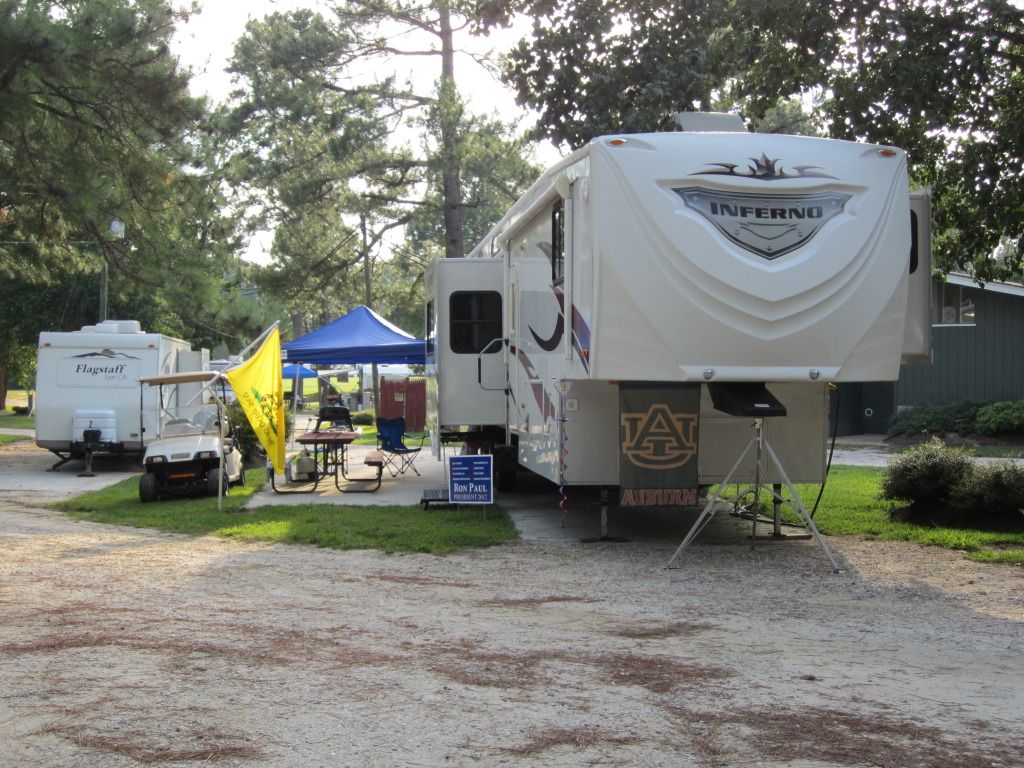
One of the many nice things about American Heritage Campground in Williamsburg is the nice landscaping around the spaces. Spaces also have shade trees - though at this campground you do not get the atmosphere of camping in the middle of the woods. That is fine with us. But many here - more here than the other campgrounds we have been too - do their own decoration of their sites. Some really to extremes. This was the site directly across from us. And you can see in the photo all that he has put out - including a political sign (in August well before the elections). If one is traveling to an area where there is little to do in the way of local attractions, I could understand making a comfortable place to be during the day at the campground, but here in Williamsburg there is nothing but attractions to fill all of your time. At this campground and a couple of others we see people spending the day sitting outside of their RVs or trailers and spending the day there. If they were walking a nature trail or this was off in the forest surrounded by nature, or there were tennis courts or a golf course, I might even understand that - but they seem to spend the day looking at the view - which is the trailer or RV next to or across from them. And the golf carts! In the photo you see off the the left a golf cart. No he did not bring that with him. You can rent these at many campgrounds. This campground is not so large that there is nothing that the campground has to offer that is not within very fast and easy walking distance. The building behind his fifth-wheel trailer is the bathroom/shower building. So certainly, there was no need for a golf cart to get there. No, you can't take the golf cart off the campground property so there is on traveling out that is possible with it. I really don't understand the golf carts.
We spent our time here for the most part at Colonial Williamsburg (CW for those who work there and come there often). Because we were were here for ten nights, I had also planned to go to a few other area attractions. As you will recall from Part I - the weather forecast every day though this trip was "Scattered Showers and Isolated Thunderstorms". Each morning it became a routine - get up, look out the window (the Roadtrek skylights in the front make this easy) and check the weather for the day. Each day was overcast. The question was - would it rain. And if it might rain, would we want to go somewhere and pay an admission to an outdoor attraction in the rain. It was one of those trips where you just wanted to yell at the sky and say "I am on my vacation, make the sun come out!" - it didn't work. We spent each day at Colonial Williamsburg with one day at Jamestowne Settlement. On two of those days at CW, it was actually pouring.
I know of a little known parking area for Colonial Williamsburg that is usually empty and easy for RVs to park in - even those larger than our Roadtreks. I have thought about whether I am just going to share the location of this parking lot - and I have decided not to. Contact me only by email if you would like to know where it is. On one of the raining mornings we parked at this lot and started out with our fold up rain jackets on. Just because it is raining, does not mean that the temperature is cool and the rain just increased the humidity on this already hot day. As we walked around Colonial Williamsburg, it was just too hot to wear the jacket and just as we were peeling them off - the rain stopped and the sun actually peeked through the clouds. The next time it actually did rain, it was pouring and this time it did not stop. We spent the day inside CW's museum building - after waiting a considerable time for the rain to at least let up enough to go outside the Roadtrek and disconnect the electric cable from the campground outlet without getting electrocuted. Raining or not - always click the campground outlet's circuit breaker OFF before removing your plug. The circuit breaker is generally right above your outlet and it is marked "30 AMP". Do this also when plugging in - turn it ON only after you have plugged in. There are free lockers in the museum and we stashed our rain jackets there and spent a nice dry afternoon inside. The rain was so severe that day that there was heavy flooding within twenty miles of where we were.
I am not going to go into detail about Colonial Williamsburg but I will say that last year, I was not happy to see the overemphasis on "production-like" programs without any real interaction with the public. This year that has changed - at least a little. And we spent time talking one on one with several "people of the past" during programs. We, actually spent a lot of time attending programs - something that has not been offered as much in several years. Despite the uncertainty of the weather, we had a very good time in Colonial Williamsburg. Here are some photos -
People you might see -
I usually don't talk about where we eat when we are traveling but we had dinner in a restaurant in Williamsburg that I just have to share. The name of the restaurant is Pierces Pit Bar-Be-Cue and it is located at 447 East Rochambeau in Williamsburg, Virginia. The food is - barbecue - and I had some of the most wonderful ribs and pulled pork that I have ever had. It is said that really good ribs are fall off the bone ribs - and the bone came out clean from these ribs. The sauce was not to overwhelming or excessively sweet. This is not a waitress restaurant. You order at a counter and wait for your number to be called to pick up your food. There are tables both inside and outside to sit at. There is extra sauce at a counter and soda machines to fill and refill your soda cup. I have been to regular restaurants for ribs, but these have been for the most part, chain barbecue restaurants. Pierces is not a chain - and everyone local knows about it. Expect to wait on line before you get up to the counter. It is worth the wait.
We left American Heritage on our last day and headed north toward Mount Vernon which was our next attraction stop. We would be not be staying over night there, but would be moving on from there to Pennsylvania for a few days before we headed home.
As I said, we did go to Jamestown Settlement and I will write about that in two weeks. I will write about Mount Vernon - and our exciting ride in the Roadtrek in a bad storm to get there, after that. Next week we will take a little detour to a mod I made while in Virginia.
One of the many nice things about American Heritage Campground in Williamsburg is the nice landscaping around the spaces. Spaces also have shade trees - though at this campground you do not get the atmosphere of camping in the middle of the woods. That is fine with us. But many here - more here than the other campgrounds we have been too - do their own decoration of their sites. Some really to extremes. This was the site directly across from us. And you can see in the photo all that he has put out - including a political sign (in August well before the elections). If one is traveling to an area where there is little to do in the way of local attractions, I could understand making a comfortable place to be during the day at the campground, but here in Williamsburg there is nothing but attractions to fill all of your time. At this campground and a couple of others we see people spending the day sitting outside of their RVs or trailers and spending the day there. If they were walking a nature trail or this was off in the forest surrounded by nature, or there were tennis courts or a golf course, I might even understand that - but they seem to spend the day looking at the view - which is the trailer or RV next to or across from them. And the golf carts! In the photo you see off the the left a golf cart. No he did not bring that with him. You can rent these at many campgrounds. This campground is not so large that there is nothing that the campground has to offer that is not within very fast and easy walking distance. The building behind his fifth-wheel trailer is the bathroom/shower building. So certainly, there was no need for a golf cart to get there. No, you can't take the golf cart off the campground property so there is on traveling out that is possible with it. I really don't understand the golf carts.
| American Heritage Campground Sites |
I know of a little known parking area for Colonial Williamsburg that is usually empty and easy for RVs to park in - even those larger than our Roadtreks. I have thought about whether I am just going to share the location of this parking lot - and I have decided not to. Contact me only by email if you would like to know where it is. On one of the raining mornings we parked at this lot and started out with our fold up rain jackets on. Just because it is raining, does not mean that the temperature is cool and the rain just increased the humidity on this already hot day. As we walked around Colonial Williamsburg, it was just too hot to wear the jacket and just as we were peeling them off - the rain stopped and the sun actually peeked through the clouds. The next time it actually did rain, it was pouring and this time it did not stop. We spent the day inside CW's museum building - after waiting a considerable time for the rain to at least let up enough to go outside the Roadtrek and disconnect the electric cable from the campground outlet without getting electrocuted. Raining or not - always click the campground outlet's circuit breaker OFF before removing your plug. The circuit breaker is generally right above your outlet and it is marked "30 AMP". Do this also when plugging in - turn it ON only after you have plugged in. There are free lockers in the museum and we stashed our rain jackets there and spent a nice dry afternoon inside. The rain was so severe that day that there was heavy flooding within twenty miles of where we were.
I am not going to go into detail about Colonial Williamsburg but I will say that last year, I was not happy to see the overemphasis on "production-like" programs without any real interaction with the public. This year that has changed - at least a little. And we spent time talking one on one with several "people of the past" during programs. We, actually spent a lot of time attending programs - something that has not been offered as much in several years. Despite the uncertainty of the weather, we had a very good time in Colonial Williamsburg. Here are some photos -
People you might see -
| Patrick Henry |
| Thomas Jefferson |
| General Geoge Washingon and Staff |
| British General Benedict Arnold who led the British troops to capture Williamsburg in 1781 |
| Building a mold to cast a brass cannon |
I usually don't talk about where we eat when we are traveling but we had dinner in a restaurant in Williamsburg that I just have to share. The name of the restaurant is Pierces Pit Bar-Be-Cue and it is located at 447 East Rochambeau in Williamsburg, Virginia. The food is - barbecue - and I had some of the most wonderful ribs and pulled pork that I have ever had. It is said that really good ribs are fall off the bone ribs - and the bone came out clean from these ribs. The sauce was not to overwhelming or excessively sweet. This is not a waitress restaurant. You order at a counter and wait for your number to be called to pick up your food. There are tables both inside and outside to sit at. There is extra sauce at a counter and soda machines to fill and refill your soda cup. I have been to regular restaurants for ribs, but these have been for the most part, chain barbecue restaurants. Pierces is not a chain - and everyone local knows about it. Expect to wait on line before you get up to the counter. It is worth the wait.
We left American Heritage on our last day and headed north toward Mount Vernon which was our next attraction stop. We would be not be staying over night there, but would be moving on from there to Pennsylvania for a few days before we headed home.
As I said, we did go to Jamestown Settlement and I will write about that in two weeks. I will write about Mount Vernon - and our exciting ride in the Roadtrek in a bad storm to get there, after that. Next week we will take a little detour to a mod I made while in Virginia.
Labels:
190,
American Heritage Campground,
Chevrolet,
Chevy,
Class B,
motorhome,
parking,
Roadtrek,
tourist attraction,
traveling,
vacation,
Virginia,
Williamsburg
Wednesday, January 4, 2012
Grand Illumination at Colonial Williamsburg
The main attraction for our trip in our Roadtrek to Colonial Williamsburg in December 2011 was to return to Colonial Williamsburg's annual event - Grand Illumination. It was a British custom to celebrate significant events with an Illumination - the lighting and display of candles in the windows of homes and public buildings. Very special events would be accompanied by fireworks. Among the events that would receive such honor was the celebration of the King's birthday. And since the early days of the Colonial Williamsburg restoration, the historic area of the city has celebrated the birthday of the "King of Kings" with an Illumination - accompanied by the decoration of the homes and buildings in Colonial Williamsburg with elaborate wreathes and greens.Grand Illumination takes place on the Sunday of the first full weekend in December. The historic area is decked out in natural decorations - you won't see a plastic Santa Claus anywhere. The decorations must be made and represent only things that would have existed in the 18th Century. Now, it is important to understand that the decorations that you see are not historically correct to the 18th Century - when, if any decorations at all were put up, they would have been simple greens hung inside on a window or wall. What you are seeing are decorations that are a traditional Southern style. These are wreathes of greens and fruits and other natural things. But it is lavish and very much what one would like for a traditional Christmas celebration. It attracts tens of thousands every year and the high point is the actual Grand Illumination with fireworks at three locations in the historic area that are set off simultaneously. It is possible to stand in one place and see the same fireworks in the sky in three directions! To say the least, it is very impressive.
We have been going to Grand Illumination since 1996, but this was interrupted for two years when our traveling stopped. With the Roadtrek, we knew we were going back again! Read the last two articles for the details of the trip itself.
The colonial city begins to be decorated just before Thanksgiving and the decorations stay up until after Christmas and New Years Day. The day of the Grand Illumination is always a Sunday and as I said, is the first full weekend in the month of December. That day at about 3 pm things start happening on the street. Colonial performers move up and down Duke of Gloucester Street playing music. You encounter colonial citizens of the city as they walk about. You may see acrobats. Everything is a delight and great fun! Since the morning the number of tourists increase exponentially. Thousands come in for this event. Since everything takes place outside no ticket is required to come, watch, and enjoy. Parking gets to be difficult as the day progresses so this is a day to come early and plan to stay late. There are stages set up at four locations around the city - one on two sides of the Capitol, one at the Palace Green directly in front of the Governor's Palace, and one on Market Square at the Magazine. At around 5:30 pm entertainment is presented on each stage. The acts this year moved from stage to stage so you saw the same entertainment no matter where you were. Years past the acts varied from stage to stage. The fireworks go off when it is dark - and they are spectacular! After the fireworks, things get a bit crazy as you are in a crowd of over 30,000. It is a time to hold onto your family and make your way to the center of Duke of Gloucester Street where two marching fife and drum corps will come from two directions and meet in the middle - all lit by carried torches. This signifies the end of the ceremonies for the day.
Now, I want to share with y0u some of the things that we saw and I will do that through the photos that I took on this trip. What you are seeing are the decorations, the main street in Colonial Williamsburg - Duke of Gloucester Street, and some of the people who work at Colonial Williamsburg who come out in 18th Century persona to bring history to life as it was just before the American Revolution during the Christmas season.


Labels:
190,
American Heritage Campground,
campgrounds,
camping,
Chevrolet,
Class B,
motorhome,
Popular,
Roadtrek,
RV,
travel,
vacation,
Virginia,
Williamsburg,
winter
Wednesday, December 28, 2011
Our Final Trip of the Season - Part 2
We set off on a pleasant Thursday morning for Virginia. A few days before the trip I checked the air in the tires of the Roadtrek and decided to bring the front tires up to 60 psi. Roadtrek's manual recommends that the front tires be 50 psi and the rear tires always be kept at exactly 80 psi. I once spoke to Roadtrek and asked about the tire pressure and I was told that 50 psi in the front is where to start, but add 5 psi at a time up to 65 psi and no more and see how you like the ride. I have been keeping the front tires at 55 psi and the ride seemed fine. Many speak of keeping the front tires at 65 psi. Roadtrek had told me that the ride gets a bit rough at that, so I have not gone that far, but I wanted to try the tires at 60 psi. I have to tell you that many of the bumps and bangs have diminished greatly now that the tires are at 60 psi. The trip off Long Island on what must be the worst road surfaces in the country was a whole different and much smoother experience.
Anyway, we were off. No trip out of this area lately does not include stopping in traffic and it was almost an hour and a half to get to what should have been a forty five minute ride. Once we got on to the New Jersey Turnpike, despite the construction there, it was an open run. We were taking Interstate 95 almost all of the way. Many hate this route because of the traffic around Washington, D.C. on both sides of the city - especially if you get there between 4 and 7 for their three hour "rush hour". We were going to get into this no matter what and this was the most direct route to take.
We did have to diverge off of Route 95 when we approached Baltimore. No propane is permitted in the tunnel that travels under the city of Baltimore and that means getting off of I95. There are two ways to go - to the west of the city on I695, the Baltimore Beltway 0r around the east side of the city on the same I695. I asked on an RV travel and routes forum and everyone recommended taking the eastern route. We did and had no problems and we moved quickly through the Baltimore area taking one of the bridges to get to the south of Baltimore. If you are ever traveling this way, this is the route to take.
We approached Washington, D.C. without any traffic at all and went around the city on the Capital Beltway which is I495. It was approaching 4:00 pm. On the other side of Washington we were not so lucky and went directly into stop and go traffic. Our plan was to stop in Fredricksburg, Virginia for dinner which is about 40 miles south of D.C. and it took us more than two hours to get there. Of course, along the way between the two cities, Meryl needed to make a pit stop - and we were stuck in the middle lane with no way to move to the right lane in the bumper to bumper traffic. Let me explain, that the Roadtrek is a very long and large vehicle. It takes some planning to change lanes and the one thing that you never really want to do is make sudden changes - unless you wish to crash into the car that suddenly comes up out of nowhere in the lane next to you (and the way the mirrors work you will not always see a car along side in just the small blindspot that exists). In this case, there was just no way to get into the non-existent spaces between car bumpers along side of us. We did wind up passing the rest area, moving gradually over to the right when we could and then getting back on in the opposite direction to go back and try again.
We finally arrived in Fredricksburg and had dinner. This is where this great WaWa gas station is also. It always has the cheapest price for gas and this time I paid only $3.03 a gallon. This may not sound like a big deal to some but at home gas when we left was $3.57 and higher at most stations. And the Roadtrek takes A LOT of gas! (On the way home just a week later, the gas at this station had gone up six cents per gallon. Still good - but really, six cents in one week?!?)
Well, after dinner the road was finally clear and we headed south to the turn off that goes around Richmond and takes you to I64 which travels along the peninsula into the Tidewater that leads to Williamsburg. It was after 10 pm when we arrived at American Heritage Campground. The office closes much earlier and our space was posted on a bulletin board next to the front door. From the map I could see that the space was two down from the bathhouse. We traveled through the main road of the campground and counted rows to row 6. When we got to where the space was shown on the map we could not find a number for the space, but where we were was exactly where we should be. With a bit of maneuvering and guidance from Meryl I backed into the space.
When we were at this campground in the summer I found that the concrete pad spaces were perfectly level. I rolled back and forth on this pad to find the most level spot and found it - exactly level. This was important tonight because after we hooked up our electric and cable I wanted to install a pair of levels inside the front of the Roadtrek, one on the dash and the other on the inside of the door. Up to now we have been using a round level that we place on the only flat spot of the inside of the Roadtrek that we have found and that is between the seats and back on the enamel floor. It means leaning into the side door to see the bubble, move out again, and move the van until that bubble comes level. It has been a pain. To install levels inside, the Roadtrek must be on perfectly level ground - or made level. This spot, I knew, would be ideal for this and I came prepared with a pair of adhesive stick on levels. This would be an easier task if you are screwing the levels on and not using the adhesive, but I, at this point, was not into the idea of putting holes into my new Roadtrek. So with a great bit of maneuvering and adjusting I got the right left level on the middle of the dash (where you really cannot screw into anyway) and the other for front to back level - well, we tried a lot of spots for that and none were easily visible on the door. We wound up putting this on the cloth header above the driver's door. Perfect. I was so happy. For the rest of the trip - well, almost the rest of the trip - I could just glace up and on the dash and see that when I pulled in the Roadtrek was perfectly level. So you ask, why not the whole rest of the trip. Along the way, back north while still in Virginia, I glanced up at the level on the header and it was gone. The adhesive did not stick to the cloth very well. I figured it was lost out the door when we had opened it along somewhere that day - but when we stopped for dinner on the way, Meryl found it stuck to the back of my pants. No longer usable, but at least not lost. And, of course, I had to stop and buy another pair and get the RT level in the Pennsylvania campground, and put the front back level in some other spot where it would stick. We decided on the passenger door - where with a flashlight pointed at it, it would be visible from the driver's seat. And when we got home, I bought two stainless steel screws and screwed it place permanently.
A few tidbits about the trip. On the third day at the campground as we were about to leave in the morning, I realize why we could not find the number for the space that first night. It was on the back of the electric box. It was there because this was a pull through space. There was nothing but road in front of us or behind us. This discovery made it so easy to get into the space. No backing up - just pull straight in from the road behind. Now, we know to look for this type of thing.
About the toilet bags. First, they smell, even after use like vanilla sugar cookies - an odd, but interesting observation. They really worked well. We used the campground toilets before we settled in for the night and took care of all posterior business then. Once we closed ourselves in for the night, however, we did need to use the toilet for urination - several times (when you get older you will understand). We kept the same bag in the whole night -and I must admit that each morning it was quite full, but wearing gloves, I would remove it from the toilet and seal it up - get it outside immediately and add it to the garbage bag that we were leaving for the trash pick up. They had to wonder what was so heavy inside that garbage bag. It really was quite heavy when full - and it really never was completely full.
Before we left I had purchased - because of our unusual encounters with the weather this past season - an emergency broadcast weather radio that receives the NOAA forecasts and warnings. I had this with us and on just in case. The weather in Virginia was beautiful and just about every day went well over 60 degrees. Nights were warm enough that I did not need to turn on the heat most nights. We had been discussing whether we should stay on Tuesday in Williamsburg, as planned, and leave on Wednesday OR if we should leave on Tuesday. Before we left we learned that a commitment that we had with a local museum at home at which we do a holiday history program had changed dates and if we returned on Thursday night as planned, we would be out on Friday to do this program. We were thinking that perhaps this was pushing ourselves too much and it would be much more comfortable to be home on Wednesday night instead. When we paid for the nights at American Heritage, we told the woman at the desk that we might decide to leave on Tuesday and not Wednesday, but we wanted to keep it open. We paid for five nights instead of six and the space would be available to us if we wanted to add that sixth night. Nice! On Monday, I listened to the NOAH forecast - rain was expected on Tuesday night into Wednesday with flooding expected on the I95 corridor. That made our decision for us- we were leaving Tuesday. We would spend most of the day in Williamsburg and head off around 2 or 3 pm. This was a good decision because it was raining when we got to Pennsylvania (we had called ahead to change our reservation there). It was a better decision when I put on the NOAH radio in Pennsylvania and heard an emergency SNOW alert for Lancaster County to start on Wednesday evening at 7! Here we go again, in PA with snow on the way. OK - we were getting used to fast get away now. We spent part of the day in PA on Wednesday, had dinner for lunch at one of our favorite restaurants, and I was determined to be out of the snow zone before it started at 7:00 pm. It did snow - about four inches but we never saw a flake. We closed out our camping season true to form - with an unanticipated storm warning!
So how was Williamsburg? Come back next week to read all about Grand Illumination and Colonial Williamsburg in the Christmas Season!
Anyway, we were off. No trip out of this area lately does not include stopping in traffic and it was almost an hour and a half to get to what should have been a forty five minute ride. Once we got on to the New Jersey Turnpike, despite the construction there, it was an open run. We were taking Interstate 95 almost all of the way. Many hate this route because of the traffic around Washington, D.C. on both sides of the city - especially if you get there between 4 and 7 for their three hour "rush hour". We were going to get into this no matter what and this was the most direct route to take.
We did have to diverge off of Route 95 when we approached Baltimore. No propane is permitted in the tunnel that travels under the city of Baltimore and that means getting off of I95. There are two ways to go - to the west of the city on I695, the Baltimore Beltway 0r around the east side of the city on the same I695. I asked on an RV travel and routes forum and everyone recommended taking the eastern route. We did and had no problems and we moved quickly through the Baltimore area taking one of the bridges to get to the south of Baltimore. If you are ever traveling this way, this is the route to take.
We approached Washington, D.C. without any traffic at all and went around the city on the Capital Beltway which is I495. It was approaching 4:00 pm. On the other side of Washington we were not so lucky and went directly into stop and go traffic. Our plan was to stop in Fredricksburg, Virginia for dinner which is about 40 miles south of D.C. and it took us more than two hours to get there. Of course, along the way between the two cities, Meryl needed to make a pit stop - and we were stuck in the middle lane with no way to move to the right lane in the bumper to bumper traffic. Let me explain, that the Roadtrek is a very long and large vehicle. It takes some planning to change lanes and the one thing that you never really want to do is make sudden changes - unless you wish to crash into the car that suddenly comes up out of nowhere in the lane next to you (and the way the mirrors work you will not always see a car along side in just the small blindspot that exists). In this case, there was just no way to get into the non-existent spaces between car bumpers along side of us. We did wind up passing the rest area, moving gradually over to the right when we could and then getting back on in the opposite direction to go back and try again.
We finally arrived in Fredricksburg and had dinner. This is where this great WaWa gas station is also. It always has the cheapest price for gas and this time I paid only $3.03 a gallon. This may not sound like a big deal to some but at home gas when we left was $3.57 and higher at most stations. And the Roadtrek takes A LOT of gas! (On the way home just a week later, the gas at this station had gone up six cents per gallon. Still good - but really, six cents in one week?!?)
Well, after dinner the road was finally clear and we headed south to the turn off that goes around Richmond and takes you to I64 which travels along the peninsula into the Tidewater that leads to Williamsburg. It was after 10 pm when we arrived at American Heritage Campground. The office closes much earlier and our space was posted on a bulletin board next to the front door. From the map I could see that the space was two down from the bathhouse. We traveled through the main road of the campground and counted rows to row 6. When we got to where the space was shown on the map we could not find a number for the space, but where we were was exactly where we should be. With a bit of maneuvering and guidance from Meryl I backed into the space.
When we were at this campground in the summer I found that the concrete pad spaces were perfectly level. I rolled back and forth on this pad to find the most level spot and found it - exactly level. This was important tonight because after we hooked up our electric and cable I wanted to install a pair of levels inside the front of the Roadtrek, one on the dash and the other on the inside of the door. Up to now we have been using a round level that we place on the only flat spot of the inside of the Roadtrek that we have found and that is between the seats and back on the enamel floor. It means leaning into the side door to see the bubble, move out again, and move the van until that bubble comes level. It has been a pain. To install levels inside, the Roadtrek must be on perfectly level ground - or made level. This spot, I knew, would be ideal for this and I came prepared with a pair of adhesive stick on levels. This would be an easier task if you are screwing the levels on and not using the adhesive, but I, at this point, was not into the idea of putting holes into my new Roadtrek. So with a great bit of maneuvering and adjusting I got the right left level on the middle of the dash (where you really cannot screw into anyway) and the other for front to back level - well, we tried a lot of spots for that and none were easily visible on the door. We wound up putting this on the cloth header above the driver's door. Perfect. I was so happy. For the rest of the trip - well, almost the rest of the trip - I could just glace up and on the dash and see that when I pulled in the Roadtrek was perfectly level. So you ask, why not the whole rest of the trip. Along the way, back north while still in Virginia, I glanced up at the level on the header and it was gone. The adhesive did not stick to the cloth very well. I figured it was lost out the door when we had opened it along somewhere that day - but when we stopped for dinner on the way, Meryl found it stuck to the back of my pants. No longer usable, but at least not lost. And, of course, I had to stop and buy another pair and get the RT level in the Pennsylvania campground, and put the front back level in some other spot where it would stick. We decided on the passenger door - where with a flashlight pointed at it, it would be visible from the driver's seat. And when we got home, I bought two stainless steel screws and screwed it place permanently.
A few tidbits about the trip. On the third day at the campground as we were about to leave in the morning, I realize why we could not find the number for the space that first night. It was on the back of the electric box. It was there because this was a pull through space. There was nothing but road in front of us or behind us. This discovery made it so easy to get into the space. No backing up - just pull straight in from the road behind. Now, we know to look for this type of thing.
About the toilet bags. First, they smell, even after use like vanilla sugar cookies - an odd, but interesting observation. They really worked well. We used the campground toilets before we settled in for the night and took care of all posterior business then. Once we closed ourselves in for the night, however, we did need to use the toilet for urination - several times (when you get older you will understand). We kept the same bag in the whole night -and I must admit that each morning it was quite full, but wearing gloves, I would remove it from the toilet and seal it up - get it outside immediately and add it to the garbage bag that we were leaving for the trash pick up. They had to wonder what was so heavy inside that garbage bag. It really was quite heavy when full - and it really never was completely full.
Before we left I had purchased - because of our unusual encounters with the weather this past season - an emergency broadcast weather radio that receives the NOAA forecasts and warnings. I had this with us and on just in case. The weather in Virginia was beautiful and just about every day went well over 60 degrees. Nights were warm enough that I did not need to turn on the heat most nights. We had been discussing whether we should stay on Tuesday in Williamsburg, as planned, and leave on Wednesday OR if we should leave on Tuesday. Before we left we learned that a commitment that we had with a local museum at home at which we do a holiday history program had changed dates and if we returned on Thursday night as planned, we would be out on Friday to do this program. We were thinking that perhaps this was pushing ourselves too much and it would be much more comfortable to be home on Wednesday night instead. When we paid for the nights at American Heritage, we told the woman at the desk that we might decide to leave on Tuesday and not Wednesday, but we wanted to keep it open. We paid for five nights instead of six and the space would be available to us if we wanted to add that sixth night. Nice! On Monday, I listened to the NOAH forecast - rain was expected on Tuesday night into Wednesday with flooding expected on the I95 corridor. That made our decision for us- we were leaving Tuesday. We would spend most of the day in Williamsburg and head off around 2 or 3 pm. This was a good decision because it was raining when we got to Pennsylvania (we had called ahead to change our reservation there). It was a better decision when I put on the NOAH radio in Pennsylvania and heard an emergency SNOW alert for Lancaster County to start on Wednesday evening at 7! Here we go again, in PA with snow on the way. OK - we were getting used to fast get away now. We spent part of the day in PA on Wednesday, had dinner for lunch at one of our favorite restaurants, and I was determined to be out of the snow zone before it started at 7:00 pm. It did snow - about four inches but we never saw a flake. We closed out our camping season true to form - with an unanticipated storm warning!
So how was Williamsburg? Come back next week to read all about Grand Illumination and Colonial Williamsburg in the Christmas Season!
Labels:
American Heritage Campground,
campgrounds,
camping,
Chevrolet,
Chevy,
Class B,
motorhome,
Pennsylvania,
Popular,
Roadtrek,
RV,
travel,
vacation,
Virginia,
Williamsburg
Wednesday, December 21, 2011
Our Final Trip of the Season - Part 1
Before the Roadtrek and when we stayed in hotel rooms for a number of years we were going to Colonial Williamsburg in the beginning of December for their special holiday event, Grand Illumination. With the Roadtrek we could start doing this again - but with the uncertainty of the weather even in the beginning of December, we would have to do this with the Roadtrek winterized. We have been to Virginia on this weekend in years when the temperatures have been in the 70's (one year over 80) and other years the temperatures dropped into the low 20's. It is just to unpredictable to take a chance. We had the Roadtrek winterized a few weeks before.
We would be traveling without water and no water hookup when we got to the campground. This meant a different way to start thinking about traveling and we started planning for this trip back in September with what we would do - to go waterless. There are three basic needs for water. Drinking - easily taken care of with bottled water. Washing - also possible with bottled water and a basin to wash in. Toilet needs - that was the question. The campground has a bathhouse with toilets, sinks, and showers, but in the cold you don't really want to get up in the middle of the night to get dressed, walk out to the restroom, and then come back to go back to bed. Some will say that you can just use the toilet in the winter substituting anti-freeze for water to flush, but this still means dumping the tank and if the temps fall to freezing this is not an easy task with a cold macerator hose that is coiled up into a small compartment that will not move as freely as it does when it is warm. This was not a difficult puzzle to solve, because there are things made just for this purpose. The easiest is to purchase a supply of "wag bags". These are sold under various names in camping stores. Walmart sells two brands of these - one brand in the stores and a different brand online. These are intended to be used with a frame that has a toilet seat on top and you hang these bags below the seat. As it turns out these bags fit perfectly in the Roadtrek toilet.
Let me explain what these bags are, because even I did not believe there was such a thing when I first learned about them. This is a large silver color zip lock bag that has inside an even larger black plastic bag attached at the bottom. Inside that inner bag is a chemical or "bio-gell" that gells all liquid and solid waste and deodorizes it. What you do, is open the ziplock bag and carefully pull the inner bag out. You place that outer bag down into the Roadtrek toilet and then follow that with the fully open large inner bag. You gather the edges of the black bag around the edge of the toilet and put the seat down on top trapping the edges into place. You then reach in (its clean at this point! but I did use gloves as I did not know if the chemical inside would be a problem to come into contact with) and open the bag as much as possible pushing the sides against the toilet bowl. The bag is now ready for use. You can do whatever you need to do in the bag. When you are finished, you simply lift the toilet seat, gather the clean edges of the bag up and fold them over to close the inner black bag, and then let that bag go back into the attached outer bag. Zip the ziplock and dispose. The companies that make these claim that it is legal and safe to dispose of them in any garbage receptacle. There is no odor and they do not leak.
I had read that others do this with no problem and we decided that this is what we would try for this trip. As I said, Walmart does sell them in their camping department. They are not cheap - almost $11.00 for six bags. During the day we would use public restrooms or the restroom at the campground but at night after bed, if nature called, we would use the bag - pre-placed in the toilet. I began to find out as I looked in Walmarts for these bags that they are popular items and often sell out. I started buying boxes of bags in September. This trip would be for nine days and I was not certain how many we would need. Ultimately, I bought six boxes at various Walmarts - that was 36 bags all together. We could always return full boxes that were not opened and it was better to have them with us than find out that the local Williamsburg Walmart did not have them. I will talk about using these later on.
For drinking and washing we could use bottled water, but Meryl had the idea to get a Brita Water Dispenser. This is a small rectangular dispenser with a valve spout that filters water for drinking. With this we could use water just as we would from the sink faucet and we could fill the dispenser every night at the restroom of the campground (or the hose connection at our hookup). With the grey water tank winterized, we did not want to allow any water go down the sink drain, so we began looking for a plastic box with a lid that would fit perfectly in the sink. Meryl saw one that would be perfect in Lowes early on, but did not buy it for some reason. Of course, Lowes no longer carried this once we went back to purchase it. We looked all over including several stores when we where traveling in September and October for this box. On a trip to a Kmart we found the box - it is the Snapware Smart Store box that says on the label that it fits a 14" shelf. It fits inside the Roadtrek sink perfectly. The handled lid snaps tightly on. Meryl decided that by cutting a hole in one of the corners of the lid, once out of the sink the lid could be snapped on and it would be easy to carry the box without spilling so that we could empty it through the hole that we added in the lid into a sink at the bathhouse. This worked perfectly. We set up the Brita Dispenser on the side of the sink, spout pointing into the sink, with the Snapware box (no lid of course) in the sink to catch all of the water. Not only was this easy to put water into a cup (paper, of course) but it was easy to turn on the spout and wash your hands under the running water, all caught by the box without a drop over the side. Each morning, I simply lifted the box of water out of the sink, snapped the lid on and carried it out to dump. When we would leave for the morning we would place this box under the sink in the cabinet, and put the Brita Dispenser into the sink on a large towel to keep it from moving around (and catch any stray drips). Again, this all worked perfectly!
We were all set. We were heading for Williamsburg, Virginia for the first full weekend of December. I made my campground reservations early in October to be sure we had a space and I also requested a space near the restroom building. We would go for 7 nights in Virginia and one night on the way back in Lancaster just to break up the almost nine hour (longer with stops and traffic) trip. On the way down to Virginia we would do the trip on one run. My only concern was the weather. Last year had we had the Roadtrek and making this trip there was a large snow storm at home at this same time. I am not ready yet to deal with the Roadtrek in snow, so if that was the case again this year, I would cancel the reservations, forfeit the $10 to the campground in Williamsburg for canceling, and hope for better weather in 2012. And if you have been reading along on this site you know that we do not have the best of luck with weather - a ten foot blizzard would not have surprised me.
We were leaving on a Thursday. The festivities in Williamsburg take place on Sunday and we decided to extend our little winter vacation to return on the next Thursday. Happily, as we were leaving the weather was fine - and predictions were for good weather all along - and good temperatures as well. We were off to the American Heritage Campground in Williamsburg, Virginia.
END OF PART 1.
Come back next week for PART 2.
We would be traveling without water and no water hookup when we got to the campground. This meant a different way to start thinking about traveling and we started planning for this trip back in September with what we would do - to go waterless. There are three basic needs for water. Drinking - easily taken care of with bottled water. Washing - also possible with bottled water and a basin to wash in. Toilet needs - that was the question. The campground has a bathhouse with toilets, sinks, and showers, but in the cold you don't really want to get up in the middle of the night to get dressed, walk out to the restroom, and then come back to go back to bed. Some will say that you can just use the toilet in the winter substituting anti-freeze for water to flush, but this still means dumping the tank and if the temps fall to freezing this is not an easy task with a cold macerator hose that is coiled up into a small compartment that will not move as freely as it does when it is warm. This was not a difficult puzzle to solve, because there are things made just for this purpose. The easiest is to purchase a supply of "wag bags". These are sold under various names in camping stores. Walmart sells two brands of these - one brand in the stores and a different brand online. These are intended to be used with a frame that has a toilet seat on top and you hang these bags below the seat. As it turns out these bags fit perfectly in the Roadtrek toilet.
Let me explain what these bags are, because even I did not believe there was such a thing when I first learned about them. This is a large silver color zip lock bag that has inside an even larger black plastic bag attached at the bottom. Inside that inner bag is a chemical or "bio-gell" that gells all liquid and solid waste and deodorizes it. What you do, is open the ziplock bag and carefully pull the inner bag out. You place that outer bag down into the Roadtrek toilet and then follow that with the fully open large inner bag. You gather the edges of the black bag around the edge of the toilet and put the seat down on top trapping the edges into place. You then reach in (its clean at this point! but I did use gloves as I did not know if the chemical inside would be a problem to come into contact with) and open the bag as much as possible pushing the sides against the toilet bowl. The bag is now ready for use. You can do whatever you need to do in the bag. When you are finished, you simply lift the toilet seat, gather the clean edges of the bag up and fold them over to close the inner black bag, and then let that bag go back into the attached outer bag. Zip the ziplock and dispose. The companies that make these claim that it is legal and safe to dispose of them in any garbage receptacle. There is no odor and they do not leak.
I had read that others do this with no problem and we decided that this is what we would try for this trip. As I said, Walmart does sell them in their camping department. They are not cheap - almost $11.00 for six bags. During the day we would use public restrooms or the restroom at the campground but at night after bed, if nature called, we would use the bag - pre-placed in the toilet. I began to find out as I looked in Walmarts for these bags that they are popular items and often sell out. I started buying boxes of bags in September. This trip would be for nine days and I was not certain how many we would need. Ultimately, I bought six boxes at various Walmarts - that was 36 bags all together. We could always return full boxes that were not opened and it was better to have them with us than find out that the local Williamsburg Walmart did not have them. I will talk about using these later on.
For drinking and washing we could use bottled water, but Meryl had the idea to get a Brita Water Dispenser. This is a small rectangular dispenser with a valve spout that filters water for drinking. With this we could use water just as we would from the sink faucet and we could fill the dispenser every night at the restroom of the campground (or the hose connection at our hookup). With the grey water tank winterized, we did not want to allow any water go down the sink drain, so we began looking for a plastic box with a lid that would fit perfectly in the sink. Meryl saw one that would be perfect in Lowes early on, but did not buy it for some reason. Of course, Lowes no longer carried this once we went back to purchase it. We looked all over including several stores when we where traveling in September and October for this box. On a trip to a Kmart we found the box - it is the Snapware Smart Store box that says on the label that it fits a 14" shelf. It fits inside the Roadtrek sink perfectly. The handled lid snaps tightly on. Meryl decided that by cutting a hole in one of the corners of the lid, once out of the sink the lid could be snapped on and it would be easy to carry the box without spilling so that we could empty it through the hole that we added in the lid into a sink at the bathhouse. This worked perfectly. We set up the Brita Dispenser on the side of the sink, spout pointing into the sink, with the Snapware box (no lid of course) in the sink to catch all of the water. Not only was this easy to put water into a cup (paper, of course) but it was easy to turn on the spout and wash your hands under the running water, all caught by the box without a drop over the side. Each morning, I simply lifted the box of water out of the sink, snapped the lid on and carried it out to dump. When we would leave for the morning we would place this box under the sink in the cabinet, and put the Brita Dispenser into the sink on a large towel to keep it from moving around (and catch any stray drips). Again, this all worked perfectly!
We were all set. We were heading for Williamsburg, Virginia for the first full weekend of December. I made my campground reservations early in October to be sure we had a space and I also requested a space near the restroom building. We would go for 7 nights in Virginia and one night on the way back in Lancaster just to break up the almost nine hour (longer with stops and traffic) trip. On the way down to Virginia we would do the trip on one run. My only concern was the weather. Last year had we had the Roadtrek and making this trip there was a large snow storm at home at this same time. I am not ready yet to deal with the Roadtrek in snow, so if that was the case again this year, I would cancel the reservations, forfeit the $10 to the campground in Williamsburg for canceling, and hope for better weather in 2012. And if you have been reading along on this site you know that we do not have the best of luck with weather - a ten foot blizzard would not have surprised me.
We were leaving on a Thursday. The festivities in Williamsburg take place on Sunday and we decided to extend our little winter vacation to return on the next Thursday. Happily, as we were leaving the weather was fine - and predictions were for good weather all along - and good temperatures as well. We were off to the American Heritage Campground in Williamsburg, Virginia.
END OF PART 1.
Come back next week for PART 2.
Labels:
190,
American Heritage Campground,
campgrounds,
camping,
Chevrolet,
Chevy,
Class B,
Roadtrek,
RV,
travel,
vacation,
Virginia,
Williamsburg,
winter,
winterized
Wednesday, October 5, 2011
Jamestown, Virginia - National Park Service Site
There were many things in the Williamsburg, Virginia area that we could have done in addition to going to Colonial Williamsburg. We did not have time for much more, but we did spend a day at National Park Service's Jamestown Island. This is the original site of the first English settlement in North America. No - the first was not Plymouth Rock.
In 1607, Jamestown was established as a business venture to make the Dutch East India Company very rich back in London. They thought that there was gold to be found. What they eventually discovered and made their wealth on was tobacco. This is where the story of Pocohontas comes from - and it is true. This is where the men starved the first winter and while many died, some resorted to ca
cannibalism to stay alive. The site is part of the National Park Service under the name Historic Jamestowne and it has been in operation for over a century. This site is not to be confused with Jamestown Festival Park which is an attraction not far away. Jamestown Festival Park is a living history recreation of Jamestown and none of it is original and it is not located on the actual island. It is a very nice and very interesting attraction, but if you want to see the "real" thing - you need to go to the NPS site on Jamestown Island.
For many, many years the site was presented primarily with the area called "New Towne", where the settlement matured into a bustling town. It was always presented that the site of the original settlement and fort had eroded into the James River which you are immediately at the edge of. The guides would always point out to the river and say that is where the fort must be and it is long gone. Then they would shrug and say, "We just don't know." As you toured the grounds they would also p
oint out the Confederate Earthworks. These are dirt mounds built into a fort by the Confederates to defend against a Yankee attack from the river. I recall asking a guide, why has there not been archaeology done under the Confederate Earthworks to see if there is any remains of the original settlement's fort. She smiled and told me that the ground is still sacred to the South and it would be disrespectful to that history to disturb it. I always had a feeling that if they dug they would find the fort right there. I was just a kid. I told my pare
nts and really no one else at the time. Later touring it with my wife, I told her about it too. It seems that I was not the only one that felt this way. Archaeologist, William Kelso, had this same idea. He was able to do something about it and in the early 1990's (this is that recent and it is still going on) exploratory digs were made under the Earthworks and guess what - I was right. They found the fort - all of it. The Jamestown Restoration Project run by the APVA with the National Park Service has been digging and finding remarkable things including skeletons that tell a great deal of a story of the past that has been unknown until now. What they have done on the site is place markers and log representative structures where parts of the fort and buildings were. They are still digging and still finding buildings and artifacts.
There is a museum building on the site that houses all of the artifacts to display them to visitors including two of the skeletons. The building in itself is unique as the where the building has been placed was the site of the First State House in North America. The foundations are there under the building but rather than cover this historic find up, they have built the building on cement piers above the ground and placed glass in some of the floor areas so that you can see what lies beneath. This happens to be the building that we were in when the hurricane hit - and this unique construction lent a part to our feeling like we were swaying back and forth as the earthquake shook.
National Park Servic
e has rangers give tours of the grounds. There are guides stationed all around the fort site to explain what has been found, what is being found, and what they are hoping to find. What you will see takes a bit of imagination to appreciate. There are no buildings to walk through with the exception of the remains of a brick church that was built after the settlement became established. But if you watch the archaeologists dig, you may just see something taken out of the ground that has not been seen by human eye in more than 300 years.

I recommend going here and spend part of the day. After you see the real thing, go to Jamestown Festival Park and see what it looked like to the settlers. You will meet some along the way and there you can go aboard reconstructions of the three ships that brought the settlers from England in 1607. They also have a very good musuem.
Now, would you like to hear how Meryl caused the earthquake? Really... Ok, below you see a photo of a section of burials of original colonists that were found on these spots. Each died during the first year of the settlement. The remains were found by the archaeologists, studied and then put back where they were. Each grave is marked with a metal cross and you can see these in the photo -

it is the custom of people who are Jewish to place a rock on a grave stone just as others would leave flowers. As there are few flowers in the desert in the Middle East and plenty of rocks, this makes sense. As we walked past this burial area - and you can walk through if you wish - Meryl, who is Jewish, went over to look at the crosses and told me that she had an overwhelming need to place a rock on one of them. She told me that they looked so lonely and she needed to let them know that people still care. OK, I said, if you really need to then go ahead. And she picked up a small stone and placed it on the crossbar of one of the crosses. She paused for a moment and we walked on toward the museum which we wanted to visit. As we walked away from the crosses, I commented that the Church of England colonist beneath that cross must be spinning now with the Jewish rock on his/her grave marker. We laughed ... It was not too long after that, when we first entered the museum and started to look in the first display case that the earthquake hit. As I have described the building swayed and the lights hanging from the ceiling started to swing. After it stopped and we recovered from the experience, Meryl said to me, "Did I do that?". "Huh?", I said. "Well, you said that person must be spinning, maybe he really was upset by it." Well, maybe so because we walked past that cross a little while later and the rock was gone. So, if anyone asks, why did that earthquake in August 2011 happen in Virginia - well the answer is, "It's Meryl's fault."
In 1607, Jamestown was established as a business venture to make the Dutch East India Company very rich back in London. They thought that there was gold to be found. What they eventually discovered and made their wealth on was tobacco. This is where the story of Pocohontas comes from - and it is true. This is where the men starved the first winter and while many died, some resorted to ca
For many, many years the site was presented primarily with the area called "New Towne", where the settlement matured into a bustling town. It was always presented that the site of the original settlement and fort had eroded into the James River which you are immediately at the edge of. The guides would always point out to the river and say that is where the fort must be and it is long gone. Then they would shrug and say, "We just don't know." As you toured the grounds they would also p
There is a museum building on the site that houses all of the artifacts to display them to visitors including two of the skeletons. The building in itself is unique as the where the building has been placed was the site of the First State House in North America. The foundations are there under the building but rather than cover this historic find up, they have built the building on cement piers above the ground and placed glass in some of the floor areas so that you can see what lies beneath. This happens to be the building that we were in when the hurricane hit - and this unique construction lent a part to our feeling like we were swaying back and forth as the earthquake shook.
National Park Servic
I recommend going here and spend part of the day. After you see the real thing, go to Jamestown Festival Park and see what it looked like to the settlers. You will meet some along the way and there you can go aboard reconstructions of the three ships that brought the settlers from England in 1607. They also have a very good musuem.
Now, would you like to hear how Meryl caused the earthquake? Really... Ok, below you see a photo of a section of burials of original colonists that were found on these spots. Each died during the first year of the settlement. The remains were found by the archaeologists, studied and then put back where they were. Each grave is marked with a metal cross and you can see these in the photo -
it is the custom of people who are Jewish to place a rock on a grave stone just as others would leave flowers. As there are few flowers in the desert in the Middle East and plenty of rocks, this makes sense. As we walked past this burial area - and you can walk through if you wish - Meryl, who is Jewish, went over to look at the crosses and told me that she had an overwhelming need to place a rock on one of them. She told me that they looked so lonely and she needed to let them know that people still care. OK, I said, if you really need to then go ahead. And she picked up a small stone and placed it on the crossbar of one of the crosses. She paused for a moment and we walked on toward the museum which we wanted to visit. As we walked away from the crosses, I commented that the Church of England colonist beneath that cross must be spinning now with the Jewish rock on his/her grave marker. We laughed ... It was not too long after that, when we first entered the museum and started to look in the first display case that the earthquake hit. As I have described the building swayed and the lights hanging from the ceiling started to swing. After it stopped and we recovered from the experience, Meryl said to me, "Did I do that?". "Huh?", I said. "Well, you said that person must be spinning, maybe he really was upset by it." Well, maybe so because we walked past that cross a little while later and the rock was gone. So, if anyone asks, why did that earthquake in August 2011 happen in Virginia - well the answer is, "It's Meryl's fault."
Labels:
190,
American Heritage Campground,
campgrounds,
camping,
Chevrolet,
Chevy,
Class B,
earthquake,
Jamestown,
Jamestowne,
Popular,
Roadtrek,
RV,
travel,
vacation,
Virginia,
Williamsburg
Wednesday, September 28, 2011
Colonial Williamsburg - Part 3
So far I have told you in general about Colonial Williamsburg in Part 1 and Living History at Colonial Williamsburg in Part 2, now, in this final Part, I am going to tell you about the things to see in Colonial Williamsburg - the real heart of this museum attraction.
As I have described Colonial Williamsburg is part of a city that has been restored and reconstructed to look just as it did just before and during the Americ
an Revolutionary War. What you are seeing ranges from the period of 1763 to about 1781. These are not a collection of buildings that existed at some other location and were moved here to be a museum. Every building that you see stood on the exact spot as you see it. The archaeologists of Colonial Williamsburg dug until they found the original foundations of the buildings and houses that were no longer standing and the built on those same brick foundations to reconstruct the building. They used journals and descriptions written at the time. They found engravings of buildings done in the Period. They also had a map that was drawn by a French soldier who was in Williamsburg in 1781 that shows every building in its place. You can follow this map today and what you will see will match what the Frenchman drew over 230 years ago.
My favorite time to walk through Williamsburg is late at night. The tourists have left for the day and the sounds that you hear are from the crickets in the trees. The sky is so clear that you can see thousands of stars bright and shining. This may be common to many who live out in the country away from the bright lights of cities but I don't get to see a sky like this when I am not in Williamsburg. There is a peacefulness that sweeps me back to the past.
The main street through the historic area is Duke of Gloucester Street, called DOG street by the locals and employees. The street is one mile long from the gate of the Colonial Capitol building to the gate of William and Mary College at the opposite end. Along this street and the two streets that run parallel on each side and along the side streets that connect the three is the historic area, and this is where most of the restoration sits. During the day, depending on the time of the year that you are there the
street is bustling with visitors. The restoration is open all year and the highlight of the year is during Christmas time when all of the buildings are decorated for Christmas as the colonists did (no, no electric lights or Christmas trees). This lasts from the first full weekend in December to after Christmas. On that first weekend is Grand Illumination, but you are going to have to wait hear about that until I get there again this December with my Roadtrek.
As you walk along the street you may (with an admission pass) go into buildings that open. Some are trades shops and you will see blacksmiths working, gunsmiths working, silversmiths working, milliners making gowns, tailors making suits, weavers weaving and dyeing, carpenters building, brick makers forming bricks out of clay mud, woodworkers making furniture, and much more. Some of the buildings are the homes of the wealthy and some are homes of the master tradesmen. You will also go into the Capitol Building, the Governors Palace where the Royal Governor lived, the Court House, the Public Hospital for the Insane, the Magazine where weapons were stored, and more. There are also the Taverns that were the hotels and motels/restaurants/bars of the 18th Century. It is in the taverns that men met each night to discuss the politics of the day and when you come to Colonial Williamsburg you will learn that some of these taverns played a very important part in the founding of our nation.
If it existed in the city then, it is here now on the original site. The only exception to this is found on a walking path between the Visitors Center and the Historic Area. There you will see Great Hopes Plantation. This has been constructed to show how the common people lived in the 18th Century. Log houses with dirt or wood floors were far more common than the elite mansions of the wealthy. This is a working farm and you can participate in some of the daily chores.
The most recent building to be restored is Carlton's Coffeehouse and this has been a long time coming and much anticipated. It was completed about a year ago. As I could
not travel, I watched the reconstruction of the building on one of Colonial Williamsburg's webcams. There are six of them. Here is a link. A coffee house was different than a tavern and until tea was boycotted it was a place to go to drink tea, coffee, and chocolate. A meal could be had with special arrangement as well. After 1774 the tea was gone and the drinks of the day were coffee and chocolate. Chocolate was not eaten as a candy but made into a thick, spiced drink. Carltons now serves a free sample during its tours. I must say that it was very different. It consists of chocolate ground to a paste from the beans, cinnamon, nutmeg, and cayenne pepper. It was not sweet like today's hot chocolate. It was thick and the flavor took a little getting used to but once I tried it, I wanted more.
On the edge of the Historic Area is the Public Hospital for the Insane. The cleverly designed interior of the building shows you the history of the hospital from the 18th Century into the 19th Century when it burned to the ground, and below ground level, is the Dewitt-Wallace Gallery and the Abby Aldridge Rockefeller Folk Art Museum. There you will see Colonial Williamsburg collection of original furniture, clothing, textiles, ceramics, silver glassware, guns, and more. Abby Aldridge Rockefeller, the wife of John D. Rockefeller, collected American folk art. Her collection is housed in a wing of this building. This building alone can take the better part of a day to go through. In the summer it is a great place to escape from the Virginia heat that can reach over 100 degrees. (A note on the heat - to preserve the antiques and the buildings themselves, most of the restored and reconstructed buildings are air conditioned, though you will not see an air conditioner.)
It is impossible to see Colonial Williamsburg in one day. Plan for four days. Allow yourself to leave the rush of the 21st Century and travel back in time to a place and time that was just as busy - and a little dangerous with a war looming ahead - but certainly nothing like your everyday life. And each time that you go something will be a little different. Research and archaeology is going on all of the time and things are changed to reflect new discoveries of the past. If you like history, Colonial Williamsburg is a Must See!

As I have described Colonial Williamsburg is part of a city that has been restored and reconstructed to look just as it did just before and during the Americ
My favorite time to walk through Williamsburg is late at night. The tourists have left for the day and the sounds that you hear are from the crickets in the trees. The sky is so clear that you can see thousands of stars bright and shining. This may be common to many who live out in the country away from the bright lights of cities but I don't get to see a sky like this when I am not in Williamsburg. There is a peacefulness that sweeps me back to the past.
The main street through the historic area is Duke of Gloucester Street, called DOG street by the locals and employees. The street is one mile long from the gate of the Colonial Capitol building to the gate of William and Mary College at the opposite end. Along this street and the two streets that run parallel on each side and along the side streets that connect the three is the historic area, and this is where most of the restoration sits. During the day, depending on the time of the year that you are there the
As you walk along the street you may (with an admission pass) go into buildings that open. Some are trades shops and you will see blacksmiths working, gunsmiths working, silversmiths working, milliners making gowns, tailors making suits, weavers weaving and dyeing, carpenters building, brick makers forming bricks out of clay mud, woodworkers making furniture, and much more. Some of the buildings are the homes of the wealthy and some are homes of the master tradesmen. You will also go into the Capitol Building, the Governors Palace where the Royal Governor lived, the Court House, the Public Hospital for the Insane, the Magazine where weapons were stored, and more. There are also the Taverns that were the hotels and motels/restaurants/bars of the 18th Century. It is in the taverns that men met each night to discuss the politics of the day and when you come to Colonial Williamsburg you will learn that some of these taverns played a very important part in the founding of our nation.
If it existed in the city then, it is here now on the original site. The only exception to this is found on a walking path between the Visitors Center and the Historic Area. There you will see Great Hopes Plantation. This has been constructed to show how the common people lived in the 18th Century. Log houses with dirt or wood floors were far more common than the elite mansions of the wealthy. This is a working farm and you can participate in some of the daily chores.
The most recent building to be restored is Carlton's Coffeehouse and this has been a long time coming and much anticipated. It was completed about a year ago. As I could
On the edge of the Historic Area is the Public Hospital for the Insane. The cleverly designed interior of the building shows you the history of the hospital from the 18th Century into the 19th Century when it burned to the ground, and below ground level, is the Dewitt-Wallace Gallery and the Abby Aldridge Rockefeller Folk Art Museum. There you will see Colonial Williamsburg collection of original furniture, clothing, textiles, ceramics, silver glassware, guns, and more. Abby Aldridge Rockefeller, the wife of John D. Rockefeller, collected American folk art. Her collection is housed in a wing of this building. This building alone can take the better part of a day to go through. In the summer it is a great place to escape from the Virginia heat that can reach over 100 degrees. (A note on the heat - to preserve the antiques and the buildings themselves, most of the restored and reconstructed buildings are air conditioned, though you will not see an air conditioner.)
It is impossible to see Colonial Williamsburg in one day. Plan for four days. Allow yourself to leave the rush of the 21st Century and travel back in time to a place and time that was just as busy - and a little dangerous with a war looming ahead - but certainly nothing like your everyday life. And each time that you go something will be a little different. Research and archaeology is going on all of the time and things are changed to reflect new discoveries of the past. If you like history, Colonial Williamsburg is a Must See!
Subscribe to:
Posts (Atom)