Roadtrek

Roadtrek
Showing posts with label Jamestown. Show all posts

Wednesday, February 3, 2016

Historic Jamestowne - Jamestown, VA 2015

Let's leave the cold winter of 2016 and go back several months to a much warmer time and some nice memories of our Summer 2015 trip. One of the places that we went back to on this trip was Historic Jamestowne - the National Park Service and Preservation Virginia site of the original Jamestown site - the first English settlement in America in 1607.

This is a historic site and "attraction" that is always in transition. You can visit this week and next week there may be a discovery that will change history and it will be presented to those visiting as it is happening. Before this trip, I knew that there had been a new discovery that was doing just that. Historic Jamestowne is also known as Jamestown Rediscovery. Rediscovery because until 1994 no one really knew for sure what lay beneath the ground on this historic site and landmark. It was known that this was the site of the original settlement and the start of the colony. It was known that there was a fort built here, but it was believed that the ground that the fort stood on had been overtaken by the James River and sat somewhere close by off shore under the water. This is what you would be told when taking a tour - this is what I was told when I was a boy visiting with my parent's in the 1960's. They would point out into the James River and say that was where the fort was. They would walk you past monuments and a series of rolling hills that were the "Confederate Earthworks" - an earthen fort the Confederate soldiers built during the early part of the  Civil War to defend this area from Northern attack from the James River. I was always interested in history and always curious. I also have always had a sense of what is logical and I remember that my thought then was clearly this - if the original Jamestown Fort is supposed to be in the river but no one is really sure, then why has no one dug here - in the Confederate Earthworks that bordered the river - just to make sure that Jamestown was not underneath. I remember asking the guide/Park Ranger this and was told that the earthworks were just as much a part of history as Jamestown and no one would ever desecrate that historic landmark. Well, it seems that I was not the only one who had this thought, and before I got there, Dr. William Kelso came to the site in 1963 as a grad student and had the same idea. It took him until 1994 for the permissions to be had, the grants to be obtained and the digging to start - only to discover that I  - and Dr. Kelso - were correct. The whole thing is under where so many had walked since 1607 and little by little - with some leaps and bounds - it is all being revealed.

If you have any interest in history at all this is really exciting. You can go to a museum or a historic site and look at things in a glass case and see an old structure and someone will tell you this or that happened here and this is what we found and this is exciting, but you are looking at the same things that so many others have looked at coming there. You will do that here too - BUT you may just be here on a day when an archaeologist is digging in just the right spot and will pull out of the dirt something that no one has seen for over 400 years until that moment when the person digging and you watching will see it for the first time since. Here is a video that will show you what I am talking about -


 This is why we keep going back. The last time that we were at Historic Jamestowne we also got to experience another first - a significant earthquake. There were no earthquakes this time but I did have a new experience that I will tell you about later on. I also got to use my National Park Service Senior Pass for the first time - and I knew ahead of time that I would not get to go in free since the NPS is joint here with Preservation Virginia and they do not accept the pass for any discount - but we did only pay $5 each rather than the usual admission price of $14.00 each which was OK by me!

There is RV parking here at Historic Jamestowne that will accommodate large RVs. Because the Roadtrek can often fit in a regular single car parking space and the spaces here are all up against a low curb with grass behind, we just parked the Roadtrek in a regular parking space. If you come in a larger RV or trailer just follow the signs to the RV parking lot and you will have no problem parking.

There is a museum in the Visitor's Center building that has been in existence since before Jamestown Rediscovery and that has some interesting artifacts - though none to the original settlement. There is also an introductory film presentation that is very well done and should be seen before heading outside. There are also tours and programs that are scheduled throughout the day. These include tours guided by Park Rangers and also first person living history programs where you will encounter specific people of the past who were there.

The new discovery that I wanted to see was outside but we watched the film, saw a living history presentation (that related to this new discovery),  and joined a tour before we headed along on our own.  A recent focus has been on the original church (Church of England or Anglican Church) of 1608. The church that most are familiar with at Jamestown is a later church building which a good section of which had remained standing through the years (the large brick building seen in one of the photos below). The Church of 1608 is long gone but with the discovery of the fort and locating where things were, the location of the church has been known. In 2015, four graves were found on the location of the church - four of Jamestown's founders - and with one of them was found a little silver box.


As you can see in the photo above - taken of a sign at the site, the skeletons of the four men were uncovered (they remain there still) and on the left of the photo you can see a picture of the silver box.


What is the big deal about a small silver box when there have been so many things dug up here at Historic Jamestowne? The box is identified as a "Reliquary" - a container of Holy Relics. It cannot be opened without damaging it but it has been examined with high technology to see what is inside. There are seven pieces of bone, two fragments of lead ampulla which is a small flat flask to hold holy water or sacred blood. So what? This is something only a Catholic would have. So what? Catholics are not accepted in England at this period of time - since Henry the Eighth broke England away from the Catholic Church and the Pope declared the King and Great Britain his enemy and Britain returned the sentiment. Catholics were called Papists (the followers of the Pope) and they were not tolerated in England. So what is a Catholic Reliquary doing in the grave of a founder of Jamestown? It has been felt over time that there may have been one or more Spanish spies in Jamestown. The Spanish were the enemy - not just because they were Catholics but for many reasons of the time. Could this noted figure of the colony be one of them? No one knows for sure. Perhaps someday more evidence will surface about why this was in this grave, but this was a major discovery - and is noted for 2015 as one of the Top Ten archaeology discoveries in the world for 2015. This is not the first time that a discovery at Historic Jamestowne has achieved this honor.  To historians this really is a big deal.


There have been other discoveries as well in this past year - not quite so monumental as the silver box but of interest. A cellar kitchen has been unearthed which was part of the bread bakery for the settlement. There were two bake ovens found in the walls of what was the cellar to an above ground building. Below you can see one of them.


The beginning of the colony was very difficult and there came a period that is called "The Starving Time". In this cellar were found bones that had been butchered for food - and proving what has been long suspected, the some of the colonists resorted to cannibalism to survive as there were human bones among these including several parts of the young woman pictured at the left of the photo above - named now as "Jane". You can see Jane in the exceptional museum of many of the artifacts that have been brought up at Historic Jamestowne - thanks to Preservation Virginia and Jamestown Rediscovery.


My other first on this visit was to experience 3D goggles as part of a hands on exhibit area in a shed located between the fort site and the Preservation Virginia museum. This is only open select hours and it has a number of things that you can see up close and touch. The 3D goggles contained the bake oven cellar site and by putting them on you could move around the archaeological dig - walk through it, turn and see around it - reach out and feel that you could perhaps touch it (which, of course you can't and won't until someone finally invents the holodeck). This blew me away. With all of the history around me, I was so impresses with this 21st Century high tech device. We would have easily passed up this little education shed - we usually do figuring that they are intended for children, but I am so happy that I decide to go and take a look inside this one!

Meryl got to see something that she was looking forward to seeing also. I have mentioned before that Meryl researches and is becoming quite an authority on historic embroidery - focusing on the 17th through 19th Centuries. There was a reenactment this past year of Pocahontas's wedding to John Rolfe. A number of embroiders volunteered to recreate the wedding clothing worn by Pocahontas and this was on exhibit in (of all places) the gift shop at the Preservation Virginia museum. Meryl got to see it up close - she did not participate in its creation but she had followed it along as it was discussed in progress.


The embroidery is on her shift and cap. This was worn by the woman portraying Pocahontas at the reenactment of the wedding four hundred years after the actual event.

We always have a good time here. I highly recommend this as a must see. America started here - not in Plymouth, Massachusetts in 1620 but in Virginia at Jamestown in 1607.  Historic Jamestowne is not to be missed.

Wednesday, November 7, 2012

Jamestown Settlement, Jamestown, Virginia


In the year 1607 three ships full of colonists landed on the bank of the James River in what we know today to be Virginia to undertake a business venture. The settlement that they established was names Jamestown. This was the first permanent English settlement in America and from this group of men, our nation was born.

Today, you can visit two museums that tell the story of Jamestown. One is the actual site of the settlement and what you will see there are archaeological digs, their resulting finds, and the layout of discoveries that continue every day of the settlement. This is run in a joint venture by the National Park Service and the Society of the Preservation of Virginia Antiquities. That attraction is called Historic Jamestowne and we visited there in our Roadtrek a year ago.  This year our Roadtrek brought us to the other museum dedicated to Jamestown - Jamestown Settlement.

Jamestown Settlement is a privately run living history musuem. Here you will see the settlement of Jamestown brought to life by living history interpreters recreating life in Jamestown within a replica of the original fort that was built, in the native village of Powhatan, and on the three ships that brought the colonists from England. In addition, there is a large musuem filled with artifacts, displays, and presentations to fully explain life in the "New World".

Jamestown Settlement is located in Jamestown, Virginia adjacent to the original site and National Park Service historic park. There is plenty of parking and while there is not dedicated RV parking there is no problem parking your Roadtrek - or even a larger RV. We parked in an empty part of the lot in two spaces back to front and there was no problem. The museum and interpretation center is is a large building next to the parking lot. As you enter this building there are admission ticket counters, a gift shop, and a cafeteria. After you purchase your ticket you walk to a long hallway that spans the entire rear of the building and this takes you to an orientation film, the musuem, and at the end of the hall, the exit to the living history area. Other than the museum this is an outdoor attraction. Plan this for a day that will not rain. We tried, and with hopes of just a cloudy day - as you can see from the photos - it did rain lightly that afternoon. In anticipation of that possibility, we stopped first to see the introductory film in the musuem theater - the story of the founding of the settlement and its first years - and then we headed outside, saving the indoor museum for later.

Outside you can explore on your own or take a guided tour which is included in your admission. Tours have scheduled starting times which will be posted. You may leave the tour at any time, if you wish. We went outside for our group tour and our tour guide was a woman portraying a member of the  Powhatan tribe. She took escorted us down a path to the Powhatan Village. Everything that you see at Jamestown Settlement has been created down to detail from research of journals and documents kept by the settlers. Some of these included drawings and sketches of what the settlers saw and the Powhatan Village represents the result of that research. The Powhatan people lived in huts made of sea grass. In the village you will see and walk into those huts - fully furnished inside just as they were. You will also see skills of the native people demonstrated. With the guide you are taken around the village and through one of the dwellings as she answers questions and explains what you are seeing and the life of the Powhatan people. From here the guide escorts you through the forest to the settlers fort. You are welcome to come back to the village later to explore on your own.

Once at the fort you are introduced to one of the settlers and then the Powhatan woman leaves you with him. He is now your guide for the fort. The fort has been recreated just as it was again based on extensive research. As archaeology at the original site discovers new findings about the fort, Jamestown Settlement revises their reconstruction. For many years and until the last ten years or so, it was thought that the original fort site had eroded into the James River and no longer existed. An archaeology project started to investigate areas that before had been left undug because they were covered by Civil War earth works. There was a reluctance to disturb one history for an earlier history. Test digs proved the theory of where the fort may be correct and an extensive project was undertaken and still continues today - at the original site. So, very much so, every part of history as it was known of Jamestown keeps changing.

In the fort your guide will explain the life of the colonists and the hardships that they endured in the first year of the settlement. You will learn about the "starving time" which almost wiped out the small colony. You will be taken though a few of the buildings but not all, and again, it is expected that you will come back to the fort later to explore on your own. Throughout the fort there are people portraying colonists who are going about their daily lives. Some demonstrating trades, some tending gardens, some doing their military duty. You will see bread baked in a bake oven, carpentry, blacksmithing, armor repair, the firing of a matchlock musket - something that is not commonly seen - even as a colonial reenactor who fires a flintlock musket regularly, I had to see the matchlock fired, and through the day there are scheduled firings of one of the fort's cannons. Your guide will next take you out of the fort and down to the river where you will be introduced to one of the sailors who sailed on one of the three ships that brought the colonists to the New World.

There are three ships - the Susan Constant, the Godspeed and the Discovery. (I hope you were not thinking the Nina, the Pinta, and the Santa Maria - or the Mayflower!) The sailor will tell you about the voyage and its hardships. You will learn that in mid-voyage they had to wait on the ocean for the wind to come blowing in the right direction to get to their destination - and how long that took. Your guide will then invite you to explore each of the ships and that ends the guided tour. You can walk on board of each ship. You can go into the holds at the bottom of the ships. You can see the captain's quarters, and where the colonists spent the voyage. These are real ships floating on the James River and tied up to the docks. These ships are capable of sailing. On the ships you will only slightly feel the rocking of the ship on the water - enough to help you understand what it would be like to be out on open sea for months.


When you are ready to leave the ships, you return on your own now to the fort. Spend time in the fort. Look at the various buildings - inside and out. Talk to the people. There is even armor out for you to try on. When you are ready to move on again, return to the Powhatan Village and see everything there.

When you have seen all of the outside living history attractions, come back up the path that you took down to the Powhatan Village and return to the musuem building. Start your exploration of the museum, not at the end where you just came back inside, but go down the hallway to the beginning. The museum is arranged by years.  At the start of the museum's presentation, you will see first what Virginia was like before the colonists arrived. You will learn about the native people and how they lived. The museum then moves along to show you what life was for the colonists in England. Some of these men were quite wealthy - this colony was a business venture. They were coming to make money more than anything else. You will see various rooms from homes of different classes of people. And you will learn that what they were after was gold - and in this part of Virginia there is no gold - though they would not know that. What they found was tobacco and with that the colony succeeded.  In the museum you will learn more about the voyage. You will see artifacts from the colonists. You will learn about the real Pocahontas - not the Disney version or the myths. You will see how the settlement developed and how it grew to be the first capital of Virginia and then later was abandoned for a somewhat more comfortable environment up river to Williamsburg.

 Plan on spending a full day at Jamestown Settlement. I recommend seeing this first before you go to Historic Jamestowne, the NPS site where it all really happened. You will have a much better understanding of what is abstractly shown at the original site, if you see it come to life first at Jamestown Settlement. This is one of the must sees - both sites are - when you come to this part of Virginia. And it will help you appreciate what you see at Williamsburg as well and what it took to birth a nation.

Kitchen

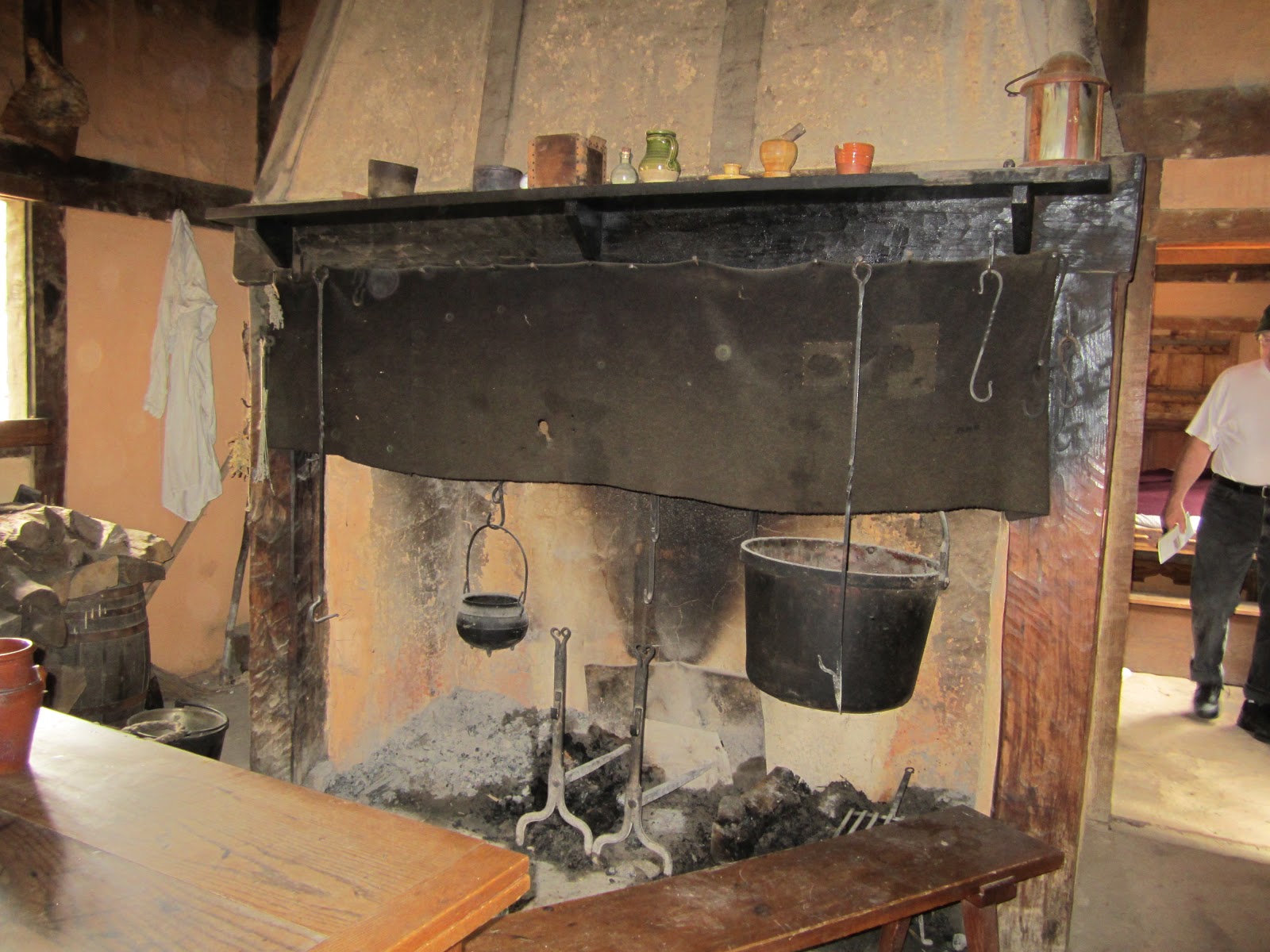
Fireplace

Colonist's bedchamber

Tobacco - Virgina "Gold"

Colonist's Home 

Governor's Home

Armor brought from England to be worn in the Virginia heat!

Governor.s Bedchamber 

Bake Oven

Cannon Drill


Wednesday, October 5, 2011

Jamestown, Virginia - National Park Service Site

There were many things in the Williamsburg, Virginia area that we could have done in addition to going to Colonial Williamsburg. We did not have time for much more, but we did spend a day at National Park Service's Jamestown Island. This is the original site of the first English settlement in North America. No - the first was not Plymouth Rock.

In 1607, Jamestown was established as a business venture to make the Dutch East India Company very rich back in London. They thought that there was gold to be found. What they eventually discovered and made their wealth on was tobacco. This is where the story of Pocohontas comes from - and it is true. This is where the men starved the first winter and while many died, some resorted to cacannibalism to stay alive. The site is part of the National Park Service under the name Historic Jamestowne and it has been in operation for over a century. This site is not to be confused with Jamestown Festival Park which is an attraction not far away. Jamestown Festival Park is a living history recreation of Jamestown and none of it is original and it is not located on the actual island. It is a very nice and very interesting attraction, but if you want to see the "real" thing - you need to go to the NPS site on Jamestown Island.

For many, many years the site was presented primarily with the area called "New Towne", where the settlement matured into a bustling town. It was always presented that the site of the original settlement and fort had eroded into the James River which you are immediately at the edge of. The guides would always point out to the river and say that is where the fort must be and it is long gone. Then they would shrug and say, "We just don't know." As you toured the grounds they would also point out the Confederate Earthworks. These are dirt mounds built into a fort by the Confederates to defend against a Yankee attack from the river. I recall asking a guide, why has there not been archaeology done under the Confederate Earthworks to see if there is any remains of the original settlement's fort. She smiled and told me that the ground is still sacred to the South and it would be disrespectful to that history to disturb it. I always had a feeling that if they dug they would find the fort right there. I was just a kid. I told my parents and really no one else at the time. Later touring it with my wife, I told her about it too. It seems that I was not the only one that felt this way. Archaeologist, William Kelso, had this same idea. He was able to do something about it and in the early 1990's (this is that recent and it is still going on) exploratory digs were made under the Earthworks and guess what - I was right. They found the fort - all of it. The Jamestown Restoration Project run by the APVA with the National Park Service has been digging and finding remarkable things including skeletons that tell a great deal of a story of the past that has been unknown until now. What they have done on the site is place markers and log representative structures where parts of the fort and buildings were. They are still digging and still finding buildings and artifacts.

There is a museum building on the site that houses all of the artifacts to display them to visitors including two of the skeletons. The building in itself is unique as the where the building has been placed was the site of the First State House in North America. The foundations are there under the building but rather than cover this historic find up, they have built the building on cement piers above the ground and placed glass in some of the floor areas so that you can see what lies beneath. This happens to be the building that we were in when the hurricane hit - and this unique construction lent a part to our feeling like we were swaying back and forth as the earthquake shook.

National Park Service has rangers give tours of the grounds. There are guides stationed all around the fort site to explain what has been found, what is being found, and what they are hoping to find. What you will see takes a bit of imagination to appreciate. There are no buildings to walk through with the exception of the remains of a brick church that was built after the settlement became established. But if you watch the archaeologists dig, you may just see something taken out of the ground that has not been seen by human eye in more than 300 years.


I recommend going here and spend part of the day. After you see the real thing, go to Jamestown Festival Park and see what it looked like to the settlers. You will meet some along the way and there you can go aboard reconstructions of the three ships that brought the settlers from England in 1607. They also have a very good musuem.

Now, would you like to hear how Meryl caused the earthquake? Really... Ok, below you see a photo of a section of burials of original colonists that were found on these spots. Each died during the first year of the settlement. The remains were found by the archaeologists, studied and then put back where they were. Each grave is marked with a metal cross and you can see these in the photo -


it is the custom of people who are Jewish to place a rock on a grave stone just as others would leave flowers. As there are few flowers in the desert in the Middle East and plenty of rocks, this makes sense. As we walked past this burial area - and you can walk through if you wish - Meryl, who is Jewish, went over to look at the crosses and told me that she had an overwhelming need to place a rock on one of them. She told me that they looked so lonely and she needed to let them know that people still care. OK, I said, if you really need to then go ahead. And she picked up a small stone and placed it on the crossbar of one of the crosses. She paused for a moment and we walked on toward the museum which we wanted to visit. As we walked away from the crosses, I commented that the Church of England colonist beneath that cross must be spinning now with the Jewish rock on his/her grave marker. We laughed ... It was not too long after that, when we first entered the museum and started to look in the first display case that the earthquake hit. As I have described the building swayed and the lights hanging from the ceiling started to swing. After it stopped and we recovered from the experience, Meryl said to me, "Did I do that?". "Huh?", I said. "Well, you said that person must be spinning, maybe he really was upset by it." Well, maybe so because we walked past that cross a little while later and the rock was gone. So, if anyone asks, why did that earthquake in August 2011 happen in Virginia - well the answer is, "It's Meryl's fault."