Roadtrek

Roadtrek
Showing posts with label Roadtrek 170. Show all posts

Wednesday, July 10, 2024

Chevy Express Van Tire Pressure and some things to know about the Roadtrek tires

 This article applies only to Roadtreks that are built on the Chevy Express van chassis. This does not apply to Dodge, Sprinter, Dodge Pro Master or any other chassis that Roadtrek has built an RV on.

When I got my 2011 190 Popular built on the Chevy Express 3500 van new from the factory, I had questions about what the best tire pressure would be for the van.  There is a sticker on the driver's door frame toward the bottom that says the tire pressure should be 50 psi in the front tires and 80 psi in the rear tires, but I was reading in the various RV forums that other Chevy Roadtrek owners were varying the front tire pressure.  I contacted Roadtrek's customer service at the time and was able to speak with a Roadtrek factory service technician.  I asked him what the best tire pressure was and why would owners be varying the front tire pressure.  

His answer was this - 

The rear tire pressure must always be filled cold (meaning before the Roadtrek has been driven for that day) to exactly 80 psi as shown on the door sticker, BUT the front tires can be varied. He explained that by varying the front tires in 5 psi increments from the suggested 50 psi that is shown on the sticker, the feel of the ride of the Roadtrek can be changed.  Each change again needs to be done when the Roadtrek has not been driven. 

1)  Start with the two front tires at 50 psi and drive the Roadtrek and evaluate for yourself the feel of how the van drives.

2) Next day  or days later  increase the psi in the two front tires to 55 psi (again when cold).  Again go for a drive and evaluate and compare the feel of the drive to what it was like when the tires were at 50 psi in the front.

3) Next day or days later increase the psi in the two front tires to 60 psi (again when cold).  Again go for a drive and evaluate and compare the feel of the drive to what it was like when the tires were at 50 psi  and at 55 psi in the front.

4) Next day or days later increase the psi in the two front tires to 65 psi (again when cold).  Again go for a drive and evaluate and compare the feel of the drive to what it was like when the tires were at 50 psi  and at 55 psi and 60 psi in the front.

5) STOP the process.  Do not increase the tire pressure in the front tires over 65 psi as he explained that over 65 psi the ride of the Roadtrek's feel will start to degrade. 

6) Decide which psi you liked the ride at most after having driven at each of these psi for the two front tires. 

7) Put the tire pressure of the two front tires (filled cold) at the psi you liked the best. That is the pressure they should be kept at for that feel of the ride you preferred. 

We liked the feel of the front tires at 60 psi and have kept that from when we did this evaluation to today. I have read others say that they also like 60 psi front. This does not mean that you will like 60 psi front - you may like one of the other increments of 5 psi over 50 psi - or you might like the 50 psi that Roadtrek starts you off at for the front tires.

+++++++++++++++++++++

Some things about the Roadtrek tires -    

As you are driving all vehicle tires get hot from friction against the road and the psi increases in the tires in this process. This is normal and the tires are made to be able to hold that increase in tire pressure.  The Roadtrek tires are no different and the tire size and designation that Roadtrek puts on the Roadtreks are made to accommodate these changes in pressure as you drive.  The tires on the Roadtrek Chevy Express van are light truck tires.  They also need to have an "E" rating - not all tires do.  This is what allows the tires to be filled at high pressure to start with.  The tire size that came with my Roadtrek 2011 190 Popular is LT245/75R16/ELT - light truck     R- Speed rating     /E - what I have just referred to.

These are tires for a commercial light truck - a vehicle heavier than a car or regular van. This tire size is not limited to any one make of tires. What is important to know is if you go to a tire retailer's website and are looking at tires  - they often ask you fill in what year, make and  model is the van - in my case that would be a 2011 Chevy Express 3500 van.  Then they ask what tire size you want - and I put in LT245/75R16/E - as that is the size that was on my Roadtrek coming from the Roadtrek factory - and the correct tire for the Roadtrek.  What will come up on the tire website is "THAT TIRE IS NOT FOR THIS VEHICLE" and if I was buying tires for a regular, not a Roadtrek, Chevy 3500 or 2500 passenger or cargo van that would be correct. BUT we do not have a regular, passenger or cargo van - we have a converted Chevy 3500 or 2500 van that is now a Class B motorhome. And this size tire with all of its designations is what the Roadtrek needs to have. 

Now just to make this a little more confusing - (don't ya just hate when that happens?) - when I put in the size including the /E at the end - some tires came up with the right size BUT WITHOUT THE /E! So I had to make doubly sure that the tires I was looking to select and buy had the /E on the end. 

Everyone has their preferences about what brand of tires they like and I am not going to get into what brand I like and why - or why this one is better than that one. So I leave brand up to you! The other decision to make when looking at these tires in this size is some are "All Season" tires - and they are good in different weather conditions - rain, snow, ice.   Other tires in this size are "All Terrain" tires - these are tires that are made for off road driving and may or may not be best when it comes to different weather conditions - some are and some may not be. When I was looking to get new tires for my Roadtrek I found a tire that I liked that was All Terrain - and since in the mud the Roadtrek is heavy and can sink (don't ask), I thought it would be a good idea to have that type of tire.  When I went to buy the tires and I was speaking with the tire shop manager and said I was interested in those tires he asked me how much off road driving do you do - and do you do more highway driving than off road driving.  Well, honestly, the extent of off road driving my Roadtrek has done is driving on gravel roads in campgrounds and onto gravel campsites, and an occasional grass field - which I will no longer drive onto if it has been recently raining. I told him 95% of the driving my Roadtrek does is on paved roads and highways. His advice was buy the All Weather tires instead of the All Terrain tire because the All Terrain tire will be a rough ride on a paved road and the All Season tire will be a much smoother ride.  There was a model of the tire I was looking at that was All Season - and less money - and that is what I bought and had put on. So far they have been good. 

The other thing to know about the Roadtrek tires is that the two front tires MUST be the same PSI.  We found out about this when we got our Roadtrek home from the dealer we bought it at two states away.   When we picked up the Roadtrek at the dealer we drove our car to the dealer and when we got the Roadtrek and were coming home (a day later)  Meryl wanted to drive - and that was fine with me. Meryl has been driving our passenger vans for years and she has no problem driving the Roadtrek - so I followed her in the Roadtrek in our car going home.  When we got home she asked me if I felt the Roadtrek was pulling to the right when driving it. I had been driving it locally the night before while we stayed close by to the dealer just in case anything was wrong with the Roadtrek - which there was - but that is in a very early article- and on the small farm roads I was driving it on I had not noticed. So the next day we got into the Roadtrek and I drove it on a local limited access expressway to see if it was pulling - not that I did not believe Meryl - and, of course, it was pulling to the right. (Meryl is always right and I do mean that.) So now we had to find out what to do. We called Roadtrek at the factory and they said call Chevy. We called Chevy and when we told Chevy it was converted to a Class B RV they sent us back to Roadtrek - who contacted Chevy corporate and Chevy said to bring it to the local Chevy dealer's service and they would do an alignment under warranty. (This little tale becomes an epic. 😏 ) So we went to the Chevy dealer's service and they said "we don't do alignments we send them out to a local alignment shop and they are expecting you and we went there. At the chain company alignment shop they looked at the Roadtrek and said - we don't have a rack or the height in our shop to do an alignment on a van that is that tall and that heavy - and recommended a truck shop. The service tech could see I was more than a little disappointed and said wait let me see something. He went over to the Roadtrek with a tire gauge and asked me what way was it pulling - "to the right" I said- and he got out his tire gauge and checked the right front tire. He then went to the left front tire and checked that tire. The right tire was a LOT less psi than the left front tire.  He filled the right front equal to the left - and said drive around for awhile before you go to the truck shop to get an alignment and see if it still pulling to the right - or anywhere.  We went right over to the expressway and drove - the Roadtrek drove straight as an arrow! And it still does.  The unfortunate part of this story is that to deliver the Roadtrek from the factory in Canada to the Roadtrek dealer in Pennsylvania, it was driven by a Roadtrek driver. A driver who never said anything to the Roadtrek dealer that is was pulling - as when we spoke to the dealer about all of this they were surprised. This was the state of Roadtrek in 2011 - which is another story that I have not written about.

Anyway - the moral of the tale is if your Roadtrek is pulling when you are driving check the two front tires and make sure they are the same psi! 

One last thing -   I keep the Roadtrek's spare tire at 80 psi. If a tire had to be changed and the spare put on, it is easier to take the 80 down to 60 for a front tire replacement than to have to fill from 60 to 80 for a back tire. When you check the air in the tires - don't forget to check the spare!  

If you have any questions contact us by using the Email Us!  link on the right column of this page!


Monday, July 8, 2024

THE COOL CAT AIR CONDITIONER AND HEAT PUMP

 Early Chevy and Dodge Roadtreks had a home air conditioner installed.  Roadtrek then in the Chevy - and some later Dodge models changed to using the Dometic Cool Cat air conditioner and heat pump instead. The Cool Cat shares a thermostat and controls with the Furnace and this is a separate panel on the passenger side wall near the Cool Cat near the rear of the Roadtrek.  Some refer to the Cool Cat just as a "heat pump" but the Cool Cat is a combination A/C and heat pump.  The Cool Cat is 10.5 K BTUs of cooling. 

For the size of the interior of the Roadtrek this should be more than enough as there are room air conditioners that cool a room and more with 10.5K BTUs. The difference in a Roadtrek, however, is a room in a house is much better insulated that the walls and roof of the Roadtrek. 

The COOL CAT and is Cool and Heat Pump functions to work, the Roadtrek MUST be plugged into SHORE POWER OR have the GENERATOR RUNNING.  It will not work on the inverter. It will not work on battery(ies). It will not work on Solar. IF YOU ARE RUNNING THE A/C on the generator and you run the microwave at the same time it is going to overload the electrical system in the Roadtrek which will shut down to not result in damage.

Here is a photo of the Cool Cat --- 

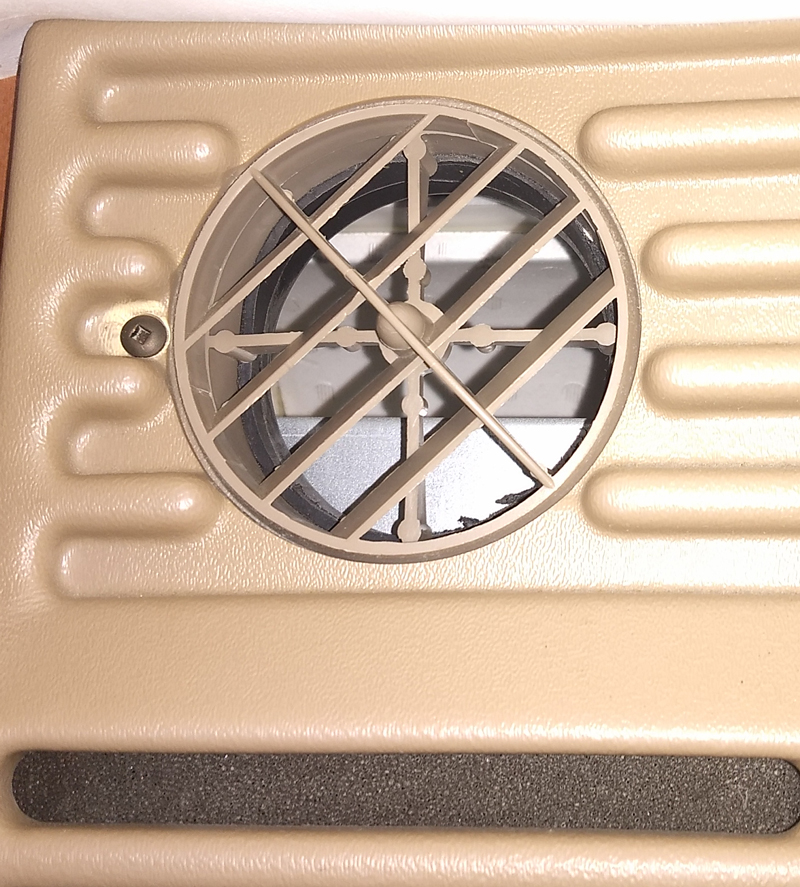
Notice that there are no controls on the unit - they are on the thermostat panel on the wall. The three round vents on the front above the grill turn around and you can point the slots in each grill up, down, to the left and to the right and at any angle. They may feel stiff to turn. Turn them, they will turn and stay where you put them. 

Under the Cool Cat above the bed on the lowered ceiling over the bed there are also vents. These vents have two knurled round wheels to direct the air from the Cool Cat where you want it coming down on the bed.  Turn the wheels with the Cool Cat running and you will find what turn of the wheels and combination of the turn of the wheels direct the air where.  These vents are black in color - some don't are not even aware that they are there. 


This is the analog thermostat panel for the Cool Cat - and the furnace. Newer Cool Cats will have a digital panel on the wall. 

Take a look at the switches and slides.  These turn on and turn off the Cool Cat - AND the furnace. 

Here is what the newer digital thermostat and control panel looks like -  

Both the analog and the digital control panels have the exact same functions and settings. 

Using the analog panel - 

COOL - turns on the Air Conditioner in the Cool Cat.

OFF - shuts off the Air Conditioner, the Heat Pump, and the Furnace.

FURNACE - The Roadtrek furnace is turned on (this runs on propane - there is no propane used for any other function on this panel.

HEAT PUMP - This turns the HEAT PUMP on inside the Cool Cat. (I will get into what that is later in this article.)

UNDER the word FAN - The ON and AUTO slide switch. This is an important switch. If you turn the Cool Cat on Cool or Heat Pump - and set that switch to ON- all the Cool Cat will do is blow room temperature air at you - all you have done is turn on the FAN inside the Cool Cat when the function slide switch is set to COOL  - NO COLD AIR COMES OUT!  For COLD AIR to come out of the Cool Cat - this must be in AUTO!  The same for the Heat pump in the Cool Cat -  Set the function slide witch to Heat Pump and with this set to ON - no heat comes out of the Cool Cat.  And also as with Cool - this Fan switch must be set to AUTO.  AUTO also acts like a power saver on a home A/C - on AUTO - when the set temperature is reached the compressor of the Cool Cat goes off and the Cool Cat goes to "sleep" waiting for the temp to get warm and then the A/C compressor comes back on and starts blowing cold again.  This same thing happens with the Heat Pump - and the FURNACE.  Often owners of Roadtreks with the Cool Cat will say it keeps going on and off. This is why. (More about this coming later.)

BELOW On/Auto is the speed of the blower in the Cool Cat - HI and LO - obviously HI - fast - LO - slow. 

The thermostat setting is on the right slide up for 90 degrees and above - that is the temp that is coming OUT of the Cool Cat  - NOT the temperature you are trying to cool down or heat up from. Slide down for down to 40 degrees.  NOTE - Fahrenheit settings on the right side and Celsius settings on the left side.  

HOW TO TURN ON THE AIR CONDITIONER FUNCTION OF THE COOL CAT - 

This is the best way to get the COOL CAT A/C blowing COLD! 

1)  FAN SWITCH ON AUTO.

2/ FAN SPEED ON HI.

3) SET THERMOSTAT SLIDE TO COLDER THAN YOU WANT IT TO BE INSIDE THE ROADTREK -  BELOW 60 UNLESS THE TEMP INSIDE IS NEAR 60 - IF SO, THEN COLDER!

4) SLIDE THE FUNCTION TO COOL. 

 The Cool Cat should come on. It will NOT blow cold right away and how long it will take to feel cold will depend on how hot it is inside the Roadtrek. If the inside of the Roadtrek is 100 F or above, it is going to take a little while for you to start feeling cook air coming out and then blow cold.  This could take 15 minutes maybe.  If the temp inside is 80F it will take less time to feel cold air coming out. 

 I recently ran the A/C with the inside of the RT in the upper 90s - it took 30 minutes to bring the inside of the Roadtrek to 80 degrees - standing in front of the A/C I felt cold. (My thermometer is near the driver's end of the kitchen counter.) In an hour it was 70 degrees inside.  We have been in the RT sitting at night in the front seats swiveled to watch the TV in the rear with the Cool Cat blowing cold and get too cold in the front. 

5) When the temp inside is near where you want it - turn the thermostat down to the temperature you want it to be. Let it run and enjoy the cold. 

6) When you want to shut off the Cool Cat A/C  slide the function switch down to OFF. 

THE HEAT PUMP  

The heat pump is an electric heater that is built into the Cool Cat. This is becoming popular  in home A/Cs.  The important thing to know about the heat pump is that it DOES NOT WORK if the temperature inside the RT or outside the RT at 40F degrees or lower (I have also found it not go on at 45F inside.) This is how it is designed - it is not a defect. It is meant to be used when it is cool inside the Roadtrek - not COLD inside the Roadtrek. When it is cold - 40 or just above - turn on the FURNACE instead. It works in the Spring and the early Fall - I had it on in early Spring - and it was cool at night and just enough to want a little heat. It got cold overnight and I was awakened by COLD air hitting me from the Cool Cat.  I jumped up to get to the panel and start the furnace.  It is so limited that we rarely use it. 

STARTING THE HEAT PUMP  

1)  FAN SWITCH ON AUTO.

2) FAN SPEED ON HI.

3) SET THERMOSTAT SLIDE TO WARMER THAN YOU WANT IT TO BE INSIDE THE ROADTREK -  ABOVE 80. 

4) SLIDE THE FUNCTION TO HEAT PUMP - NOTE - FURNACE IS ABOVE HEAT PUMP - DO NOT PAUSE WHEN YOU GO PAST FURNACE GETTING TO HEAT PUMP -  THE FURNACE WILL START (OR TRY TO START IF PROPANE IS NOT TURNED ON IN YOUR ROADTREK) When the furnace starts when you don't want it, it is a pain to get it off as it must cylce though trying to ignite the furnace and at the same time turn on the furnace's fan which keeps running (as it is supposed to) when the furnace is turned on. 

5) When it is warm enough for you inside the Roadtrek slide the thermostat to the temp you want it to stay at. 

PROBLEMS THAT CAN HAPPEN WITH THE COOL CAT THAT ARE NOT THE COOL CAT'S FAULT!

 Here are two photos - First is the location of the Thermostat panel --- 


Notice how close it is to the Cool Cat just above and to the right! 

This is the photo of the Cool Cat we started with! Look closely at the left round vent! What direction is it pointing in? DOWN AND TO THE RIGHT! And what is down and to the right in the photo above -  the thermostat!   As I had said - the Cool Cat shuts down when the thermostat  temperature is reached. The thermostat gets COLDER before any other place inside the Roadtrek - so the Cool Cat shuts down waiting for it to get hot inside again - at the thermostat! The Cool Cat keeps going ON and OFF!

Roadtrek has a few design flaws and this is one of them!  The thermostat should NOT be next to the air conditioner! 

SO WHAT DO YOU DO ABOUT THIS?!    

Simple - 

TURN THE LEFT VENT AWAY FROM THE LEFT SIDE OF THE VAN. 

It can be pointed up to the ceiling - or straight ahead with a little slant to the right.  


ANOTHER PROBLEM THAT CAN HAPPEN!  

When we first got our Roadtrek new, I did not know about setting the Fan speed to HI. I did not want it blowing heavy on us so I would set it to LO.  Makes sense, right? Well we got the RT in early Spring. I would run the A/C because it was warm enough inside the RT to need it - but outside it was not that warm.  I started hearing a noise coming from the Cool Cat when it was running like marbles in a can being shaken around. It turned out that the noise was ice balls forming inside the Cool Cat and hitting the fan inside and bouncing around.  I did not know at the time that this was what was happening. 

We took a trip that year in late September and it was warm enough for the A/C at night and it was running when we went to bed.  Early that morning I woke up hearing a loud bang - coming from the Cool Cat!  And it stopped working and would not turn on again. As it turned out, we were an hour and a half from the dealer we bought the Roadtrek at - it was a weekday and I called them when they opened that morning. They said bring it right now and we will look at it. We did  - and they did. They found inside the Cool Cat it was solid ice!  They put down a tarp and melted the ice. When they told us it was ready - they said never put the fan speed on LO.  If it had been on HI this would not have happened. Lesson learned - I was sure the Cool Cat was a goner - it was fine once the ice was gone.  I keep it on HI from then on! 

**********

You should know that there are no accessible parts inside the Cool Cat while it is mounted in the Roadtrek other than the filter. If you remove the front grill - held in place with Robertson screws (square hole screws) - there is nothing you can get at inside that is mechanical. The  Cool Cat must be removed from the Roadtrek - not a job you want to even consider unless you have a great deal of hands on experience in RV repairs - for any repairs. There is also no built in way to recharge its coolant - that is a closed system. I am told that if the Cool Cat is out a professional A/C shop MAY be able to cut in a port-  which does require the Cool Cat to be removed from the Roadtrek - and unless this pro A/C shop is not a RV service shop they are not going to take the Cool Cat out and reinstall it! 

What you can do yourself and is easy is change the filter and this does not involve removing a single screw. Here is a link to our article on how to change the Cool Cat filter. 

https://roadtrek190popular.blogspot.com/2024/04/removing-filter-from-cool-cat-air.html

 As is our new policy - if you have any questions - use the Email Us! link on the right column of the page.


Tuesday, June 1, 2021

ON FACEBOOK - CHEVY Roadtrek 190, 170, 210 Support, Help, and Sharing

 Facebook has been a great resource for Roadtrek owners. I have been a member of a group on Facebook that focuses on the Chevy Roadtreks since it started. The group has gone by a couple of different but related names.  The group owner of this group recently announced that since he had sold his Roadtrek he wanted to stop being the administrator of the group and asked for someone to take over the group.  I have been the administrator of other Facebook groups for a long time and thought that taking on an additional group would not be a problem for me - so I volunteered. With a lot of thought, I renamed the group - "Roadtrek 190, 170, 210 Support, Help and Sharing" - as this really what the heart of the group is all about. The group welcomes all Chevy Roadtrek owners. The group also welcomes Chevy Roadtrek 200 model owners - a very brief Roadtrek model as well as Roadtrek Chevy Simplicity and Ranger owners (both versions of the Roadtrek 190. We also have members of the group who are looking to buy a Chevy Roadtrek or are just interested in learning more about them. 

I emphasize on the group that there is no relevant question that cannot be asked and that all of the members who can help with that question do so, and not say to just do a search to get help. On the group you will read about the good things and the not so good things that happen with members' Roadtreks. We share problems and ask how to resolve them. We talk about modifications we have made and how to do the things one needs to do when out traveling with the Roadtrek, maintaining the Roadtrek, and fixing the Roadtrek when it needs to be fixed. 

We have member/Roadtrek owners who are very knowledgeable about Chevy Roadtreks. We have members who are new owners and are just starting out who ask for guidance from the group. We also have members on the group who are looking to buy a Chevy Roadtrek and present to the group what they have seen, the condition one is in, and ask for opinions on whether it is a good buy or one to avoid. 

I am on the group just about every day and am happy to answer questions along with the other members. When I thought about taking on this group one of the thoughts that went through my mind was that the group would be a good resource for the readers of Meryl and Me Hit the Road and they will be able to come on the group and interact with me directly.  This rounds out how I can help our readers as an added benefit to direct emails from readers - which we love and answer diligently, and questions posted to article comment sections here on Meryl and Me. 

The group is now well established.  Most know but maybe not all do - Facebook is free to join.  The group is set to "Private" meaning no one who is not a member of the group can see anything on the group. This keeps away any trouble makers. Only members can see the group posts - even when asking to join the group, you will only see an introduction to the group. And once on the group you have access to all of the knowledge on the group including a FILES section of manuals, documents, and other related information files about Chevy Roadtreks. When I come across something useful, I put a copy into the Files section of the group - as do other members. When you apply  to join you MUST answer all of the membership questions in detail! 

SO - YOU ARE INVITED!

COME JOIN US!

The name of the Facebook group is - 
ROADTREK 190, 170, 210 SUPPORT, HELP, AND SHARING
 
THE GROUP ADDRESS IS - 


Sunday, May 2, 2021

EASY TO MAKE PROPANE TANK OPENING COVER

One day you walk past the back of your Roadtrek and you look down at the center of the bumper and you discover that the cover that goes over the opening to the propane tank fill and off/on knob is GONE!  Forget about trying to find a new one. If you could it will cost you more than you should spend. There is an easy way to replace that cover with a simple DIY project that only requires a trip to a home store like Home Depot and a decent pair of scissors. 

 This is what you have lost -  


CLOSE UP - 

A very similar cover to the original can be easily made with some bathroom rubber wall cove base. This is sold on a roll at Home Depot or Lowes. It comes on a roll or you should find it to cut to length by the foot at the store. You don't need a lot - two feet is enough to make two - spares are good to have. Black blends with the bumper but it comes in other colors as well.  You don't want it thick so look for one that is thin.

 This is what rubber wall cove base looks like: 

It can be cut with a good pair of scissors. Use the measurements of the opening combined with the turn latches at the center of each side that hold the cover in place. The height of the cove base should be fine as it comes. All you have to measure is the width you need it to be for the cover. Not much has to be done to the cove base other than cut it to size and cut notches for the turn latches to fit into so that they turn to hold the new cover in place. This comes with a lip at the bottom - just like the original cover has. It sits on the bumper the same as the original and is just about the same height as the original. The cove base comes two ways - with adhesive on the back and without - you want it WITHOUT ADHESIVE. Once you make it, it is going to attach exactly the same way the original did. It will fit in the space between the two turn latches. Set it in place with the slots over the open latches on each side. Turn the latch into the cover. If the latch does not fit, trim the slots for the latches so that they turn easily over the rubber. It may be tighter than the original but that is OK as it will be harder to open on its own and get lost.

For anyone who has not lost their cover - use the original to make a template which will make creating a new one even easier. Don't put it off - as it is even easier if you have the original to use a template - before you lose the original.

AND when you have the new cover on you should make a leash for it so that it will not get lost again. All you need to do is put a small hole in the corner and take a length of strong nylon fishing line through the hole and tie the ends around one of the brackets along the bumper just inside. Make the fishing line long enough to be able to take the cover off and sit it out of the way on the bumper or hang off the bumper when filling the propane tank.

For a few dollars and very little time you have a new cover!


Monday, October 12, 2020

CHEVY ROADTREK PARTS

By now, most Chevy Roadtrek owners should know that a year ago Roadtrek was sold out of bankruptcy to a new owner company that is based in Europe. This company made decisions that have grossly effected every Chevy Roadtrek owner. They decided no longer to build Roadtreks on the Chevy chassis - but even worse, they no longer support the Chevy Roadtrek with parts. There are a number of parts in the Chevy Roadtrek that are specific to the Chevy Roadtrek. The new owners sold off all Chevy Roadtrek parts inventory to two different RV dealerships who have both made the parts available to Chevy Roadtrek owners. One dealership bought the parts inventory. This will last as long as what they have has not sold out. The other dealership bought an even more important set of components - they bought the MOLDS that make the lower body work on the sides of the Chevy Roadtreks. These include the bottom side panels - what Roadtrek called the "ground effects", the outside cabinet doors - storage cabinets drawers (drawers in the 210), battery compartment, and door over where the power cord comes out. Why is this so important - without these if your Chevy Roadtrek is in an accident and these parts get damaged without a supplier that is molding new pieces, your Roadtrek can't be repaired. (Before this company got these molds from the "new" Roadtrek, there were some Cheyy Roadtrek owners who were told by body shops that without the parts there was nothing they could do to make repairs - and at least one was told by their insurance company that without repair the Roadtrek would be considered "totaled". 

SO - thank goodness for these two companies. Their prices are expensive but they are the only game in town.

MOBILIFE RV CENTER, Kitchener, Ontario

4166 King St E, Kitchener, ON N2P 2G5

1-866-653-5886

 rvsales@mobilife.on.ca

https://www.mobiliferv.ca/rv-parts/roadtrek/?fbclid=IwAR1ukm6d7QCfUxvbeTpudRQ4MfUtRIMYuwhOER4RuCgmMPYJ8JWRi0KImgs


BODY MOLDED PARTS FOR CHEVY ROADTREKS

Easy Life Motors, LLC dba Van.Life, Jackson, MS

(833) 433-3332‬

 https://van.life/contact-us/

 https://van.life/roatrek-inquiry-form/?fbclid=IwAR1q-cstx1le7ZX9liuDXQ5msYUUyDKwn8m4pGtOw_qRAPIZOjYIXemYzrY