I have been holding off writing this article since the end of October 2019. My last post of August 2019 - ended on a happy note. My new batteries were in, The battery separator was replaced and when driving the batteries were charging. It seemed like all was great. Well... no it was not.
Why have I waited to write this? I wanted to make sure that now things really were OK. And I just wanted to not tempt fate - once again. At this point as you read this, hopefully, all is well, but for a long time it was not. Now I have pages of documentation and voltage checks that I made shortly after the last article was published, but I, promise, I will not include all of that in this article. I don't even want to look at all of that again. I will give you some details to explain what took place.
The last article came out on this site on August 30, 2019. On September 6th, I went out to check the voltage of the batteries and they read 12.56 volts. That is a lot for brand new batteries to drop. Three days later - September 9th - I went to the Roadtrek again and checked the voltage of the batteries and the battery voltage was ----- 10.1 volts! Essentially the new batteries drained to dead. This part is important to understand - there was NOTHING ON INSIDE THE ROADTREK TO DRAIN THE BATTERIES LIKE THIS.
I downloaded the technical manual for LifeLine AGM batteries to find out what to do? The manual is 40 pages long! In the manual there is a section called "Deep Discharge Recovery". What I had was a "deep discharge"! The second paragraph in this section says, "WARNING: This procedure should only be done by a trained technician." That warning was followed by another "WARNING" and also a "CAUTION". All of which I was in no position qualified or capable of doing." What I did instead was plug the Roadtrek in for 72 hours plus to try to bring the batteries back to charge. After it charged - and the batteries did charge - I turned off the TrippLite 750 inverter/converter/charger on the unit slide switch on the front right of the TrippLite. To do this you slide it to the middle position DC OFF. This cuts its connection with the batteries - whether the battery switch is on or off. In this position the TrippLite has ZERO drain on the batteries. It is the same as if you disconnected the battery cable from the TrippLite.
Hoping that all now was OK - we decided to take a trip and we drove on a one day and back trip 400 miles. - Another point of interest - when you drive the Roadtrek the batteries charge when the engine is running. The battery switch can be ON or OFF. AND MORE IMPORTANT TO KNOW - the TrippLite has NOTHING TO DO WITH THIS PROCESS OF CHARGING. It is strictly the connection between the battery separator (or in older RTs the battery isolator) and the Roadtrek batteries with the Engine battery - and the engine alternator which is doing the charging. - So, we drove 400 miles after charging the batteries at home plugged in using the TrippLite set to "Charge Only" and that battery voltage went to 12.8 which is very good. 12.8 v DC is a fully charged battery or battery bank. Sounds good, right? Wishful thinking. In four days (which included two hours of exercising the generator under half load - which also charges the batteries through the TrippLite set to "Charge Only" - the batteries dropped - with the TrippLite set to "DC OFF" to 12.1 volts. Again, I plugged in to charge.
During all of this I went out and bought a fairly good - recommended - multi-meter so that I would be sure I was getting accurate readings. I was - as I checked this to my 12 volt plug in digital meter. I stopped in at the mechanic who works on our car and the Roadtrek and asked him if he would test the Roadtrek to determine if there was any drain on the batteries. He took the RT into his shop and the results - there was ZERO drain on the batteries from the Roadtrek or the van. Something was very wrong.
I contacted the shop in New Jersey that I bought the batteries from and that installed the new AGM batteries. What I got in response was that I could bring the RT back to them and that they would need it "for awhile" and they had to determine what was wrong with the Roadtrek before they would test the batteries and put in a claim for replacement under the batteries one year full replacement warranty. What troubled me by what they said was the "for awhile" part. They charge by the hour - a lot by the hour - and I could see this becoming even more expensive than dumping these batteries and starting all over again taking the loss of the money. They would not give me a clear answer about when and how long they would be charging for labor. I made an appointment to bring it in to them - in New Jersey and leave the Roadtrek. But in the meantime until the appointment I started doing what I should have done before I even bought the batteries from them. I looked up customer complaints and reviews about this shop. What I found was greatly disturbing. Not one but the same comments over and over - they take an RV in for service - keep it an extended period of time - little is done - nothing really is resolved - and they charge for all of that - and more. Oh boy! I try not to stress over the Roadtrek but this was really getting me down. I was not sure what to do. I did not trust this shop at all any longer.
As always, Meryl had the solution. She said - call the Roadtrek dealer/service - which I did. I both called and emailed all of the details - all of the documentation about what was happening and all of the voltage readings - and what we knew - which basically was that zero drain was found on the batteries from the Roadtrek. Initially they were going to take it in for one day. Even I felt that it really needed to be there for more than a day - just to monitor what was happening with the batteries and to really go fully over the electrical system in the Roadtrek and make sure that there was nothing not functioning as it should that was causing the batteries to drop. I spoke with the customer service rep that we have been working with since we got the Roadtrek in 2011 from this dealer new - and spent a lot of time with getting things put in correct order after it came out of the factory with a lot of problems. We are on a first name basis - and have had many pleasant conversations with over the years. She told me that they thought I was in a hurry and it would be better if they kept it. We set a day to bring the Roadtrek and leave it with them. At the same time we learned that they have moved their service facility off the property where the sales room is and they were now down the road some. We got detailed directions. To bring the Roadtrek there to leave it we had to also bring our car to get home. That meant one follows the other. The next day I cancelled the appointment at the shop we bought the batteries at.
I put together a very extensive package of materials about the batteries and my log of what was going on since we got the new batteries. At this point I was not sure if the Roadtrek shop - from which I did not buy the batteries from - would be able to get replacements under the batteries' warranty. I just wanted things fixed - and for me to tell any shop what I told the Roadtrek shop under any other circumstances would be just craze - but I wanted this fixed and done with - I said, "if the batteries are bad and you can't get them replaced under warranty I will take the loss - take them out, throw them away - and get me two good AGMs that you would use to replace the Roadtrek originals". Yep, I was pretty much at the end of my tolerance in dealing with getting working batteries in the Roadtrek. As it was the entire summer when we should have been traveling in the Roadtrek we were getting the batteries replaced -and then dealing with bad batteries. The only trip we took the entire summer in the Roadtrek was four days the week of July Fourth - plus the one day and back the same day trip of 400 miles (which was rather pleasant). We usually go away for a few days at the end of October and I was planning on that trip as the last trip of 2019.
The trip down to Pennsylvania to drop off the Roadtrek we set off with Meryl driving the Roadtrek and me driving our passenger van. (Ah yes! With all the excitement going on with the Roadtrek just before this trip down, our car started making noises when shifting down. I asked our mechanic if I could drive it to PA and he said - "I wouldn't" - so I didn't. My passenger van is a 1996 and I have only driven it locally for a long number of years. So I asked the same mechanic - who knows it well - if it would make ti to PA and back and he said sure. Just in case I took it out on a highway at night for an hour to make sure it would. It did that fine - and that is what I was going to drive to PA - a trip this van has not taken in maybe over 10 years or longer.) SO - We have Midland Walkie Talkies with a 28 mile range (clear open field outside) and we each took one - and they kept us in contact the entire trip. The only time we lost contact was when the Roadtrek got ahead of me and went around a long curve- but as soon as we both were on straight highway again the radios connected. Meryl rarely gets to drive the Roadtrek and had not driven it that far since she drove it home from Pennsylvania with me following. We got to the service center in its new location. Had a nice chat with our friend - talked about Roadtrek and the new owners - and we left it in good hands. They were planning on our having it back in about 12 days. And they were not charging me for labor unless they were actually working on it. They have been very good with us since we first met this dealer in 2009 when we started looking at Roadtreks - and met them at an RV show in New York.
Getting home was a lot more exciting. We stuck around the area for a couple of hours - had lunch and stopped at a store that was not far for a couple of pies - not just any pies - and not chocolate shoofly but a cake in a pie called Funny Cake which is mostly only found in this area of Pennsylvania. We were this close - we had to go and pick up a couple. Well. We finally almost got to the PA Turnpike - coming from a direction we have not come from before and had to head east from and we made a wrong turn that took almost a half hour to correct - and we got back to the PA Turnpike rush hour had started. Six hours later - we got home. Thank goodness we were together in the van because had this happened on the way down in two vehicles it would have been even more of a mess. We made a mental note - when coming back to pick up the Roadtrek - get there early and come straight back home!
Back home and life goes on. I was getting email updates from Roadtrek dealer/service. During this time Meryl's 90 year old mom needed some help getting to routine medical appointments and we were taking her. We got a call from Roadtrek and they said it would be ready in two days.
Findings from Roadtrek dealer service - Roadtrek electrical systems and charging - ALL GOOD! New batteries - one bad, one good. The bad one was bringing the whole thing down. A new replacement added to the good battery would make all GOOD. AND THEY HAD A DISTRIBUTOR WHO WOULD TAKE THE BAD BATTERY AND REPLACE IT WITH THE SAME UNDER WARRANTY.
SO as far as the Roadtrek was concerned all was going to be good. The minor problem at home was we were scheduled to take Meryl's mom to the doctor when we should have gone back for the Roadtrek. I let the shop know this and they said no problem - call us next week and we will set a day to expect you. That would have been good if the weather had not changed - and it got suddenly very cold and a bit snowy - not at home but in PA. Just before I was going to call the next week, I got a call that morning from the Roadtrek shop - the weather forecast is predicting well below 28 degrees in the next few nights and your Roadtrek is not winterized. May we winterize it if you can't come right now to get it? Well, I had heard this same thing about the weather and it was there and here - and even if I could have gone right then to get it - I would have it home in the same cold. I told them absolutely yes - as I had thought to ask them to do this anyway when I called later that day. So they would winterize the Roadtrek. Of course, those who have read my articles on winterizing the Roadtrek I have little things that I do that the shops often don't do - and I had to make sure they knew not to use compressed air in the lines - as this is a never do according to Roadtrek (at least the "old Roadtrek"). I went through my please don't and please make sure to do this and that - which I would have done if I was doing it myself. She said, of course. And for the first time since they did the winterizing that first year we owned the Roadtrek - and took their one to one winterizing class - which is the basis for my steps on winterizing - plus my additions - I was not winterizing the Roadtrek. And like a parent with his child away for the first time when something they do together is not done - I worried if they were really going to do it all the way I do. (And they did!)
We finally got to get to PA and pick up the Roadtrek - and as we were sure to do after our first experience getting home in rush hour PA, NJ, and NY style - we picked it up around 11 am. Stopped for twenty minutes to have lunch. Got on the southbound road to the PA Turnpike - did not make the same mistaken turn as we did the last time - now following each other - and got home in the expected three hours - and only got into traffic in New York - Walkie Talkies with voice activated transmission making sure that each was finding the correct turns.
I will not say what I was charged except that everything to do with the batteries and checking out the Roadtrek's systems to make sure they were good was reasonable. The winterizing surprised me as to what it now costs which is a lot more than it was 8 years before - but checking around I was charged ballpark for what winterizing costs to do today. It is a good thing to do it yourself- as you save a LOT!
I learned a very important lesson in all of this. The lesson is don't try to go cheap! I got a quote from the Roadtrek dealer/service on the batteries and installation before I decided to go to the place in New Jersey to buy the batteries. The quote was higher on the batteries but lower on the installation (and I was charged in addition by the shop in NJ for shipping the batteries from LifeLine to them - and they were supposed to be a LifeLine distributor. plus parts that were not needed.to do the install). Had I gone to the Roadtrek dealer/service from the start the total price - as there was no shipping involved - they were going to the same distributor that did the warranty exchange a few miles away from them - and there were no added, unnecessary parts - would have been less than what it cost me in New Jersey plus they would have fully checked out the batteries at the time of install - and I would have had the Roadtrek for travel - no need to make two trips down and back with multiple vehicles which involved tolls and gas - and not had to pay for getting everything checked out. All in all - I should have listened to Meryl when she told me to go to the Roadtrek dealer/service from the start - why? Because Meryl is always right. I don't say that mockingly. She will tell you, herself, that she is always right - and you know - honestly - she is.
We never did get to take that trip at the end of October. The weather was bad. Things were going on at home that could not be put aside. But the Roadtrek was fixed and fixed right.
Our Roadtrek dealer/service is Fretz RV in Souderton, PA. As I have said they have always been good to us!
I have been checking voltage regularly ever since I got the Roadtrek back. It has gone on a day trip since then. The generator gets its monthly exercise. And until today - because I don't want o get into the habit of not plugging it in - even though it really does not need to be charged - I had only plugged it in once. As I write it is outside plugged in and charging. Other than when plugged in or running the generator when I put the TrippLite into Charge Only setting, I keep the TrippLite on the DC OFF setting - and there is still zero drain on the batteries. The batteries stay at 12.9 volts - may go to 12.8X volts with x being a 100th of a volt . The lowest I have seen is 12.82 volts - all indicating that they are fully charged and holding that charge. It has been four months now. The green light on the battery monitor inside the Roadtrek on the wall always shows C - top LED - for the momentary check of the batteries inside with the plug in 12 volt meter - and then the battery switch goes right off.
Would I still recommend LifeLine AGM batteries to replace your Roadtrek AGMs? I am not sure if I would. Maybe it is not unusual for one to get a bad battery. I don't know. I have never gotten a bad vehicle battery. These batteries are supposed to be hand assembled at the factory in California. They are supposed to be the best - and at a price for the best. When I read though the LifeLine technical manual they talk about all the things one is supposed to do annually to maintain these batteries. Well, the AGMs Roadtrek put in when they built my Roadtrek in 2011 lasted until - and maybe even would have lasted longer past - 2019. I decided to replace them because they were not charging when driving - and we found out after buying the new batteries that the problem with that was not the batteries at all but the battery separator going bad. So I might still have had the OEM batteries now if that had not happened. And all I ever did to maintain those batteries was to plug in every month and charge them - once a month up to when they were four years old and then I started plugging in twice a month - to keep them charged. And with these new batteries- well that is my plan also -they will get plugged in once a month - which is also good for keeping the engine battery charged (depending on the year of your Roadtrek). I can't be doing what they say to do and I have no idea how to do what they say to check and record, discharge, and ,,. Well. they will get plugged in. You can download the manual on the LifeLine website and decide for yourself.
I will be writing some articles about what I have learned about the Roadtrek electrical system which goes beyond the basics I have written about in the past. There are things that work a lot differently than I had thought they did. i have mentioned some of them so far. But that is for another article.
Once again, thanks for coming along on this journey - one I rather I would have not had to take.
Roadtrek

Showing posts with label voltage. Show all posts
Showing posts with label voltage. Show all posts
Saturday, February 29, 2020

Wednesday, March 29, 2017
A Review of the Classic Roadtrek Electrical System
We get a lot of questions from readers about the electrical system in their Roadtrek. We always are happy to respond and answer what we can. In 2012 and 2013 I wrote a series of articles that explain the electrical system in our - and in what I would call a "classic" Roadtrek. Classic meaning a basic system that does not include the new electric options that Roadtrek has introduced since my 2011, starting in about 2013/14. This means no solar panels, no lithium EcoTrek batteries, no VoltStart, and no Engine Generator. This does include coach battery or batteries, shore power plug in, an Onan built in generator, an isolater or separator, an engine battery, and a three in one inverter, converter, charger or two units - inverter and converter/charger.
I will start with a very important tool in understanding the electrical system in these "classic" Roadtrek electrical systems - a computer simulation of the electric system. To use you must specify a year and model in the drop down menu that is at the bottom of the left column on the page. Select 2010 for years 2010, 2011, and 2012 - and possibly 2013. If you have a basic electric system in your Roadtrek beyond those years select 2010 also. IN ADDITION, there is a link at the top of the Simulator page for NOTES. This will open a PDF file that gives a great deal of explanation. I did not create the simulator nor write the "Notes". I was sent this link by Roadtrek back in 2011 and the author of the simulator has updated the Notes since.
ROADTREK ELECTRIC SIMULATOR
Next, some history as I know it. Originally the electric system used a converter/charger unit and in some (and not in some at all) an inverter unit. The converter/charger charges your batteries and takes 110 volt power and converts it into 12 volt DC power. The inverter takes 12 volt DC power and changes it into 110 volt AC power.
During the 2005 model year, Roadtrek began to change this. Instead of two separate units, they started to install a three in one single unit that provided all three functions - inverter/converter/charger. By 2006 the changeover was complete. If you own a 2005 Roadtrek you may or may not have the single unit - you may have the two separate units.If you have a model year before 2005 you have the two separate units. If you have a 2006 you have the single unit. The single unit installed in 190s, 170s, and 210s is the TrippLite 750. In the Sprinter models, there is also a TrippLite but a more powerful unit - greater in wattage than 750 watts. With the larger unit you can run the microwave oven on your inverter. With the TrippLite 750 you cannot.
At the end of 2010, Roadtrek made another change. They stopped using wet cell deep cycle coach batteries and started using AGM deep cycle coach batteries. The change over is complete with the 2011 Roadtrek model year. I know many with 2010's that got deep cycle wet cell coach batteries, but some have told me that their 2010 came with AGMs - likely late in the model year. If you have a 190 and have two coach batteries. With the AGMs these are two 6 volt coach batteries wired in series.
I am not going to go completely though each component in the electrical system again, as the articles from 2012 cover these fairly well - and those articles, I have been told, have helped many. I am going to link those articles here so that it is all in one place. Start with the first introductory article and then read the rest from there. Here are the LINKS -
THE ELECTRIC SYSTEM - Intro
BATTERIES
THE GENERATOR
SHORE POWER
THE INVERTER
LOCATING THE INVERTER
CHARGING THE ROADTREK BATTERIES
IMPORTANT TO KNOW ABOUT THE INVERTER
LOW COACH BATTERIES AND THE GENERATOR
GETTING AN ACCURATE READING OF THE BATTERY VOLTAGE
THE BEST WAY TO KNOW YOUR BATTERY'S VOLTAGE
PLUGGING INTO AN OUTLET THAT IS NOT 30 AMPS
To give you some brief information not covered in the above, your Roadtrek has either a Battery Isolater OR a Battery Separator. Each provides the same function BUT each works a differently to do this from the other. If you have a Roadtrek before 2006 (or 2005 IF your 2005 has the three in one inverter/converter/charger) you have a BATTERY ISOLATER. If you have a Roadtrek after 2005, you have a BATTERY SEPARATOR (specifically, a Sure Power 1315-200 Bidirectional 12 volt 200 amp battery separator. Either should be located in your engine compartment on the rear wall just about in front of the steering wheel. What these do is keep your engine battery and your coach battery(ies) apart and stop one from draining the other. The engine battery and the coach batteries are linked between these units BECAUSE while you are driving your engine battery will charge your coach battery - and similarly, when plugged into shore power or running your generator, your coach batteries will charge your engine batteries. (There may be some exceptions - see the simulator as this will show you exactly what happens when the engine is running OR the engine is off and you are plugged into shore power or running your generator- specifically for your year and model). The change from a Battery Isolater to a Battery Separator came because of the TrippLite three in one unit which did not work correctly with a battery isolater. Be aware that the Isolater or Separator do not last forever. They can go bad over time. I have been told that when odd things start happening with your batteries and electrical system the first thing to do is have the isolater or separator checked. It can be tested to see that it is working properly. Now - just a personal observation. This past year I was not certain that the battery separator in my Roadtrek was functioning properly. I have since determined that it does. When I was unsure I set out to find the Sure Power 1315-200 Bidirectional 12 volt 200 amp battery separator to replace it. I assumed - never assume - that it was a common part. It is NOT. I contacted a few local RV dealerships (not Roadtrek) and they did not stock this - some had never heard of this particular model. I did locate it on the Internet at just a few RV parts retailers - in the middle and on the other side of the country. It is not a matter if it goes bad you can get a new one right away. You will wait to have it shipped to you or whoever is going to replace it for you. Interestingly, I have discovered the same thing about AGM 6 volt deep cycle batteries - 12 volt are easy to find - 6 volt are not.
Here are three links to help with the Sure Power 1315-200 Bidirectional 12 volt 200 amp battery separator -
LINK 1
LINK 2
LINK 3
Take your time reading the different articles referenced and linked in this article. Read them more than once. It takes some time to put all of this together and understand how this or that works - or even just what it is and does.
So there you have it. I am still happy to help and answer your specific questions. It is best to use the Email Us link that is located in the column to the right on this page and email us directly rather than putting a comment on this article. It is much easier to interact with you this way and get the specifics. When you email, please remember to include the year and model Roadtrek that you have (or any RV - we get lots of questions on basics from non-Roadtrek or even Class B owners).
Wednesday, January 6, 2016
Taking the Roadtrek for a Drive...
We have been having some odd things happen in the Roadtrek going back to our trip this past August. When I wrote about that trip I talked about the coach batteries not starting to drive when we started the engine to leave for the trip. It took about twenty minutes of driving when we stopped to check to see that the charge LED had come on the battery monitor. This has been happening since then. The engine is started and the charge LED does not come on to show the coach batteries are charging when the "test" button is pressed. After awhile it does come on, but this is not how this was before and this is not right.
I have been doing some research and asking some friends on the Roadtrek Owners Facebook Group and have learned some things about the relationship between the engine battery and the coach batteries and the Separator unit that is installed between them. It seems that the Separator connects the systems when one or the other voltage is 12.8 volts. So if the engine battery is below 12.8 volts it is not going to be connected to the coach system to charge the coach batteries until the engine battery comes up in charge. And conversely - I am told - if the coach batteries are below 12.8 volts the engine battery will not be charged until the coach batteries come up in charge. I am not an engineer and I really do not understand all of this but others who are knowledgeable about these things have it explained it this way to me.
While the battery is a 12 volt battery, apparently that does not mean that at 12 volts it is OK. I am told that it should be up around 12.9 or higher to be charged and that at 12.1 it is at half charge. This holds for the Roadtrek's coach battery system as well - 12.1 is half charge and with the Roadtrek batteries (likely all batteries) you never want the charge to go to half as it shortens the charging life of the battery - or so I am told.
Had the Roadtrek been just a regular van without the Roadtrek conversion, I would not think anything at all about the engine battery at this point. Turn the key and the van starts right up with no hesitation. In a car or just a van, that is all I would care about. In the Roadtrek, the inter-relationship of the van's electrical system with the Roadtrek electrical system was what was giving me concern and alerting me to give this attention. The system with the Separator and the Roadtrek's inverter/converter/charger - in my Roadtrek the Tripp-Lite 750 - is designed to charge all batteries when driving, running the generator, or plugged into shore power. This system if not functioning as it had always functioned before.
A few days before Christmas I decided to take an opportunity of good weather and unseasonably warm temperatures and plug in the Roadtrek to shore power at the house to charge all of the batteries - coach and engine. Before starting I checked the charge with the digital meter and the engine was around 12.3 volts. I plugged in to shore power and the digital meter in the 12 volt vehicle socket in the dash did not indicate that the engine battery was charging. I checked four hours later and it was with a reading of 14.5. So I left the Roadtrek plugged into shore power for almost 24 hours. The coach batteries charged fine. The engine battery about a half hour after pulling the shore power cord was reading only 12.1 volts! Not good. I had two thoughts - the engine battery was going bad - it is just going on five years old - or the separator is going bad which I have read they do and that when there are odd things happening in the electric system it may be an indication that the separator has gone bad. I did not know which. I went back to the Facebook group with that question and what I got back was that five years is long for the engine battery. What I did was start the engine and let it run at idle on the drive way for one hour and it did charge the engine battery up to 12.65 volts. The vehicle alternator was charging the battery. A day latter it had dropped and it dropped more after a few more days. The engine battery seemed to be on its way out.
I had been talking with Meryl before this all took place that we should change the plug in schedule for the Roadtrek from charging once a month to perhaps charging two or three times a month in addition to the generator exercise of 2 hours a month - which, if all are working correctly, will also charge all of the batteries. I also said to her that we really should take the Roadtrek out for a drive every so often. The only reason that we don't do this is the difficulty getting it off the driveway and into the four lane avenue in front of our house. That road is full of traffic day and night. It can take as much as 45 minutes when backing out of the driveway to wait for a clear and safe spot to back the Roadtrek into the street and then get to the curb so that Meryl can get in. She has been out in the street during this maneuver with a walkie-talkie telling me when it is clear to back out into the road. We knew this before we started out with the Roadtrek and it is a pain but the price to pay to be able to have the Roadtrek so we put up with it.
I had been thinking that on Sundays during the day the traffic is less than it is at other times and that was an idea for taking the Roadtrek out for a drive. We did not do this the Sunday after Christmas. I did decided to try on New Years Day when there were very few cars (or trucks) passing by the house. I wanted to drive for at least two hours on a highway with the Roadtrek which should when all is well charge all of the batteries to full. So for New Year's Day 2016 we took the Roadtrek for a ride!
Even with the little traffic going past it took ten minutes for a clear spot to back out and be on our way. I had to get to the North Shore of Long Island to get to the Long Island Expressway and if I wanted to drive a hour each way out and back I had to head east toward the end of the Island. To get to the LIE I had to head north and I wanted to not take streets to do that I headed to the Seaford Oyster Bay Expressway that the Roadtrek is permitted to drive on due to height restrictions on other highways (parkways). This is Route 135 - an expressway built to cross the Island around mid-way that was intended to join a bridge that was never built that would cross the Long Island Sound to Connecticut. That idea ended a long time ago along with the expressway ending abruptly into a field. You see on Long Island we have something called NIMBY - "Not in my backyard!" and some decided they did not want a bridge in their backyard - so we don't have one. Anyway, we drove by streets to the 135, headed north and joined the 495 - the Long Island Expressway eastbound toward the end of Long Island that is shaped like a fishes tail into the Atlantic Ocean.
The 495 is not a very scenic drive. Mostly what you see are barricades along both sides of the Expressway that block the road noise from the backyards of houses, industrial parks, and shopping centers that line the road. Of course, those barricades have to be there or the NIMBYs would rise up and demand that there be no main highway that almost runs the length of the Island. So we talked and drove and I wondered if things related to the batteries were actually working. Around the village of Shirley we got off at an exit and looked for a place to stop to check to see if the coach batteries were charging.
We seemed to pick the one southbound road that had no place to easily stop. We drove for 15 minutes south before a shopping center came up to our right and we pulled in. Yes, the coach batteries were charging. The Chevy has a volt meter on the dash and all along I could see that this was up above the middle (14 volts) mark indicating that the engine battery was charging. I left the engine running while we were stopped. Pulling out every exit was going the wrong way. The road from the parking lot that led to the road we had come in on was no left turn onto that road. We went straight and crossed that road and had to drive to a parking lot to the left down the road to be able to pull in there and eventually get out by the single exit that allowed a right turn and then back up to the main road to make a right to head north back to the Expressway. Isn't Long Island wonderful?
So a half hour lost on this stop but a half hour added to our trip as I was determined to do an entire two hours at highway speed so we while we were more than an hour driving, I wanted to drive for two full hours at highway speed - just to give the van and the battery charge a workout. It had been almost two months since we had driven the Roadtrek before this. I got back on the 495 and kept heading east. I glanced at the clock which in my Roadtrek is on the GPS screen and it said that it was after five. I could not believe that we had been driving that long - and it was not getting dark out. Meryl scrambled around to reach her cell phone to check the time and it was only just after four. I then realized that the last time we were in the Roadtrek was before the change to Standard Time and the clock had never been turned back. Well, this was a good time to gain that extra hour...
It has been awhile since I have driven this far out east and I did not remember that the LIE actually ends when it comes to the split of the two east end forks - one to Montauk Point on the south and the other to Orient Point on the north. The town where the forks meet is Riverhead. Signs came up that the Expressway was ending. It ended and I headed to the North Fork and and shortly we had come to the hour of highway driving that I was looking to do. So did we stop and look around? Nope! I found a shopping center and turned around. When we got into that parking lot, Meryl announced that this must be the new Walmart that was a big controversy in the local newspaper. It was to be the first Super Walmart 24 hour store on Long Island. Why is that a big deal? NIMBY - a few didn't want a 24 hour Walmart near them. Well, here it was, but its not a 24 hour Walmart - it closes at Midnight though that is better than the rest here that close at 10 pm, but that does not do much for us as it is an hour away. We pulled out and now headed west toward home.
The Roadtrek was back now on the 495 heading west. An interesting thing about US 495 is that the number does not fit with the standards for federal route numbering. As 495 it should connect someplace with US 95, and it doesn't. The intent may have been that a bridge would be built to connect it to 95 in Connecticut but, of course, that bridge never happened. As we drove home I realized that I was getting close to half a tank of gas and with the need to run the generator to exercise it for the next several months, it would be a good idea to stop for gas. In Huntington I pulled off to head for a BJ's Wholesale Club with a gas station that we know. Gas was $2.03 with no extra to charge it - the lowest gas is here and the lowest that the Roadtrek has gotten gas at home in NY. Of course, out of NY we have found gas lower and that has made a difference in the cost of travel this past year with the Roadtrek. I am still waiting to see gas fall below $2.00 here. It would be a pleasant surprise but the last time gas was approaching that here, it went right back up again. After filling the tank, it was back to the 495 West to connect shortly to the 135 South and home.
When the trip was over I waited three hours to check the charge on the engine battery. It read 12.65 volts. The next day it was 12.47 volts. Two days later it was 12.2. It was time to speak to the mechanic who has taken care of my Roadtrek's vehicle side since we got it. He wants me to bring it to him to check the battery and I will do that in the next two days - if I can back it out into weekday traffic and get there.
I will let you know what happens...
ADDENDUM:
My mechanic load tested the engine battery with a load of 300 amps and the result was 9.5. He told me that this number should be higher than 9.6 and that this indicated that the Chevy Roadtrek battery was low. He replaced the battery with an equivalent and it only cost me $155 including labor.
When I got home I left the engine running and I checked to see if when I put the battery switch on, the LED would go to C (Charge) when I pushed the test button. The coach batteries read 12.4 volts. I had expected to see that top green C LED light. I am guessing that this coming season I am going to need to replace the two AGM coach batteries as well - or have my Roadtrek dealer service check out the Separator. When plugged in the C LED immediately comes on so I do not thing there is any problem with the Tripp-Lite 750 inverter/converter/charger.
While I was with the mechanic we were talking about the engine charging the coach bateries while driving and it is his opinion that the alternator in the Chevy will only put a surface charge on the coach batteries and would not charge them from low to full. He does not know anything about the Tripp-Lite which has the function to charge the coach batteries when the engine is running. He said that when there were generators in old cars' engines instead of alternators they would be able to charge the batteries from low to full as they put out much more power - but they no longer exist in cars or vans.
Wednesday, June 10, 2015
The Best Way to Know Coach Battery Voltage
On our first trip of this season, our first stop was at dealer service. (I will write about this trip in a coming article.) One of the things we wanted done was to have a 12 volt outlet that is connected to the coach or house batteries installed (the batteries for the RV, not the engine). This was a project long in planning. It started with my idea to install digital voltage meter that would be connected to the coach batteries and the TEST button on the monitor panel. I went searching for how this would be done and it is relatively simple IF you know what wire is which and where it is connected - plus how to get to the wires. The monitor panel - while it is similar to models made by the company that manufactures it, is made for Roadtrek by that company. Finding a schematic for the wiring and even knowing how to pull it from the wall without damaging it was not becoming a simple task. I knew that we had to be going to service anyway - if for nothing else but to get the generator oil changed for its annual change - so why not let the dealer service department do all this for me. I then started looking for a digital voltage meter that could be installed in the space that was available adjacent to the Test button and monitor panel. There are many to be found on Amazon and Ebay but most are designed to be installed into a dashboard and not the half inch wood of the Roadtrek wall in this location. I could rig something with a frame to have it surface mounted but then found this.
What is this? This is an Equus Innova Model 3721 Battery and Charging System Monitor. It is made for a vehicle battery and plugs into the 12 volt cigarette lighter or appliance outlet in a dashboard. It has an LCD digital display with both numerical voltage and a graph, and also LED lights. On the back is a chart that tells you what voltage levels indicate. The numerical voltage is the exact reading to within the accuracy of the meter. It also folds for different angle viewing. From reading the hundreds of reviews, this is supposedly one of the best of these meters and it was available through the Walmart website's "Site to Store" free delivery for just $13.86. It may be at local retailers but it was not in the several Walmarts in two three states that I looked for it. I ordered it and had it in five days.


What is this? This is an Equus Innova Model 3721 Battery and Charging System Monitor. It is made for a vehicle battery and plugs into the 12 volt cigarette lighter or appliance outlet in a dashboard. It has an LCD digital display with both numerical voltage and a graph, and also LED lights. On the back is a chart that tells you what voltage levels indicate. The numerical voltage is the exact reading to within the accuracy of the meter. It also folds for different angle viewing. From reading the hundreds of reviews, this is supposedly one of the best of these meters and it was available through the Walmart website's "Site to Store" free delivery for just $13.86. It may be at local retailers but it was not in the several Walmarts in two three states that I looked for it. I ordered it and had it in five days.
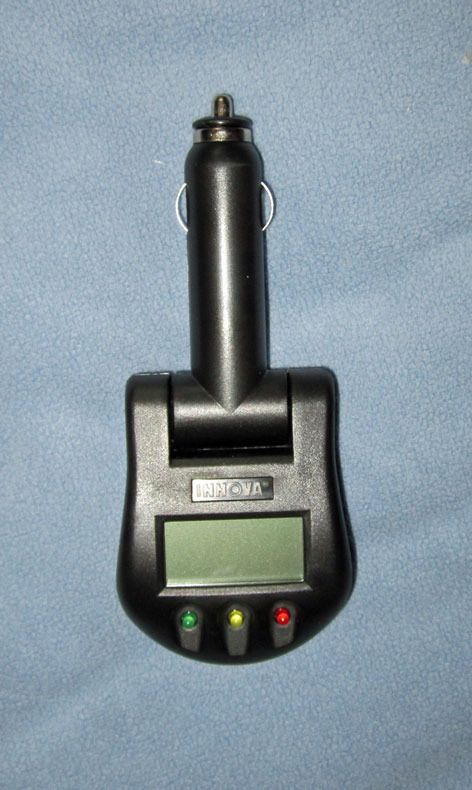

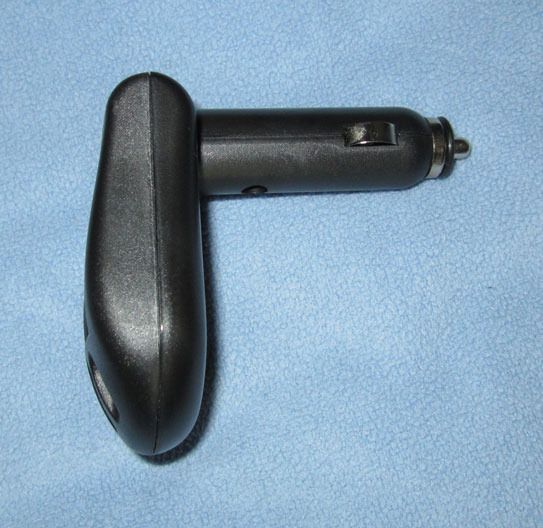
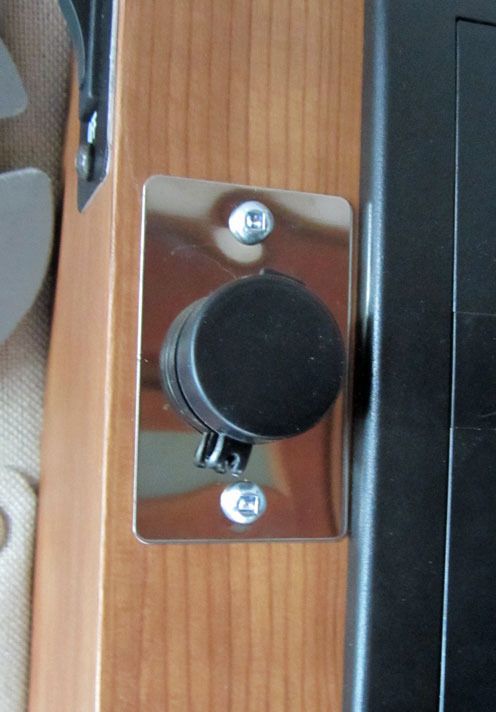
This gave me a new idea. Instead of having a permanently mounted meter installed I could have a 12 volt coach outlet installed. This would enable me to use this meter and also have the outlet for any other 12 volt charger or appliance. Now, some of you with newer or older Roadtreks will say, "But there already is a 12 volt coach outlet in the Roadtrek!" Well not in the 2011 or the 2010. I am not sure when Roadtrek stopped including a 12 volt coach outlet or started including them again, but I don't have one. Newer Roadtreks have the outlet as part of the antenna booster and I could have done it that way also - probably on my own, but inside the cabinet over the TV on the cabinet ceiling was not going to be very convenient - particularly since we keep the bed made up when traveling and opening that cabinet means climbing up on the bed. So I started looking for and found quickly a common and standard RV part - a 12 volt outlet - which it just so happened was in stock on our dealer's website's part's page. There were two to choose from. One the size of a light switch plate and the other much smaller - small enough to fit in where the monitor panel is. A discussion with Meryl and it was decided. I sent an email to our friend at dealer service - good friends after all of the time we have spent with her over the four years of our visiting her at the service center - and told her my plan and included the part number and a photo of the vicinity that I wanted to outlet installed. She said she would show the photo and the part to the tech and see what he said. A couple of days later, we were good to go - she had ordered the part and we just had to wait the month for our appointment (more about that in my article about the actual trip).
So once at service I showed her the spot that I wanted the outlet, she said it may need to be moved slightly lower which was fine and we left it to her and the tech to have the outlet installed. Five hours later - there were other things to be done - I had an outlet.
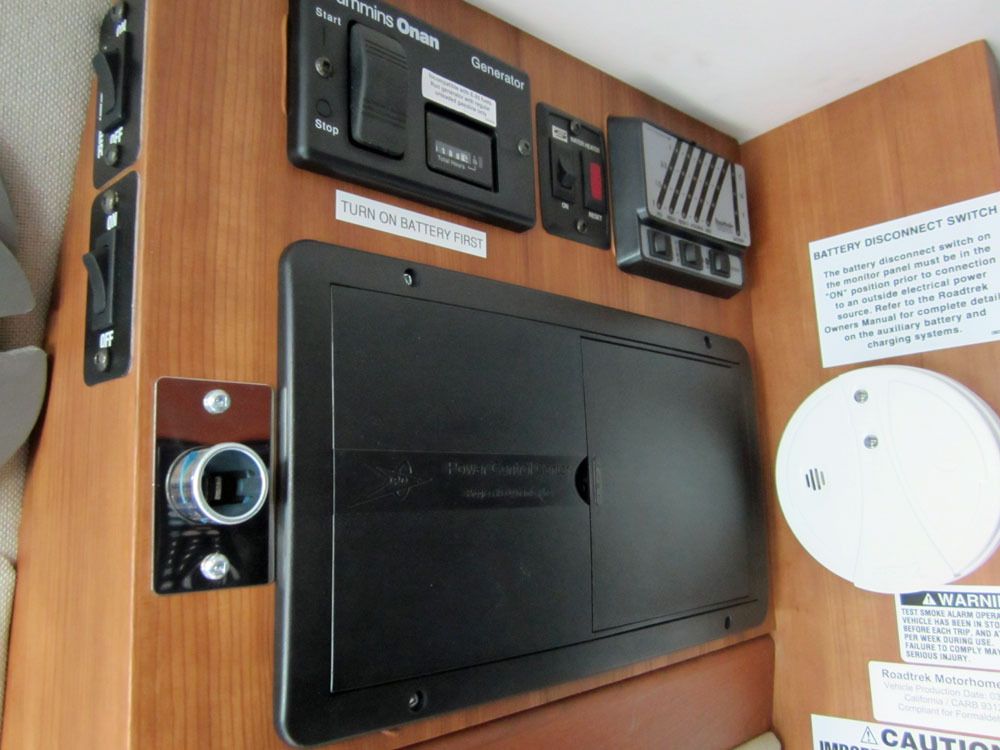
So here is how it all works - turn on the coach battery switch and just plug the meter in!
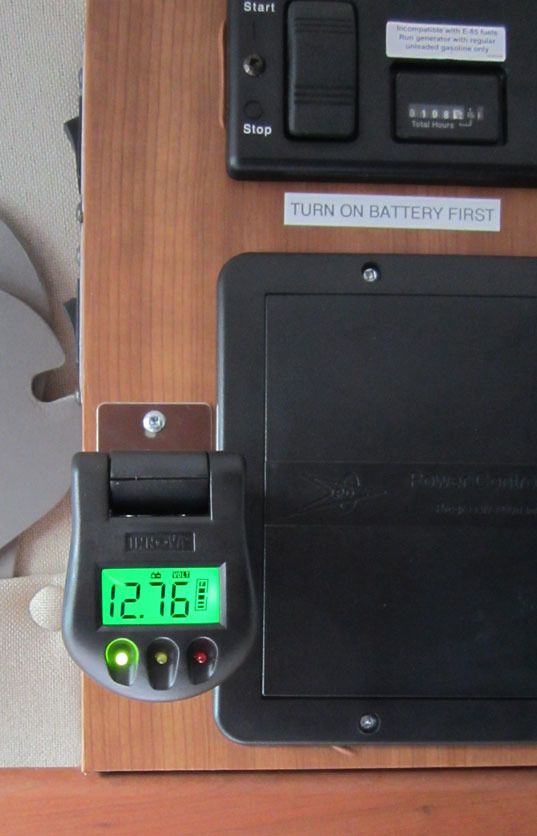
This reading is two and a half days after getting home from our trip. When this reading was photographed the "C" charge light was still lit on the monitor panel (this stays lit from a couple of days to a couple of hours after the batteries have been charging), but flickered (usually an indication it is about to drop to the next LED). A few minutes after I pulled the meter from the socket, I pushed the Test button and the panel LED was now on the "G" for "good" third up from the bottom yellow LED. I put the meter back in and the reading now was 12.4 volts. Still very good. Sitting without driving or charging even with the battery switch OFF, there is drain on the battery(ies).
When I plugged the meter in during the trip while plugged into shore power with the batteries charging the reading was 13.8. During the trip during the day while on batteries only - with the fridge on DC (AC/DC only fridge) readings were 12.6 to 12.8. We were driving during each day and plugged in each night. Finally, I am free from the monitor panel LEDs - constantly guessing what the "G" LED and the second "F" (red) LED mean. No more guessing.
I had a cap from a 12 volt socket splitter and it fit perfectly so now the outlet is not open when not in use. Not really necessary but a nice touch!
So without the Innova meter you are left with the option to take digital readings in the engine compartment at the Separator or Isolator. This is so much easier.
After I purchased the Innova I came across a small plug in LED digital 12 volt meter on Amazon for only $3.00 - with Free Shipping. I wondered how this could be sold for only $3.00 and still be shipped free and I decided to take a chance and buy one of these also. The estimated delivery date was a month and a half after the purchase date. I thought that someone could put this in their pocket and walk it to my post office from just about anywhere in the country in less time. It shipped three days after purchase and arrived one week after purchase. The meter was shipped from China -in a brown mailing envelope and inside the meter was in a bubble wrap pouch. The postage on the envelope was from China. This little LED meter works. It lights up with bright red LED readings - the difference is that this meter has only three digits where the Innova meter shows four digits on the display. Used one after the other, the LED meter read the battery voltage as 12.4 while the Innova read the battery voltage as 12.42. If the Innova only had three digits, the readings would have been the same BUT had the reading on the Innova been 12.49 and the LED meter still read 12.4 that would be somewhat different - though still not dramatic. So if you want a three dollar plug in digital 12 volt meter, search Amazon.
And just in case it needs to be said - I have nothing to do with the companies that makes these meters or this 12 volt outlet. I get nothing from anyone and I give no "official" endorsement. If there is something good that is worth sharing I share it.
Wednesday, April 30, 2014
Checking the Coach Batteries Voltage
Inside your Roadtrek on the monitor panel, you can check the battery voltage with four LED lights. The lights will tell you C (top green light) for charging and indicates that the voltage is at or above 12.7 volts, G ( second from the top yellow light) for Good - approx. 12 volts, F (second from the bottom red light) for Fair which according to the creator of the Roadtrek electric simulator in the Notes attachment is approximately 11.3 volts, and L (the bottom red light) for Low at less than 5 volts. The LEDs will give you a fast idea of where the battery voltage might be but there is no way to know how close you are to the light changing to the next lower LED at any time. Only a voltage meter with a display connected directly to the battery line can tell you that.
Bear with me for the why and I promise I will get you to the how. I decided that I wanted to take a reading on the battery voltage that was accurate. With my 2011 190's new design of coach battery compartment, there was no way to pull the batteries out to get to the terminals. The two AGM batteries are bolted with a frame to the inside of the compartment. There is access at the front to one terminal on each battery - a positive and a negative - and the batteries are wired in series. My first thought seeing this was to put the meter on those two terminals. Using the exposed positive and negative terminals I got no reading with my electric multi-meter set to read DC voltage with the scale set to a maximum of 20 volts. I was able to get a reading off of the positive battery terminal using the metal battery frame as a ground. The reading was 6.4 volts. The reading should have been near 12. Inside, the LED panel showed the voltage at the G (yellow) LED. I was getting a reading off of only one battery. This was no good. I would need to get to the rear of the batteries to get a correct reading and that was not possible. The space on top of the batteries is narrow and there is no line of clear sight to the terminals.


There are no 12 volt coach outlets inside the newer Roadtreks. In the past there were 12 volt outlets connected to coach power and it was possible to take a voltage reading from any of those outlets. Some have added a 12 volt outlet using the TV antenna booster wiring located inside of the wall of the top of the inside of the television connection cabinet. This requires taking the booster switch plate off, accessing the connection wires, not shorting the booster switch, connecting a 12 volt outlet to those wires and then making a hole for the outlets wires to come out inside the cabinet. Winegard does make a booster switch with a 12 volt outlet as part of it, but that plate has additional connections that the plate in the Roadtrek does not have. I was not about to start pulling wiring out of anywhere inside the Roadtrek to access 12 volt wiring to get a voltage reading. Sometimes it is best to leave well enough alone.
I get an idea in my head and it is hard to let it go. I wanted to know how this could be done. When I am stumped about RV things - or Roadtrek things - I go to the forums online. On one forum it was confirmed that the 6.4 volt reading was just one of the two batteries. On that same forum it was suggested to me that I could directly access the total battery voltage by going to the connections on the battery separator located under the van's front hood in the engine compartment. The responder "thought" that the left side connection went to the coach battery line.
The battery separator is used on Roadtreks starting in 2006. Previously a battery isolator was used. These two are mechanically different but provide basically the same result - the keep the engine battery and the coach battery apart but still permit the engine running to charge both the engine battery and the coach battery(ies) using the engine's alternator. With this as you drive you charge both the van battery and the coach battery(ies). An aside here, not to confuse the issue at hand, but - if you have a problem with either battery side charging, have this unit checked. They do go bad in time and have caused more unneeded expensive repairs by engine mechanics replacing other things who do not know about RV wiring with the same problem then persisting after their repair work. (So I have been told.)
OK - now that separator is located inside the engine compartment and connected to both the engine battery and the Roadtrek coach battery line. It is located on the top on the rear wall of the engine compartment on the driver's side. I looked in at it and saw that the wires from the batteries were covered with red rubber insulating boots at the connections. I was hesitant to touch these as it appeared that lifting that boot might disconnect the connection. Again, my head said to leave well enough alone - and I did at that point. I was resigned then to give up and just use the LEDs.

I went on one of the Roadtrek Facebook groups on which I had posted about this attempt to find a easy way to get to the coach battery voltage, and said that I was giving up the plan. Jim Hammill, President of Roadtrek, who has at times posted on this group, made comment about using the separator. I replied that I knew about the separator but was reluctant to mess with it. He came back to say that by just lifting the rubber boot a small bit it could not disconnect anything as the connections were bolted on and he confirmed that it was the LEFT side that does, indeed, go to the coach battery connection. By taking a reading from the right side, you are reading the engine battery voltage.
I waited for a day that it was not extremely cold - this is March when this took place, not snowing, and not raining. I was able to get a reading off the separator and the voltage was 11.83. The LEDs inside were only up to the bottom two red LEDs. The second from the bottom is supposed to light at 11.3 volts. So, while the drop from 12 volts was not that significant, it was just about time to charge the Roadtrek batteries with shore power and the weather was cooperating, so I plugged the Roadtrek in and charged the batteries. This brings me - after all of this that you have suffered through reading here to how to do this for yourself. After charging the batteries to full charge, I took another reading which I shall show you how to do! ("Finally, finally! He is getting to the good part!")
FIRST - Go inside and TURN OFF the battery disconnect switch. Take these readings with that switch OFF. Need I tell you, engine off, generator off too!
IF YOUR METER HAS AN ON/OFF SWITCH TURN IT ON. See your meter's instruction book as to how to set it to read DC voltage. Put the meter scale dial on voltage over 12 volts. There should be a 20 volt setting.
Next - open the hood.
Find the Separator. See the next two photos.


NEXT - Gently peel back the red rubber boot on the LEFT SIDE OF THE TOP OF THE SEPARATOR.

See the NUT. Above that nut is a screw bolt. You are going to take the reading on that NUT OR SCREW. The metal coming from under the nut - out from under the red boot does not carry current that will give you a reading. ONLY TAKE THE READING USING THE NUT OR SCREW.
NEXT - Using a voltage meter with probes - positive and negative - you are going to PLACE THE METER POSITIVE (RED) PROB TIP ON THE NUT.

NEXT - PLACE THE METER NEGATIVE PROBE ON A GROUND INSIDE THE ENGINE COMPARTMENT. Most metal connected to the engine compartment is a ground. The simplest thing is find a bolt head that attaches something to the vehicle body.

Here is a nice, easy to find ground right next to the Separator on the right. Despite you see in the photo you are going to touch the probes to their appropriate spot AT THE SAME TIME JUST LIKE THIS --->.

NOW, look down at your meter. There is a convenient ledge at the front of the engine compartment to set your meter on to see it easily.

The reading - after 22 hours of charging the batteries on shore power is 12.58. For an inexpensive multi-meter, that reading is good enough. I had expected to see 12.8 which was a voltage mentioned to me on one of the forums for fully charged batteries. This reading was taken about two hours after the shore power was disconnected. Inside the Roadtrek the LED panel was on all LEDs to the top C LED which not only indicates Charging but will also stay lit for a period of time - as short as a few hours or as long as a day - because of residual charge still remaining from the charging process. And as noted above when describing the LEDs on the panel, will light when the voltage is at or above 12.7 volts - here we have 12.58 and that is very, very close to 12.8. Very good!
TAKE THE PROBES AWAY FROM THE CONTACTS.
TURN OFF your meter.
PUSH THE RED RUBBER BOOT BACK OVER THE CONTACT.
CLOSE the hood.
YOU ARE DONE - and you now have an accurate reading of the coach battery voltage.
You can now do this whenever you want to find out more than the wall monitor panel LEDs will tell you. A voltage meter like this can be found in stores that sell electric components including the big box home stores. You can find one at Walmart in the electric section of the hardware aisles. This one comes from Harbor Freight stores and if you are lucky enough to find one of the many coupons that the put in many magazines and newspapers or get on their email list, you can have this meter for free with the coupon and any purchase. The meter is just the same as that sold in Walmart and the lower priced meters in the other stores and is good enough for this purpose. There are also the older dial meters that will do the same thing, but it is easier to get a clear reading on a digital screen than it is to decide where the needle is exactly pointing on the scale.
It is important to note for you that with the meter that I used - and perhaps all such meters - the reading is not instantaneous. The numbers on the screen seem to go all over the place low to higher until is stops at the final reading - which as you see in the photo above, stopped and stayed on 12.58 volts.
So there you are. Even with a newer 190 - or perhaps 210, Ranger, and Sprinters too, you have access to a direct spot to read the voltage of your coach battery(ies).
And thanks to Meryl who took the photos of my hands holding the probes and also the meter reading!
Subscribe to:
Posts (Atom)